
What is the difference between a 12-volt cigarette lighter air compressor and a traditional air pump?
The key difference between a 12V cigarette lighter air compressor (car tire inflator) and a traditional manual pump lies in their power source and working principle, which directly leads to significant differences in their usage scenarios, efficiency, convenience, and functionality.
Simply put: a car tire inflator is an electric tool that prioritizes effort-saving, speed, and precision, while a traditional pump is a manual tool that emphasizes reliability, portability, and independence from external power.
Below is a detailed comparison:
| Aspect | 12V Cigarette Lighter Air Compressor (Car Tire Inflator) | Traditional Manual Pump |
| Core Principle | Uses an electric motor to drive a piston and compress air. | Relies on manual force to drive a piston and compress air. |
| Power Source | Depends on the car’s 12V cigarette lighter socket or battery. | Relies entirely on human effort. |
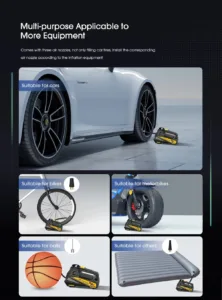
| Key Advantages | 1. Effort-saving & efficient: Fully automated, fast inflation, especially suitable for large-volume tires (e.g., car tires). 2. Precise & convenient: Built-in digital or analog pressure gauge; can preset pressure and stop automatically when reached. 3. Versatile: Usually comes with multiple nozzles for inflating cars, motorcycles, bicycles, balls, inflatable toys, etc. | 1. Absolutely reliable: No electricity needed, works in any environment. 2. Portable & lightweight: Compact, lightweight, and space-saving (e.g., bicycle pumps). 3. Zero running cost: No fuel or electricity required after purchase. 4. Easy maintenance: Simple structure, durable, and easy to repair. |
| Key Disadvantages | 1. External power dependent: Must be used near a car; limited in standalone outdoor use. 2. Continuous use limits: Motor can overheat; often requires intermittent use (e.g., 2 minutes inflation, 5 minutes rest). 3. Higher cost: More expensive than a basic manual pump. 4. Takes up space: Bulkier and requires storage in the car. | 1. Labor-intensive & time-consuming: Physically demanding for car tires; very inefficient. 2. Hard to gauge pressure: Most lack a precise pressure gauge; relies on feel/experience, leading to under/overinflation. 3. Limited functionality: Typically designed for specific valve types (e.g., Schrader or Presta). |
| Typical Use Cases | Primarily for vehicles: – Daily or long-distance travel tire checks/refills. – Temporary inflation after a puncture to reach safe pressure for driving to a repair shop. – Quick inflation of air mattresses, rubber boats, and other outdoor gear. | Primarily for human-powered vehicles & small items: – Daily top-ups for bicycles, e-bikes, motorcycles. – Inflating basketballs, soccer balls, etc. – As a last-resort emergency backup for cars. |
How to Choose?
Your choice depends entirely on your primary use case:
- Choose a car tire inflator if you:
- Mainly use it for a car.
- Value effort-saving, speed, and precision.
- Frequently go on road trips or need to inflate various items.
- Choose a manual pump if you:
- Mainly use it for bicycles, balls, etc.
- Prioritize ultimate portability, reliability, and zero running cost.
- Need to carry it in a backpack for cycling, hiking, or other activities away from the car.
Final Recommendation: For most car owners, keeping a reliable 12V car tire inflator in the vehicle is a cost-effective investment for enhanced safety and convenience. At the same time, a lightweight manual pump is ideal for bicycles. The two are not replacements but complementary tools for different needs.