
Motorcycle TPMS Tire Pressure Monitoring System Installation Guide
Installing a TPMS on a motorcycle is similar to a car, but requires more care due to the smaller tire size and more complex riding conditions. Below are detailed installation steps and important considerations.
I. Pre-installation Preparation
- Tool Preparation: Wrenches, screwdrivers, a jack (or motorcycle stand/center stand/paddock stand), a valve core removal tool, and a torque wrench (if installing internal sensors).
- Equipment Check: Ensure the TPMS kit is complete, including sensors (usually 2, for front and rear wheels), a receiver/display unit, mounting accessories, and the instruction manual.
- Safety Measures: Ensure the motorcycle is parked stably, ideally on a level surface. Wear protective gear like gloves.
II. Internal TPMS Installation Steps (Recommended for Professional Shops)
Internal sensors are mounted inside the tire. They offer precise data and are less prone to theft, but installation is complex. It is strongly recommended to have this done by a professional motorcycle mechanic or tire shop.
- Remove the Tire
- Use a jack or stand to lift the motorcycle. Remove the axle nut/bolts and take the wheel off the bike.
- Mark the relative position of the tire to the rim for easier reassembly.
- Replace the Valve Stem
- Use the valve core tool to deflate the tire completely. Remove the original rubber valve stem.
- Install the TPMS-specific valve stem (metal or reinforced rubber) into the rim hole and secure it loosely with the provided nut.
- Install the Sensor
- Insert the sensor from the inside of the tire outward. Ensure the washer/gasket is on the outside of the rim.
- Secure the sensor to the valve stem using the fixing bolt/nut, tightening it to the specified torque (typically 5–8 Nm – refer to the product manual).
- Remount the Tire and Inflate
- Carefully remount the tire using a tire changer, avoiding any pinching or damage to the sensor.
- Inflate the tire to the motorcycle manufacturer’s recommended pressure (typically front: 2.2–2.5 bar / 32–36 psi, rear: 2.5–2.9 bar / 36–42 psi).
- Wheel Balancing
- The added weight of the sensor makes wheel balancing mandatory. Perform a dynamic balance test and add adhesive wheel weights until the imbalance reading is “0”.
- Reinstall the Wheel
- Mount the wheel back onto the motorcycle according to the marks made earlier. Tighten the axle nut/bolts to the specified torque.
III. External TPMS Installation Steps (Can be Self-Installed)
External sensors screw directly onto the valve stem. Installation is simple, but note potential concerns regarding accuracy and theft.
- Clean the Valve Stem
- Unscrew the original valve stem cap. Use a cloth to clean the threads, ensuring they are free of dust and grease.
- Install the Sensor
- Following the manual, first thread the hex nut onto the valve stem, then place the anti-theft washer (if provided).
- Screw the sensor onto the valve stem. Use the provided wrench to hold the sensor and tighten the hex nut in the opposite direction to secure it firmly.
- Check for Leaks
- After installation, spray soapy water on the connection to check for air bubbles (leaks). Re-tighten if necessary.
- Repeat the Process
- Install the other sensor on the second tire using the same method.
IV. Receiver Installation and System Pairing
- Mount the Receiver
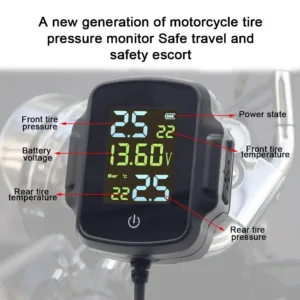
- Mount the receiver (display unit) near the handlebars or instrument cluster, ensuring it’s within the rider’s line of sight.
- Power it typically via a 12V power outlet (cigarette lighter socket) or USB. Wireless charging models are also an option.
- System Pairing/Syncing
- Turn on the receiver’s power. Enter pairing mode as per the instructions.
- Ride the motorcycle for about 50–100 meters. The sensors should automatically activate and transmit data to the receiver.
- If a tire’s data is not shown, try riding slowly for a few more minutes or re-initiate the pairing process.
- Calibration and Settings
- Input the motorcycle’s recommended tire pressure range into the receiver (refer to the owner’s manual).
- Set the high-pressure and low-pressure alarm thresholds (e.g., ±0.3 bar / ±4.5 psi).
V. Special Considerations for Motorcycles
- Sensor Weight Impact: Motorcycle wheels are more sensitive to imbalance. Dynamic balancing is absolutely necessary after installing internal sensors to prevent vibration at high speeds.
- Water and Dust Resistance: Motorcycles are exposed to rain and mud. Ensure the sensors have a good IP rating. Avoid directing high-pressure water jets (e.g., at a car wash) directly at them.
- Battery Life: The coin cell batteries inside the sensors typically last 1–2 years. Replace them promptly when the low-battery warning appears.
- Temperature Tolerance: Choose sensors with a wide operating temperature range (e.g., -40℃ to 85℃ / -40°F to 185°F) to handle summer heat and winter cold.
VI. Post-Installation Testing
- Static Check: Verify that the receiver correctly displays the pressure and temperature for both tires.
- Short Test Ride: Ride for a few kilometers and observe if the data updates stably.
- Alarm Function Test: Slightly deflate a tire to confirm the low-pressure alarm is triggered promptly.
Summary & Recommendations
- Internal TPMS: Best for riders seeking precision and long-term use. Installation is complex; expect to pay approximately $100–300 USD (including labor) at a professional shop.
- External TPMS: Suitable for DIY users, offering quick installation. A basic kit costs around $200–500 USD, but be mindful of potential accuracy variance and theft risk.
- Safety First: Regardless of the type, always perform a leak check and (for internal) a wheel balance after installation. Ensure the system is reliable before riding.
A properly installed TPMS allows for real-time tire pressure monitoring, significantly enhancing riding safety. It provides early warnings of pressure abnormalities, especially valuable during long trips or high-speed riding, helping to prevent blowouts.