
What Does Fault Code P0115 Mean?
Fault code P0115, applicable to all vehicle manufacturers, indicates “Engine Coolant Temperature (ECT) Sensor 1 Circuit Malfunction”.
Background: The Engine Coolant Temperature (ECT) sensor is a critical component that monitors the temperature of the engine coolant. This data is sent to the Engine Control Module (ECM) or Powertrain Control Module (PCM) to help manage vital engine functions such as fuel injection timing, air-fuel mixture, ignition timing, and cooling fan operation. A malfunction in this circuit can lead to incorrect engine operation, reduced performance, and increased emissions.
Symptoms of Fault Code P0115
- The Check Engine Light (Malfunction Indicator Lamp) is illuminated on the dashboard.
- Erratic, inaccurate, or non-functional readings on the engine coolant temperature gauge.
- Noticeable decrease in fuel economy, often by 10-15%.
- Rough idling, engine stalling, or hesitation, especially during cold starts.
- Poor engine performance and lack of power during acceleration.
- Engine overheating or failure of the cooling fan to operate correctly.
- Difficulty starting the engine, particularly in cold conditions.
- Excessive black smoke from the exhaust due to an overly rich fuel mixture.
Main Causes of Fault Code P0115
- A faulty or failed Engine Coolant Temperature (ECT) sensor itself (most common cause).
- Damaged, shorted, open, or corroded wiring and connectors in the ECT sensor circuit.
- Poor electrical connections or ground at the sensor or ECM.
- Low engine coolant level or coolant leaks affecting sensor readings.
- A faulty thermostat that is stuck open or closed, causing incorrect coolant temperature.
- A malfunctioning Engine Control Module (ECM) or Powertrain Control Module (PCM) (rare).
How to Diagnose Fault Code P0115?
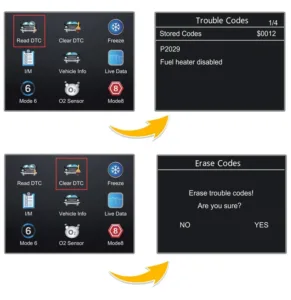
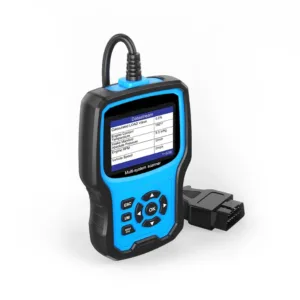
- Connect an OBD2 scanner or car scanner to the vehicle’s diagnostic port and read the stored and pending trouble codes, confirming P0115.
- Record freeze frame data to understand the conditions when the fault occurred.
- Perform a visual inspection of the ECT sensor, its wiring harness, and electrical connectors for obvious damage, corrosion, or disconnections.
- Use a multimeter to test the circuit for continuity, shorts to power or ground, and to measure the sensor’s resistance, comparing it to manufacturer specifications for the current engine temperature.
- With the ignition on (engine off), check for the presence of the 5-volt reference signal at the sensor connector.
- Monitor live data from the ECT sensor using your vehicle diagnostics tool; an abnormally high (e.g., 140°C/284°F) or low (e.g., -40°C/-40°F) reading that doesn’t change can pinpoint the issue.
Possible Causes and Diagnostic Methods
| Possible Cause | How to Check? |
| Faulty ECT Sensor | Test sensor resistance with a multimeter across a temperature range; compare to specs. Monitor live data with an OBD2 code reader for implausible values. |
| Damaged Wiring or Open Circuit | Perform a continuity test on the sensor circuit wires between the sensor connector and the ECM. |
| Short Circuit (to Power or Ground) | Check for voltage where there shouldn’t be any (short to power) or continuity to ground (short to ground) in the signal circuit. |
| Poor Connection/Corrosion | Visually inspect connectors for bent pins, corrosion, or moisture. Clean contacts and ensure a secure connection. |
| Low Coolant / Coolant Leak | Check coolant level in the reservoir and for visible leaks. A low level can cause the sensor to read air temperature instead of coolant. |
| Faulty Thermostat | Verify if the engine reaches and maintains normal operating temperature. A stuck-open thermostat can cause a persistent low-temperature reading. |
| Faulty ECM/PCM | This is a last resort. Rule out all sensor and wiring issues first. May require professional reprogramming or replacement. |
Required Tools: OBD2 scanner / car scanner, digital multimeter, basic hand tool set, vehicle service manual for wiring diagrams and specifications.
How to Fix Fault Code P0115? (Solutions)
Simple Fixes:
- Clean corroded electrical contacts on the ECT sensor connector and reconnect securely.
- Repair minor damage to the wiring harness (splicing with solder and heat shrink is recommended for permanent repair).
- Top up the engine coolant to the proper level if low and investigate for leaks.
- After repairs, use your OBD2 scanner to clear the fault codes and perform a test drive to see if the code returns.
In-Depth Diagnosis and Repair:
- Replace the faulty ECT sensor. This is the most common fix. Location varies by vehicle but is typically near the thermostat housing or on the engine block/cylinder head.
- Repair or replace damaged sections of the wiring harness. Ensure repairs are done properly to prevent future issues.
- Replace a stuck thermostat if it is causing incorrect coolant temperature readings.
- Check and repair coolant system leaks that may be affecting the sensor.
- In rare cases, diagnose or replace a faulty Engine Control Module (ECM). Professional diagnosis is highly recommended for this.
Troubleshooting by Symptom
| Symptom | Possible Solution |
| Check Engine Light is on, temperature gauge reads normal | Likely an intermittent electrical fault. Check wiring and connectors for corrosion or looseness. |
| Check Engine Light on, temperature gauge reads extremely high (e.g., 140°C/284°F) or pegged | Probable short circuit in the sensor signal wire to ground. Disconnect sensor; if reading drops to very low (e.g., -40°C), replace sensor. If reading stays high, find and repair short in wiring. |
| Check Engine Light on, temperature gauge reads extremely low (e.g., -40°C/-40°F) | Probable open circuit. Check for 5V reference at sensor connector with ignition on. If present, sensor or its ground is faulty. If absent, check wiring for open circuit back to ECM. |
| Poor fuel economy and rough running | Faulty sensor sending incorrect “cold” signal, causing a rich fuel mixture. Test and likely replace the ECT sensor. |
| Overheating issues alongside P0115 | First, ensure the cooling system (thermostat, water pump, fan) is functioning correctly, as overheating can damage the sensor circuit. Then address the P0115 code. |
Fault Code P0115 in Common Vehicles
Chevrolet Silverado (2000-2006) & GMC Sierra: A very common platform for this code. Often caused by a failing sensor or corrosion in the connector, especially in older models.
Ford Escape (2001-2005) & Ford F-150 Lightning: Prone to wiring harness issues near the ECT sensor due to heat and vibration. The sensor itself is also a common failure point.
Toyota Corolla (2003-2008) & Camry: Known for reliable sensors, but wiring issues can occur. The code may also appear if the thermostat is stuck open, preventing the engine from reaching proper operating temperature.
Holden Commodore / Pontiac G8 / Chevrolet SS: These related GM vehicles may experience P0115 due to a faulty sensor or problems with the wiring loom near the firewall.
Saturn L-Series (L300/LW300): Specific diagnostic procedures involve comparing calculated vs. predicted airflow when ECT reaches 37°C (99°F). A stuck-open thermostat is a frequent culprit.
Pontiac Vibe / Toyota Matrix: Shared platform. The diagnostic process checks for signal voltage stuck at -40°C/-40°F (open) or 140°C/284°F (short) for more than 0.5 seconds.
Various European Models (Citroen, Peugeot, Ford, Opel/Vauxhall with specific engines): A known issue on some models involves a plastic water pump impeller detaching (e.g., Blue Print part ADC49169), causing no coolant flow and triggering P0115. The fix is to replace the pump with an updated metal-impeller design.
Isuzu Diesel Engines (6WF1, 6WG1, etc.): Common in commercial vehicles. The service manual lists specific flash code 115 corresponding to P0115, requiring systematic electrical diagnosis.
Land Rover / Range Rover: These vehicles often have complex cooling systems. P0115 can indicate circuit faults (short to ground/power, open circuit, high resistance) or sensor failure, requiring careful wiring inspection.
BMW 3-Series (E90): The ECT sensor is often located on the cylinder head. Failure can cause poor cold starts and erratic fan operation.
Honda Civic (2001-2005): A common issue where the ECT sensor fails, leading to poor fuel economy and a illuminated Check Engine Light.
Jeep Grand Cherokee (WJ 1999-2004): The sensor is located on the thermostat housing and is susceptible to failure, often causing temperature gauge inaccuracies.
P0115 Frequently Asked Questions
What should I do if I get a P0115 code?
A P0115 code indicates a problem with the engine coolant temperature sensor circuit. You should address it promptly. Start by checking your coolant level. If it’s low, top it up and look for leaks. If the level is fine, the issue is likely electrical (sensor or wiring). Using an OBD2 code reader to check for other codes and view live data is the next step.
Is it safe to drive with a P0115 code?
You can typically drive for a short while, but it is not recommended for extended periods. The engine computer will use a default temperature value (often around 80°C/176°F), which can cause poor fuel economy, increased emissions, rough running, and in some cases lead to overheating if the cooling fan isn’t triggered correctly. It’s best to diagnose and fix the issue soon.
Can I fix a P0115 code myself?
Yes, if you are mechanically inclined. The most common fix—replacing the ECT sensor—is often straightforward. It usually requires draining a small amount of coolant, unplugging the electrical connector, unscrewing the old sensor, and installing the new one with a proper seal. However, diagnosing wiring issues requires a multimeter and some electrical knowledge.
How much does it cost to fix a P0115 code?
The cost varies. If it’s just the sensor, the part typically costs between 20 to 100, and labor might add 50 to 150 if done by a mechanic. If wiring repairs or an ECM issue is involved, costs can rise significantly to several hundred dollars.
What is the difference between P0115 and P0118?
P0115 indicates a malfunction in the circuit of the Engine Coolant Temperature Sensor (e.g., wiring, connector, electrical signal). P0118 indicates the sensor itself is reading a temperature that is implausibly high (circuit high input). P0115 is a broader circuit fault code.
Why does my temperature gauge work but I still have a P0115 code?
Many vehicles have two separate sensors: one for the dashboard gauge and a separate one (the ECT sensor) that sends data to the engine computer (ECM). P0115 refers to the one for the ECM. It’s possible for the gauge sensor to work while the ECM sensor fails.
Can a bad thermostat cause a P0115 code?
Indirectly, yes. A thermostat stuck open can prevent the engine from reaching normal operating temperature. If the ECT sensor accurately reports this persistently low temperature, it might not trigger P0115 by itself, but it can cause other driveability issues. However, a severely stuck thermostat causing erratic readings could contribute to circuit diagnosis problems.
How do I test an ECT sensor with a multimeter?
Set your multimeter to resistance (ohms). With the sensor disconnected and the engine cold, measure the resistance between its two terminals. Consult your vehicle’s service manual for the specific resistance values at different temperatures (e.g., ~2000-3000 ohms at 20°C/68°F). As the engine warms up, the resistance should drop smoothly.
Will disconnecting the battery clear a P0115 code?
Temporarily, yes. Disconnecting the battery may clear the code and turn off the Check Engine Light. However, if the underlying fault is still present, the code will return after the vehicle completes a few drive cycles. Using an OBD2 scanner to clear codes is the proper method after repair.
My car overheats and shows P0115. Which came first?
This is a classic “chicken or egg” scenario. Severe engine overheating can damage the ECT sensor or its wiring, causing P0115. Conversely, a faulty ECT sensor can send incorrect data, preventing the cooling fan from turning on or causing other management issues that lead to overheating. A thorough diagnosis of the entire cooling system is necessary.
Related OBD2 Fault Codes
- P0116 – Engine Coolant Temperature Circuit Range/Performance Problem
- P0117 – Engine Coolant Temperature Circuit Low Input
- P0118 – Engine Coolant Temperature Circuit High Input
- P0119 – Engine Coolant Temperature Circuit Intermittent
- P0125 – Insufficient Coolant Temperature for Closed Loop Fuel Control
- P0128 – Coolant Thermostat (Engine Coolant Temperature Below Thermostat Regulating Temperature)
Important Note!While a P0115 code might not immediately strand your vehicle, it directly impacts engine management, fuel efficiency, and emissions. Ignoring it can lead to poor performance, increased fuel costs, and potential damage to the catalytic converter from prolonged rich running. Always use proper tools like a quality vehicle diagnostics tool for accurate diagnosis and repair wiring with care, especially in the engine bay where heat and vibration are factors.