
What Does Fault Code P0110 Mean?
Fault code P0110 is a generic OBD-II diagnostic trouble code defined as “Intake Air Temperature Sensor 1 Circuit Malfunction”. This indicates that the vehicle’s Engine Control Module (ECM) or Powertrain Control Module (PCM) has detected an abnormal signal from the Intake Air Temperature (IAT) sensor circuit, typically meaning the signal is outside the expected operating range (either too high or too low).
Background: The Intake Air Temperature (IAT) sensor is a thermistor (a temperature-sensitive resistor) that measures the temperature of the air entering the engine. This data is critical for the ECM/PCM to calculate the correct air-fuel mixture. Colder air is denser and requires more fuel, while warmer air requires less fuel. An accurate IAT reading ensures optimal combustion, performance, fuel economy, and emissions control. The sensor is often integrated into the Mass Air Flow (MAF) sensor assembly or located in the air intake duct.
Symptoms of Fault Code P0110
- Illuminated Check Engine Light (MIL).
- Poor fuel economy (increased MPG) due to incorrect fuel mixture calculation.
- Rough engine idle or stalling, especially when cold.
- Engine hesitation or stumbling during acceleration.
- Reduced engine performance and power.
- Difficulty starting the engine, particularly in cold weather.
- Black smoke from the exhaust (indicating a rich fuel mixture).
- Engine backfiring.
Main Causes of Fault Code P0110
- Faulty IAT Sensor: The sensor itself is damaged, contaminated, or has failed internally, providing incorrect resistance values.
- Wiring and Connector Issues: Damaged, frayed, corroded, or loose wires and connectors in the IAT sensor circuit (signal wire, 5V reference wire, or ground wire) are among the most common causes.
- Open or Short Circuit: An open circuit (broken wire) typically causes the sensor to read a constant -40°C (-40°F), while a short to ground causes it to read a constant 140°C (284°F).
- Poor Electrical Connection: High resistance in the circuit due to corrosion or a loose pin at the sensor or ECM connector.
- Vacuum Leaks: Air leaks in the intake system downstream of the sensor can affect the temperature reading.
- Dirty or Clogged Air Filter: A severely restricted air filter can alter airflow and potentially affect the sensor’s environment.
- Faulty Engine Control Module (ECM/PCM): A rare cause where the control module itself has an internal fault.
How to Diagnose Fault Code P0110?
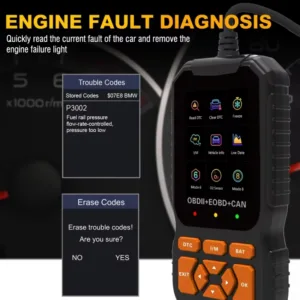
- Scan and Record: Connect an obd2 scanner to confirm code P0110 and check for any related codes (e.g., P0112, P0113). Record freeze frame data, which captures the engine conditions (RPM, load, temperature) when the fault occurred.
- Visual Inspection: Inspect the IAT sensor (often part of the MAF sensor), its wiring harness, and connectors for obvious damage, corrosion, or disconnection.
- Check Live Data: Using a capable obd2 diagnostic scanner, monitor the live IAT sensor reading. With the engine off and cold, it should closely match the ambient air temperature. A reading stuck at -40°C (-40°F) indicates an open circuit; a reading stuck at 140°C (284°F) indicates a short to ground.
- Test Sensor and Circuit: With the ignition OFF, disconnect the sensor. Use a digital multimeter to measure the sensor’s resistance across its terminals; it should change with temperature (high resistance when cold, low when warm). Test the wiring harness for continuity (open) and shorts to ground or power between the sensor connector and the ECM.
- Check for Vacuum Leaks: Inspect the intake system for leaks that could affect air temperature readings.
Possible Causes and Diagnostic Methods
| Possible Cause | How to Check? |
| Faulty IAT Sensor | Measure the sensor’s resistance with a multimeter at different temperatures and compare to manufacturer specifications. Substitution with a known-good sensor is a definitive test. |
| Open Circuit (Wire Break) | Live data shows a constant -40°C (-40°F). Use a multimeter to check for continuity in the signal and ground wires between the sensor and ECM. |
| Short Circuit (to Ground) | Live data shows a constant 140°C (284°F). Use a multimeter to check for continuity between the signal wire and chassis ground. |
| Poor Connection/High Resistance | Perform a voltage drop test across the sensor circuit while it’s active. Visually inspect and clean connector pins. |
| Faulty PCM | A last-resort diagnosis. All wiring and sensor tests must pass. Check for technical service bulletins (TSBs) related to PCM software. |
Required Tools: OBD2 diagnostic tool/scanner, digital multimeter (DMM), basic hand tools, vehicle-specific wiring diagrams, electrical contact cleaner.
How to Fix Fault Code P0110? (Solutions)
Simple Fixes:
- Clean Connectors: Disconnect the IAT sensor connector, clean the terminals with electrical contact cleaner, and reconnect securely.
- Repair Wiring: Repair any damaged wires with solder and heat-shrink tubing. Ensure all connections are tight and corrosion-free.
- Replace Air Filter: Install a new air filter if it is dirty or clogged.
- Replace the IAT Sensor: If diagnostics confirm the sensor is faulty, replace it. On many vehicles, this requires replacing the entire MAF/IAT sensor assembly.
- Repair Wiring Harness: If the fault is in the wiring, repair or replace the affected section of the harness.
- Update PCM Software: Check for and install any available PCM software updates from the manufacturer.
- Address Vacuum Leaks: Find and seal any leaks in the intake system.
- Toyota/Lexus (e.g., Corolla, Camry, Sienna): The IAT sensor is often integrated into the MAF sensor. A common issue is connector contamination due to its location near the air intake. The diagnostic procedure involves checking resistance between specific terminals on the MAF meter connector.
- Nissan/Infiniti (e.g., Altima, Sentra, X-Trail): Prone to issues with broken circuits or aging sensors. Diagnosis follows a specific sequence: checking ground connections, power supply circuit, ground circuit for open/short, and finally the sensor itself.
- General Motors (GM) Vehicles (e.g., Chevrolet, GMC, Pontiac Vibe, Holden Viva): GM’s diagnostic procedure is highly detailed. Code P0110 sets if the IAT signal indicates a temperature colder than -39°C (-39°F) for more than 0.5 seconds OR hotter than 139°C (283°F) for more than 0.5 seconds. The PCM then defaults the IAT to 20°C (68°F) in fail-safe mode. Testing involves checking for specific voltage values at the sensor connector.
- Ford (e.g., Focus, Mondeo, Puma, Expedition): Common problems include corrosion of the electrical contacts at the sensor connector.
- BMW/MINI (e.g., 3-Series, 5-Series): The IAT sensor is frequently part of a combined MAF/IAT sensor unit. Failure of this integrated unit is common and triggers P0110.
- Volkswagen/Audi (e.g., Golf, Passat): Often related to low circuit voltage caused by a poor ground connection.
- Honda/Acura: Similar to Toyota, the IAT is often part of the MAP or MAF sensor. Wiring issues and sensor failures are typical causes.
- Hyundai/Kia: Prone to connector issues and sensor failures. Diagnostic steps are similar to other manufacturers.
- Chrysler/Dodge/Jeep: The IAT sensor may be a separate unit. Common failures include sensor contamination and wiring harness damage near the engine heat.
- Subaru: The IAT sensor is typically integrated into the MAF sensor. Problems often arise from dirty connectors or a failed sensor element.
What does the P0110 code mean?
It means the vehicle’s computer has detected a malfunction in the circuit for the Intake Air Temperature (IAT) Sensor 1. The signal from the sensor is outside the normal expected range.
Is it safe to drive with a P0110 code?
You can usually drive, but it is not recommended for the long term. The engine will use a default temperature value (often 20°C/68°F), which can lead to reduced fuel economy, poor performance, rough idle, and increased emissions.
What is an IAT sensor and what does it do?
The Intake Air Temperature sensor is a thermistor that measures the temperature of the air entering the engine. The Engine Control Module uses this data to adjust the air-fuel mixture for optimal combustion.
What causes a P0110 code?
The most common causes are a faulty IAT sensor, damaged or corroded wiring/connectors in its circuit, an open or short circuit, or a poor electrical connection.
How do I diagnose a P0110 code?
Start by using an obd reader to confirm the code and view live data. If the IAT reading is stuck at -40°C/-40°F or 140°C/284°F, it points to an open or short circuit, respectively. Then, visually inspect the wiring and sensor, and perform electrical tests with a multimeter.
Can a dirty air filter cause P0110?
Indirectly, yes. A severely clogged air filter can restrict airflow and potentially affect the sensor’s local environment, but it is not a direct cause of the circuit malfunction code.
How much does it cost to fix a P0110 code?
Costs vary: DIY sensor replacement typically ranges from $50 to $200 for the part. Professional repair at a shop, including diagnosis and labor, can range from $100 to $400, depending on the vehicle and root cause (sensor vs. wiring).
Can I fix a P0110 code myself?
Yes, if you are comfortable with basic automotive electrical diagnostics. Start by checking the sensor connector for corrosion and cleaning it. If you have an obd tool scanner, you can monitor live data to see if the sensor reading is plausible.
What is the difference between P0110, P0112, and P0113?
- P0110: General “Circuit Malfunction” – the signal is out of range.
- P0112: “Circuit Low Input” – the signal voltage is too low (sensor reading a constant high temperature ~140°C/284°F, indicating a short to ground).
- P0113: “Circuit High Input” – the signal voltage is too high (sensor reading a constant low temperature ~-40°C/-40°F, indicating an open circuit).
Will disconnecting the battery clear P0110?
It may clear the code temporarily, but if the underlying fault is still present, the code will return once the vehicle completes its drive cycles and the monitor runs again.
Why does my P0110 code keep coming back?
This indicates the root cause has not been fixed. Common reasons are an intermittent wiring fault (broken wire that makes contact sometimes), a failing sensor that works intermittently, or a poor connection that corrodes again.
Do I need to replace the MAF sensor for a P0110 code?
Often, yes. On many modern vehicles, the IAT sensor is built into the Mass Air Flow (MAF) sensor assembly. If the IAT portion is faulty, the entire MAF/IAT unit must be replaced.
How do I test an IAT sensor with a multimeter?
Set the multimeter to resistance (ohms). Disconnect the sensor and measure resistance across its two terminals. Resistance should be high when the sensor is cold and decrease as you warm it with your hand. Compare your readings to the manufacturer’s specifications.
- P0111 – Intake Air Temperature Sensor 1 Circuit Range/Performance
- P0112 – Intake Air Temperature Sensor 1 Circuit Low
- P0113 – Intake Air Temperature Sensor 1 Circuit High
- P0114 – Intake Air Temperature Sensor 1 Circuit Intermittent
</ul
In-Depth Diagnosis and Repair:
Troubleshooting by Symptom
| Symptom | Likely Solution |
| Check Engine Light on with poor fuel economy. | Likely a faulty IAT sensor providing incorrect data, causing poor fuel mixture. |
| Rough idle and hard starting when cold. | Could be a sensor reading extreme cold (-40°C/-40°F) due to an open circuit, causing over-fueling. |
| Lack of power and black smoke. | Could be a sensor reading extreme heat (140°C/284°F) due to a short, causing under-fueling (lean condition) and potential power loss. |
Common Vehicles with Fault Code P0110

P0110 Frequently Asked Questions
Related OBD2 Fault Codes
Important Note! Code P0110 indicates an electrical circuit problem. The key to diagnosis is using a capable obd2 diagnostic scanner to view live data. Do not just replace the sensor—always check the wiring and connectors first, as they are frequent failure points. Ignoring this code can lead to decreased fuel economy, failed emissions tests, and potential long-term engine issues due to incorrect air-fuel mixtures. For accurate diagnosis, always consult your vehicle’s specific service information.