
What does the P0119 code mean?
The P0119 is a generic OBD-II (Onboard Diagnostics II) trouble code. Its official definition is “Engine Coolant Temperature Sensor Circuit Intermittent/Erratic“.
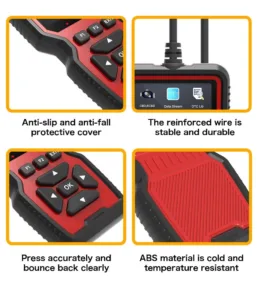
Background Information: This code is set when the vehicle’s Engine Control Module (ECM) or Powertrain Control Module (PCM) detects an unstable, fluctuating, or inconsistent signal from the Engine Coolant Temperature (ECT) sensor. Unlike P0117 (low input) or P0118 (high input), P0119 indicates the signal is not stuck at an extreme value but is instead jumping erratically. The ECT sensor is a thermistor whose resistance changes with coolant temperature. An intermittent signal prevents the ECM from accurately determining engine temperature, which is critical for fuel mixture, ignition timing, idle speed, and cooling fan operation. The first step in diagnosis is always to use a professional obd2 scanner to monitor the live ECT data stream, looking for sudden, illogical temperature swings.
Symptoms of Error Code P0119
- Illuminated Check Engine Light (MIL).
- Erratic or fluctuating temperature gauge on the dashboard.
- Poor engine performance, including rough idling, hesitation, or stalling.
- Decreased fuel economy as the ECM struggles to adjust the air-fuel mixture correctly.
- Engine overheating or running too cool due to improper fan or thermostat control.
- Hard starting, especially when the engine is warm.
- Black smoke from the exhaust during startup from an overly rich mixture.
- Radiator cooling fans may cycle on and off erratically or run continuously.
Main Causes of Error Code P0119
- Failing or faulty Engine Coolant Temperature (ECT) Sensor with unstable internal resistance.
- Poor electrical connection, corrosion, or loose pins at the ECT sensor connector or ECM connector.
- Damaged, frayed, or shorted wiring in the ECT sensor circuit (signal or ground wire).
- Low engine coolant level, causing the sensor to be partially exposed to air pockets.
- Contaminated coolant (oil, rust, debris) coating the sensor’s sensing element.
- A failing or sticking thermostat causing rapid, abnormal coolant temperature fluctuations.
- Intermittent short to power or ground in the wiring harness.
- Faulty PCM/ECM (rare) – internal issue with the signal processing circuit.
How to Diagnose Error Code P0119?
- Connect an OBD2 code scanner to confirm code P0119 and check for related codes like P0117 or P0118. Use the live data function to monitor the ECT sensor reading.
- Observe the live ECT temperature while the engine is cold. Start the engine and let it warm up. Look for erratic jumps (e.g., from 50°F to 200°F and back in seconds), drops to extreme cold (-40°F), or periods of no signal.
- Visually inspect the engine coolant level and condition. Top up if low and check for contamination.
- With the engine off and cool, inspect the ECT sensor wiring harness and connector. Look for chafing, melting (near hot components), corrosion, or loose connections. Gently wiggle the harness and connector while watching the live data on your car scanner for changes.
- Disconnect the ECT sensor electrical connector. Using a digital multimeter, measure the resistance across the sensor terminals. The resistance should change smoothly as the sensor temperature changes (e.g., warmed by hand). An erratic or open reading indicates a bad sensor.
- Test the vehicle wiring harness for continuity and shorts. Check the 5-volt reference and ground circuits back to the ECM.
- If the sensor and wiring test good, consider the possibility of a faulty thermostat causing actual rapid temperature swings, or a rare ECM failure.
Possible Causes and Diagnostic Methods
| Possible Cause | How to Check? |
| Failing ECT Sensor | Monitor live data for erratic jumps. Test sensor resistance with a multimeter while gently heating/cooling it; resistance should change smoothly, not jump. |
| Poor Connection/Corrosion | Visually inspect the sensor and ECM connectors for green/white corrosion, bent pins, or coolant intrusion. Wiggle test the connector while watching live data. |
| Damaged Wiring | Inspect the entire wiring harness for damage. Perform a wiggle test on the harness while monitoring live data. Check for continuity and shorts to ground/power. |
| Low Coolant/Air Pocket | Check coolant level in the reservoir and radiator (when cold). Perform a cooling system bleed procedure to remove air. |
| Faulty Thermostat | Monitor live coolant temperature vs. intake air temperature. A thermostat stuck open will cause a slow warm-up; erratic behavior may indicate a sticking thermostat. |
Tools needed: A professional OBD2 diagnostic scanner capable of reading live data (a vehicle code reader is essential), a digital multimeter, basic hand tools (sockets, wrenches), a cooling system pressure tester (optional), and a vehicle-specific wiring diagram.
How do I fix error code P0119? (Solutions to the Problem)
Simple Fixes
- Top up the engine coolant to the proper level and bleed the cooling system to remove air pockets.
- Clean the electrical contacts at the ECT sensor and ECM connectors with electrical contact cleaner. Apply dielectric grease to prevent future corrosion.
- Secure any loose wiring connections or repair minor wire insulation damage with heat-shrink tubing and solder.
- Clear the code with your obd2 code reader and perform a test drive to see if it returns.
In-depth Diagnosis and Repair Solutions
- Replace the faulty ECT Sensor. Drain a small amount of coolant, install a new OEM-quality sensor, refill, bleed the system, and clear codes.
- Repair or replace the damaged section of the wiring harness. Solder and seal all connections properly.
- Replace a sticking or faulty thermostat if it is causing genuine erratic temperature swings.
- If all wiring and sensor tests are perfect and the issue persists, professional diagnosis of the PCM/ECM may be necessary (rare).
Fix faults based on symptoms
| Symptom | Possible Solution |
| Erratic temperature gauge & poor performance | Diagnose with a vehicle diagnostics tool, focus on ECT sensor live data and wiring integrity. Replace sensor or repair wiring. |
| Code returns immediately after sensor replacement | The problem is likely in the wiring harness or connector, not the sensor. Perform thorough continuity and wiggle tests on the circuit. |
| Overheating with P0119 | Check coolant level and thermostat first. A faulty sensor reading can prevent cooling fans from activating correctly. |
| Intermittent Check Engine Light | This is classic for P0119. Focus on connector issues and wiring harness problems that only occur under vibration or heat. |
Common Error Code P0119 in Vehicles
General Motors (Chevrolet, GMC, Buick, Cadillac, Saturn): Very common in models like Silverado, Sierra, Tahoe, Suburban, Impala, Malibu, and CTS. GM’s diagnostic procedure often emphasizes checking for “excessive noise” in the signal and comparing ECT to IAT sensor readings after an overnight soak. Using a capable vehicle diagnostics tool is key for live data.
Ford (F-150, Escape, Explorer, Fusion, Mustang, Focus): Frequent in many models. Wiring harness issues near the thermostat housing or sensor connector corrosion are typical culprits. A car scanner is necessary to monitor the PID for erratic behavior.
Toyota/Lexus (Camry, Corolla, RAV4, Highlander, Tacoma, Tundra, Lexus ES/RX): Known for reliable sensors, but wiring issues and connector problems due to age and heat can trigger P0119. Diagnosing requires checking for intermittent opens.
Honda/Acura (Accord, Civic, CR-V, Pilot, Odyssey, Acura TL/MDX): Common, especially in older models. The sensor itself or its connector near the thermostat housing can fail. Live data monitoring with an obd2 scanner is crucial.
Chrysler/Dodge/Jeep (Ram 1500, Grand Cherokee, Charger, 300, Caravan): Often related to sensor failure or wiring issues. The intermittent nature makes it tricky; a thorough wiggle test of the harness is recommended.
BMW (3 Series, 5 Series, X5): Can be more complex due to integrated sensor circuits. Professional diagnosis with an advanced obd2 code reader is often needed to pinpoint wiring faults or module communication issues.

Hyundai/Kia (Sonata, Elantra, Santa Fe, Sorento, Sportage): A very common code. Often solved by sensor replacement, but low coolant or air in the system after service is a frequent cause.
Nissan/Infiniti (Altima, Maxima, Sentra, Rogue, Pathfinder, Frontier): Sensor failure and connector issues are typical. The code may set after rapid temperature changes.
Subaru (Impreza, WRX, Forester, Outback, Legacy): Common, sometimes linked to underlying cooling system issues (air pockets, head gasket concerns in some models) or simple sensor/connector failure.
Volkswagen/Audi (Jetta, Golf, Passat, Tiguan, Audi A4, Q5): The ECT sensor (G62) is a known failure point. Intermittent signals are often due to internal sensor failure or wiring harness problems in the engine bay.
P0119 Frequently Asked Questions
What is the first thing I should check with a P0119 code?
The first step is to use an OBD2 scanner to view the live Engine Coolant Temperature data. Look for the reading to jump erratically (e.g., from 180°F to 40°F and back) or drop out entirely while the engine is running. This confirms the “intermittent” nature of the fault. Then, check the coolant level.
Is it safe to drive with a P0119 code?
You can drive short distances cautiously, but it is not recommended for long trips. The erratic temperature signal can cause the engine to run too rich or too lean, harming fuel economy, performance, and potentially the catalytic converter. It may also prevent the cooling fans from operating correctly, risking overheating.
How much does it typically cost to fix a P0119 code?
Costs vary. DIY: $20 – $80 for a new sensor. Professional repair: $100 – $400 on average. The cost is higher if wiring repair is needed or if other components like the thermostat must be replaced. Diagnosis with a professional vehicle code reader adds to the labor time.
Can I replace the ECT sensor myself?
Yes, if you are mechanically inclined. The sensor is usually located near the thermostat housing or cylinder head. Remember to depressurize the cooling system when the engine is cold, drain a small amount of coolant, and properly bleed air from the system after refilling. Use an obd2 code reader to clear the code.
Will disconnecting the battery clear the P0119 code?
It may temporarily clear the Check Engine Light, but the code will be stored in the ECM’s memory as a “pending” or “permanent” code and will likely return once the driving cycle detects the fault again. A proper fix is required before clearing codes with a scanner.
What’s the difference between P0117, P0118, and P0119?
All relate to the ECT sensor circuit. P0117 is “Circuit Low Input” (signal shorted to ground, reads as constantly HOT). P0118 is “Circuit High Input” (open circuit, reads as constantly COLD, often -40°F). P0119 is “Circuit Intermittent/Erratic” (signal fluctuates unpredictably).
Can low coolant cause P0119?
Yes. If the coolant level is low, the ECT sensor may not be fully submerged. As coolant sloshes or air pockets pass the sensor, it can cause rapid and erratic temperature readings, triggering a P0119 code.
My scan tool shows the ECT jumping from 80°F to 210°F and back. Is this P0119?
Yes, that is a classic symptom of an intermittent circuit fault, which is precisely what triggers code P0119. The signal is not stuck but is fluctuating wildly.
How do I test an ECT sensor for an intermittent fault?
Disconnect it and use a multimeter to measure resistance across its terminals. Gently heat the sensor tip with a heat gun or hair dryer (do not overheat) while watching the resistance. It should change smoothly and steadily. Any sudden jumps, drops, or open circuits indicate a faulty sensor.
After replacing the sensor and wiring, the code came back. Why?
The issue could be a faulty connection at the ECM, a problem with the ECM’s internal circuitry (rare), or an issue elsewhere in the cooling system (like a sticking thermostat) causing genuine rapid temperature changes that the ECM interprets as a sensor fault.
Do I need to bleed the cooling system after sensor replacement?
Yes. Anytime you open the cooling system, you must properly bleed it to remove air pockets. Air in the system can cause inaccurate readings, overheating, and can trigger or mimic sensor circuit problems.
Can a P0119 code cause the engine to overheat?
Yes, indirectly. If the ECM receives an erroneously low temperature signal, it may not activate the cooling fans or may adjust fueling incorrectly, potentially leading to overheating. Conversely, a falsely high reading may cause the fans to run constantly.
What tools are essential to diagnose P0119?
Essential tools include: a quality OBD2 scanner with live data streaming capability (a professional vehicle diagnostics tool is best for this), a digital multimeter, basic hand tools, and a vehicle-specific wiring diagram for accurate pin testing.
Why is my Check Engine Light intermittent with a P0119 code?
P0119 is often an intermittent fault by nature. The light may come on when the erratic signal is detected and turn off after several drive cycles if the signal becomes stable, only to return later. This pattern strongly points to a loose connection or failing sensor.
Can a bad thermostat cause a P0119 code?
Yes. A thermostat that is sticking open and closed can cause actual rapid coolant temperature fluctuations. The ECT sensor accurately reads these swings, but the ECM may interpret the rapid change as an implausible or erratic sensor signal, setting a P0119 code.
P0119 Related OBD2 Errors
- P0115: Engine Coolant Temperature Sensor Circuit Malfunction
- P0116: Engine Coolant Temperature Sensor Circuit Range/Performance Problem
- P0117: Engine Coolant Temperature Sensor Circuit Low Input
- P0118: Engine Coolant Temperature Sensor Circuit High Input
- P0125: Insufficient Coolant Temperature for Closed Loop Fuel Control
- P0128: Coolant Thermostat (Coolant Temperature Below Thermostat Regulating Temperature)
Important! Diagnosing an intermittent fault like P0119 requires patience and systematic testing. The problem may not be present when the vehicle is stationary. Always perform a “wiggle test” on the wiring harness and connectors while monitoring live data with your scanner. Due to the involvement of the cooling system, always allow the engine to cool completely before attempting any repairs to avoid burns from hot coolant or components. If you are unsure, consult a professional technician.