
Motorcycle TPMS (Tire Pressure Monitoring System) works by using sensors to directly measure the air pressure and temperature inside each tire, then wirelessly transmitting this data to a display unit for the rider. This real-time monitoring helps prevent accidents caused by under-inflation or over-inflation.
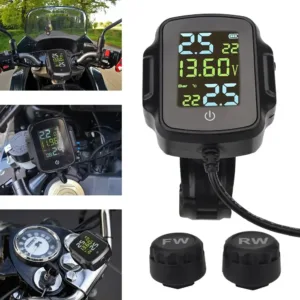
How a Motorcycle TPMS Works: Step by Step
- Measurement A small, battery-powered sensor is attached to each wheel’s valve stem (external mount) or placed inside the tire (internal mount). This sensor contains precise pressure and temperature measuring components.
- Data Processing & Transmission The sensor’s internal processor converts the physical measurements into a digital signal. When the motorcycle starts moving (typically above 15-20 km/h), an accelerometer in the sensor activates the system. It then transmits this data periodically (e.g., every minute) via a low-power radio frequency (commonly 433 MHz or 2.4 GHz) to a receiver.
- Reception & Display A compact receiver, often mounted on the handlebars or dashboard, picks up the signal. It processes the data and shows the real-time pressure (in PSI or BAR) and temperature for each tire on a small digital screen.
- Alert System The receiver compares the readings to pre-set safe ranges. If pressure drops too low, rises too high, changes rapidly (indicating a puncture), or if temperature becomes excessive, it immediately alerts the rider with a visual warning and/or an audible alarm.
Key Components of a Motorcycle TPMS
- Tire Sensors: These are the core measurement units. They are built to withstand vibration, centrifugal force, and temperature extremes. They use long-life lithium batteries (like the Panasonic BR-1632AFAN) designed for wide temperature ranges.
- Receiver/Display Unit: This is the rider’s interface. It shows numerical readings and provides alerts. It is usually powered by the motorcycle’s battery or a built-in rechargeable cell.
- Wireless Communication Protocol: The system uses a specific radio frequency and protocol to ensure reliable communication between the fast-spinning wheels and the receiver, resisting interference from the engine and other electronics.
Direct vs. Indirect TPMS (Why Direct is Standard for Motorcycles)
There are two main types of TPMS technology, but motorcycles almost exclusively use the direct method.
| Type | How It Works | Use in Motorcycles |
|---|---|---|
| Direct TPMS | Uses physical pressure/temperature sensors inside each tire to provide exact, real-time readings. | Standard. Provides accurate, tire-specific data which is critical for motorcycle safety and handling. |
| Indirect TPMS | Uses the motorcycle’s ABS wheel speed sensors to estimate pressure loss by detecting differences in wheel rotation. | Rarely used. Less accurate, cannot measure pressure when stationary, and is ineffective if both tires lose pressure equally. |
Important Technical Features
- Auto-Wake/Sleep: Sensors spend most of their time in a low-power “sleep” mode to conserve battery. They automatically “wake up” and start transmitting when motion is detected.
- Fast-Leak Detection: If the system detects a rapid pressure drop (e.g., a loss of 10 kPa within 16 seconds), it will switch to an emergency mode, sending alerts every few seconds.
- Sensor Mounting: External sensors screw onto the valve stem but may be vulnerable to damage or theft. Internal sensors are fitted inside the tire during mounting, offering better protection but requiring professional installation.
In summary, a motorcycle TPMS provides a crucial layer of safety by giving the rider precise, real-time knowledge of tire conditions. It operates through a reliable cycle of measurement by durable sensors, wireless data transmission, and clear visual display, with immediate alerts for any abnormal pressure or temperature changes.