
What Does Fault Code P0107 Mean?
Fault code P0107, applicable to all vehicle manufacturers, indicates “Manifold Absolute Pressure (MAP) Sensor Circuit Low Input.”
Background: The Manifold Absolute Pressure (MAP) sensor measures the pressure inside the intake manifold. This data is critical for the Engine Control Module (ECM) to calculate the correct air-fuel mixture for optimal combustion, performance, and emissions. A “low input” signal means the voltage from the MAP sensor to the ECM is below the expected normal range.
Symptoms of Fault Code P0107
- Check Engine Light (MIL) illuminated on the dashboard.
- Poor engine performance, hesitation, or lack of power during acceleration.
- Rough idle, unstable RPM, or engine stalling.
- Noticeably increased fuel consumption.
- Black exhaust smoke (indicating a rich fuel mixture).
- Difficulty starting the engine.
Main Causes of Fault Code P0107
- Faulty MAP Sensor: The sensor itself is defective, damaged, or contaminated (e.g., by oil from a failing PCV valve).
- Wiring or Connector Issues: Open circuits, short circuits to ground, damaged wires, or loose/corroded connectors in the MAP sensor circuit.
- Vacuum Leaks: Leaks in the intake manifold, vacuum hoses, or gaskets (e.g., intake manifold gasket) cause incorrect pressure readings.
- Failed Engine Control Module (ECM/PCM): The ECM itself has an internal fault or software issue preventing it from correctly interpreting the sensor signal.
- Reference Voltage (VREF) Circuit Problem: An open circuit in the 5-volt reference supply line from the ECM to the sensor.
How to Diagnose Fault Code P0107?
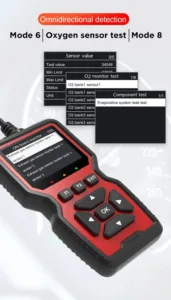
- Connect an OBD2 scanner or OBD2 diagnostic tool to confirm the presence of code P0107 and check for any related codes.
- Record freeze frame data and live data, specifically monitoring the MAP sensor voltage and pressure readings (kPa or in-Hg).
- Perform a visual inspection of the MAP sensor, its electrical connector, and the associated wiring harness for damage, corrosion, or disconnection.
- Check for vacuum leaks around the intake manifold and all vacuum lines using a smoke machine or by listening for hissing sounds.
- Use a digital multimeter to test the MAP sensor’s 5V reference voltage, ground circuit, and signal output voltage against the manufacturer’s specifications.
- If possible, substitute the MAP sensor with a known-good unit to see if the fault clears.
Possible Causes and Diagnostic Methods
Possible Cause | How to Check? |
|---|---|
Faulty MAP Sensor | Test sensor output voltage with a multimeter or scan tool under different engine loads (idle vs. WOT). Compare to specs. |
Wiring Short/Open Circuit | Perform continuity and resistance tests on the sensor’s three wires (5V ref, signal, ground) between the sensor connector and ECM. |
Vacuum Leak | Use a smoke machine to pinpoint leaks. Visually inspect intake manifold gaskets and all vacuum hoses. |
Bad Connector/Corrosion | Inspect the MAP sensor and ECM connectors for bent pins, moisture, or green corrosion. Clean and re-seat. |
ECM/PCM Failure | Rule out all other causes first. May require professional reprogramming or replacement, often diagnosed by checking for correct reference voltage output. |
Required Tools: OBD2 diagnostic scanner, digital multimeter, smoke machine (for vacuum leak test), basic hand tools, vehicle-specific wiring diagrams.
How to Fix Fault Code P0107? (Solutions)
Simple Fixes:
- Clean the MAP sensor electrical connector and the sensor’s port (if contaminated) with appropriate electrical contact cleaner.
- Repair minor wiring damage (chafed insulation, broken wire) with solder and heat shrink tubing.
- Tighten any loose intake manifold bolts or re-seat vacuum hoses. Clear the code with your obd tool scanner and test drive.
In-Depth Diagnosis and Repair:
- Replace the faulty MAP sensor. This is the most common fix. Ensure you get the correct OEM or high-quality aftermarket part.
- Repair damaged wiring harness sections. Follow proper automotive wiring repair procedures.
- Fix vacuum leaks. Replace cracked hoses, faulty gaskets (like the intake manifold gasket), or the PCV valve if it’s leaking oil into the intake.
- Update or replace the Engine Control Module (ECM). This is a last resort after confirming all sensors and circuits are functional. May require professional programming.
Troubleshooting by Symptom
Symptom | Likely Solution |
|---|---|
Check Engine Light on, poor acceleration | Diagnose MAP sensor signal. Likely needs sensor replacement. |
Rough idle, stalling, code returns after reset | Check for vacuum leaks first, then test MAP sensor circuit. |
Black smoke, high fuel consumption | MAP sensor is likely reporting incorrect low pressure, causing a rich mixture. Replace sensor. |
Common Vehicles with Fault Code P0107
- Chevrolet Cruze (2015+): A common failure point. The MAP sensor can fail internally, sending a constant low voltage signal (e.g., 0.3V instead of the normal 1-4.5V range), triggering P0107. Often requires sensor replacement .
- Ford Focus (2012-2018): Prone to wiring harness issues. Vibration can cause the ground wire for the MAP sensor to fray or break, leading to a low voltage condition and P0107. Inspection and repair of the wiring are necessary .
- Honda Civic (2006-2015): Frequently experiences P0107 due to vacuum leaks, particularly from a cracked or aged intake manifold gasket. Fixing the leak and clearing the code typically resolves the issue .
- Toyota Corolla (2014-2019): In some model years, a software glitch in the ECM can cause a false P0107 code even with a functioning sensor. A dealership ECM firmware update may be the solution .
- Hyundai Elantra / Kia Forte (2011-2016): Oil contamination from a failing Positive Crankcase Ventilation (PCV) valve can coat the MAP sensor, causing inaccurate low readings and P0107. Cleaning or replacing the sensor and the PCV valve is required .
- General Motors SUVs & Trucks (Cadillac Escalade, GMC Yukon, Chevy Suburban 2007-2014): These vehicles use a common MAP sensor design. Failures often present with P0107 accompanied by drivability issues. The sensor is located on the intake manifold and is relatively accessible for replacement .
- Mitsubishi Lancer / Outlander (various years): Has specific diagnostic procedures for P0107. The fault judgment criterion is often the sensor output voltage being less than 0.2V for 2 seconds. Diagnosis involves checking voltage at specific ECU terminals which vary with altitude .
P0107 Frequently Asked Questions
What should I do if my car shows code P0107?
Code P0107 indicates a problem with the Manifold Absolute Pressure sensor circuit. You should address it promptly as it affects engine performance, fuel economy, and emissions. Start by using an obd reader to confirm the code.Is it safe to drive with a P0107 code?
You can typically drive for a short distance, but it’s not recommended for extended periods. The engine will likely be in a “limp mode” or running inefficiently, which can damage the catalytic converter over time due to a rich fuel mixture.Can I fix P0107 myself?
Yes, if you are mechanically inclined. The most common fix—replacing the MAP sensor—is often straightforward. You’ll need basic tools and an OBD2 diagnostic scanner to clear the code after repair. However, if the issue is a wiring fault deep in the harness or an ECM problem, professional help may be needed.How much does it cost to fix a P0107 code?
Costs vary widely. A MAP sensor itself can cost from 200. If you DIY, that’s the main cost. At a repair shop, labor might add 300, bringing the total to 500. ECM issues are significantly more expensive.Will disconnecting the battery clear P0107?
It may temporarily clear the code and turn off the Check Engine Light, but if the underlying fault (bad sensor, vacuum leak) is not repaired, the code will return once the drive cycle completes. Using a proper obd2 diagnostic scanner to clear codes is the correct method after repairs.What’s the difference between P0107 and P0106?
P0106 indicates a MAP sensor circuit “range/performance” problem, meaning the signal is plausible but doesn’t match expected values based on other engine parameters. P0107 is more specific, indicating the signal voltage is simply too low.Can a bad MAF sensor cause P0107?
Not directly. The Mass Air Flow (MAF) and MAP sensors provide different data streams. However, severe drivability issues from a bad MAF might cause running conditions that could theoretically affect related sensor readings, but P0107 points specifically to the MAP circuit.How do I test a MAP sensor with a multimeter?
With the ignition ON (engine off), probe the sensor connector. You should find ~5V on the reference wire, ~0V on the ground, and a signal voltage between 0.5V and 4.5V (exact value depends on atmospheric pressure). With the engine idling, the signal voltage should drop (typically 1-2V, indicating vacuum).
Related OBD2 Fault Codes
- P0106 – Manifold Absolute Pressure (MAP) Sensor Circuit Range/Performance Problem
- P0108 – Manifold Absolute Pressure (MAP) Sensor Circuit High Input
- P0112 – Intake Air Temperature (IAT) Sensor Circuit Low Input
- P0113 – Intake Air Temperature (IAT) Sensor Circuit High Input
Important Note!Ignoring a P0107 code can lead to decreased fuel economy, potential engine damage from incorrect fueling, and failure to pass emissions tests. Always diagnose the root cause before simply replacing the MAP sensor, as vacuum leaks and wiring issues are common culprits.