
Tire Pressure Monitoring Systems (TPMS) enhance vehicle safety by alerting drivers to under-inflation. The core choice is between Direct TPMS (dTPMS) and Indirect TPMS (iTPMS). The optimal selection depends on a multifaceted analysis of your vehicle type, performance requirements, budget, and tolerance for maintenance.
Core Technical Comparison: How They Work
| Feature | Direct TPMS (dTPMS) | Indirect TPMS (iTPMS) |
|---|---|---|
| Technology | Physical pressure/temperature sensors inside each tire valve, transmitting data via radio frequency to a receiver. | Software algorithm using the vehicle’s ABS wheel speed sensors to infer pressure loss from rotational differences. |
| Data Provided | Real-time numerical pressure (PSI/Bar) and temperature for each tire. | Binary warning light only. No numerical readout. |
| Detection | Immediate, even when stationary. Highly accurate (±1 PSI). Identifies the specific faulty tire. | Requires driving >15-20 mph for several minutes. Only triggers after significant loss (~25%). Cannot detect equal pressure loss in multiple tires. |
| Calibration | Initial sensor pairing required. Sensors have 5-10 year batteries. | Manual system reset required after every tire inflation, rotation, or replacement. |
Decision Framework: Which System is Right for Your Situation?
Choosing between dTPMS and iTPMS is not a matter of one being universally “better,” but which is more appropriate for your specific operational context and priorities.
Scenario 1: Choose Direct TPMS (dTPMS) If…
Your priorities are precision, proactive safety, and performance monitoring, and you accept higher upfront cost and eventual sensor maintenance.
- You ride or drive a performance vehicle (Motorcycles, Sports Cars, Track Cars):
- Critical Need: Handling is exquisitely sensitive to exact tire pressure. dTPMS allows perfect tuning for load, cornering, and temperature.
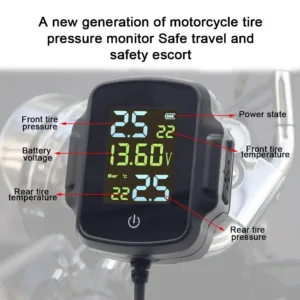
- Motorcycle-Specific Imperative: The “two-tire problem” of iTPMS is a fatal flaw. If both tires lose pressure equally (e.g., from temperature drop), iTPMS may not alert. dTPMS provides individual, real-time readings, making it the only truly safe, recommended choice for motorcycles.
- Temperature Data: A rising tire temperature reading can warn of impending failure or excessive strain.
- You operate vehicles for towing, hauling, or with variable loads (Trucks, RVs, Trailers):
- You need to adjust and monitor pressure precisely based on load. dTPMS gives you the exact data to do this safely.
- You prioritize convenience and pre-trip safety:
- You can check all tire pressures instantly from the driver’s seat or before mounting your motorcycle, without a manual gauge.
- You have a vehicle without ABS:
- iTPMS is not an option, as it relies on the ABS sensor infrastructure.
Scenario 2: Indirect TPMS (iTPMS) May Be Sufficient If…
Your priority is a low-maintenance, cost-effective system for basic legal compliance and gross leak detection on a standard passenger vehicle.
- You drive a standard passenger car with factory-equipped iTPMS:
- The system is already integrated at no extra cost. It meets minimum regulatory safety requirements in many regions.
- Your primary need is a basic warning for catastrophic leaks or flats:
- While slow, it will eventually alert you to a significant single-tire puncture during highway driving.
- You want to minimize long-term component maintenance:
- There are no sensor batteries to replace. The system uses existing ABS hardware.
- Budget is a primary constraint for an aftermarket installation:
- Adding an aftermarket dTPMS to a car that lacks any system is more expensive than relying on the vehicle’s built-in iTPMS (if present).
Limitations That Define the Choice
| Critical Limitation | Impact on Direct TPMS (dTPMS) | Impact on Indirect TPMS (iTPMS) |
|---|---|---|
| Simultaneous Multi-Tire Pressure Loss | Accurately detects and displays pressure loss in every tire individually. | May fail to trigger an alert if all tires lose pressure at a similar rate (common with temperature changes). A major safety gap. |
| Pre-Ride/Drive Verification | Provides instant pressure check while vehicle is stationary. | Provides zero information until the vehicle is driven at speed. Requires manual gauge for a pre-trip check. |
| Environmental & Usage Interference | Unaffected by driving style, road surface, or tire wear. External sensors can be vulnerable to damage/theft. | Prone to false alarms from aggressive cornering, different road traction, or uneven tire wear. Requires recalibration after tire rotation. |
| Total Cost of Ownership | High upfront hardware cost. Sensors require professional installation and eventual battery replacement (every 5-10 years). | Low/no added hardware cost if factory-equipped. No component maintenance, but may incur costs for system recalibrations. |
Synthesis: Strategic Recommendations by Use Case
- For Motorcycles, Performance Cars, and Track Use: Mandatory Choice: High-Quality Direct TPMS. The need for exact pressure control, temperature awareness, and the failure of iTPMS logic for two-wheel applications make this non-negotiable for safety and performance.
- For Standard Daily Driver Passenger Cars:
Factory iTPMS is “Sufficient” for Basic Compliance. It provides a mandated warning. However, for drivers who value precise maintenance and proactive safety, supplementing with a portable dTPMS kit or high-quality gauge is highly advisable to overcome iTPMS’s blind spots.
- For Trucks, RVs, and Vehicles Used for Towing:
Strong Recommendation for Direct TPMS. The ability to monitor pressure changes under varying loads is critical for safety, tire longevity, and fuel economy. The investment directly prevents blowouts and uneven wear.
- For Classic or Modified Vehicles Without ABS:
Only Direct TPMS is a Technical Option. A well-installed aftermarket dTPMS system is a significant safety upgrade for these vehicles.
Final Analysis: While Indirect TPMS serves as a basic, low-maintenance warning system for average passenger car use, its technical limitations render it inadequate for applications where precision and reliability are paramount. Direct TPMS is the definitive choice for motorcycles, performance-oriented use, and any scenario where tire pressure is a critical dynamic variable. For the informed owner, dTPMS transforms tire maintenance from a reactive chore into a manageable, data-driven component of vehicle safety and performance.