
What does the P011D code mean?
The P011D is a generic OBD-II powertrain trouble code. Its official definition is “Charge Air Cooler Temperature/Intake Air Temperature Correlation Bank 2“.
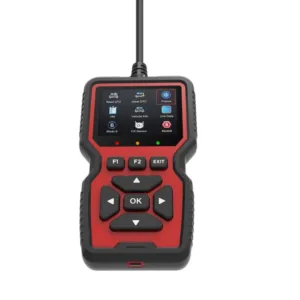
This Diagnostic Trouble Code (DTC) is stored by the Engine Control Module (ECM) in vehicles with a turbocharged or supercharged engine. It indicates that the ECM has detected an implausible or irrational relationship between the temperature readings from the Charge Air Cooler (CAC) temperature sensor and the Intake Air Temperature (IAT) sensor, but specifically for Bank 2 of the engine. This code is the counterpart to P011C, which applies to Bank 1. In a V-type or horizontally-opposed engine, “Bank 2” typically refers to the side of the engine that does not contain cylinder number 1. The ECM continuously compares the temperature of the air leaving the intercooler (measured by the CAC sensor) with the temperature of the air just before it enters the intake manifold (measured by the IAT sensor). Under normal operation, the air should be significantly cooler after passing through the intercooler. If the calculated difference or correlation between these two sensor readings falls outside a pre-programmed expected range for a sustained period, the ECM will set code P011D and illuminate the Check Engine Light. This fault can lead to incorrect fuel delivery, reduced power, and potential engine damage. The first step is to connect a professional obd2 scanner to confirm the code and check for related faults.
Symptoms of Error Code P011D
- Illuminated Check Engine Light (MIL).
- Reduced engine power and noticeable lack of acceleration, especially under load.
- Decreased fuel economy (lower MPG).
- The vehicle may enter a reduced power or “limp mode” to protect the engine.
- Engine may run rough or hesitate during acceleration.
- In some cases, black smoke from the exhaust due to an over-rich fuel mixture.
- No unusual noises are directly caused by this code, but underlying issues (like a boost leak) might cause whistling or hissing.
Main Causes of Error Code P011D
- Faulty Bank 2 Charge Air Cooler (CAC) Temperature Sensor: The sensor that measures post-intercooler air temperature on Bank 2 provides inaccurate, stuck, or out-of-range signals.
- Faulty Bank 2 Intake Air Temperature (IAT) Sensor: The IAT sensor for Bank 2 (sometimes integrated into a Bank 2-specific Mass Air Flow sensor or a separate unit) is malfunctioning.
- Wiring or Connector Issues: Damaged, chafed, corroded, or loose wiring/connectors for either the Bank 2 CAC sensor or the Bank 2 IAT sensor.
- Boost/Air Intake Leak (Bank 2): An air leak in the intake tract, intercooler, or piping specific to Bank 2 can cause unmetered air to enter and skew temperature readings.
- Faulty or Inefficient Intercooler (Bank 2 side): On engines with dual or side-specific intercoolers, a clogged, damaged, or leaking intercooler on Bank 2 can prevent proper cooling.
- Failing Turbocharger (Bank 2): On twin-turbo or V-type engines with separate turbos, a malfunctioning turbo on Bank 2 (e.g., faulty wastegate, worn bearings) can create abnormal boost and temperature conditions.
- Restricted Air Filter or Ducting: A severely dirty air filter or blocked air inlet affecting Bank 2’s airflow.
- Problem with the Engine Control Module (ECM): A software glitch or internal hardware fault causing incorrect data processing (rare).
How to Diagnose Error Code P011D?
- Initial Scan and Data Review: Use a professional obd2 code scanner to read all stored codes. Confirm P011D. Check for related codes like P011C (Bank 1), boost pressure codes, or other sensor faults. Review freeze frame data to see the conditions (RPM, load, temperature) when the fault triggered.
- Visual Inspection (Bank 2 Focus): Visually inspect the entire air intake and boost system on the Bank 2 side of the engine. Look for disconnected hoses, cracked intercooler pipes, damaged sensors, or obvious wiring issues. Locate the Bank 2 CAC and IAT sensors (consult service manual).
- Monitor Live Sensor Data: With the engine running and fully warmed up, use your car code scanner’s live data function to monitor the following parameters for Bank 2: Charge Air Cooler Temperature and Intake Air Temperature. Also monitor Bank 1 values for comparison. At idle, temperatures should be similar and near ambient. Under acceleration, the CAC temperature should be notably cooler than the IAT sensor reading. A faulty sensor may show a stuck value, no change, or an implausibly high/low reading.
- Perform a Boost Leak Test: A boost leak is a common cause of correlation faults. Pressurize the intake system (from the turbo outlet to the throttle body) with a smoke machine or boost leak tester. Listen and look for leaks, especially on the Bank 2 plumbing.
- Test the Sensors Electrically: With the ignition OFF, disconnect the suspected sensor. Using a digital multimeter, measure the sensor’s resistance and compare it to the manufacturer’s specification at a given temperature. Also, check the wiring harness connector for the correct reference voltage (usually 5V) and a good ground.
- Check for Technical Service Bulletins (TSBs): Search for manufacturer-specific TSBs related to P011D, P011C, or the involved sensors. There may be a known issue with a faulty sensor batch or a required ECM software update.
- Component Swap Test (If Possible): If the Bank 1 and Bank 2 sensors are identical and accessible, you can carefully swap them (e.g., swap the CAC sensors). Clear the codes, drive the vehicle, and see if the fault moves from P011D (Bank 2) to P011C (Bank 1). If it does, the swapped sensor is faulty.
Possible Causes and Diagnostic Methods
| Possible Cause | How to Check? |
| Faulty Bank 2 CAC Sensor | Monitor live data. Compare to Bank 1 CAC temp and ambient. Perform resistance test or swap with Bank 1 sensor. |
| Faulty Bank 2 IAT Sensor | Monitor live data at key-on (engine cold). Should read near ambient. Test resistance or swap with Bank 1 sensor if identical. |
| Wiring Issue to Bank 2 Sensor | Check for 5V reference and good ground at the sensor connector with the key ON. Test continuity of signal wire back to the ECM. |
| Boost Leak on Bank 2 | Perform a smoke test or boost leak test on the Bank 2 intake/intercooler system. Listen for hissing under acceleration. |
| Clogged/Restricted Intercooler (Bank 2) | Inspect for physical damage or external blockage. Compare temperature drop across Bank 1 and Bank 2 intercoolers using an IR thermometer after a drive. |
| Failing Bank 2 Turbocharger | Check for excessive shaft play, oil in the intercooler pipes, or abnormal noise. Monitor live boost pressure data for Bank 2. |
Tools needed: A professional obd2 diagnostic scanner with live data, digital multimeter, basic hand tools, smoke machine or boost leak tester, infrared thermometer, and the vehicle’s service manual for sensor locations and specifications.
How do I fix error code P011D? (Solutions to the Problem)
Simple Fixes
- Clean/Replace Air Filter: A dirty filter can affect airflow and sensor readings. Replace it with a new one.
- Clean and Re-seat Electrical Connectors: Disconnect the battery. Disconnect, clean with electrical contact cleaner, and firmly reconnect the plugs at the Bank 2 CAC and IAT sensors.
- Tighten Loose Intake Clamps: Inspect and tighten all clamps and connections on the Bank 2 intake and intercooler piping.
In-depth Diagnosis and Repair Solutions
- Replace the Faulty Sensor: If diagnostics confirm a bad Bank 2 CAC or IAT sensor, replace it with an OEM or high-quality equivalent. After installation, clear the codes and test drive.
- Repair Intake/Boot Leaks: Replace any cracked, torn, or leaking hoses, pipes, or intercooler end tanks on the Bank 2 side. Ensure all connections are secure.
- Repair or Replace Wiring Harness: Repair any damaged wires with solder and heat-shrink tubing. If damage is extensive, replace the affected harness section.
- Replace the Intercooler (Bank 2 side): If the intercooler is leaking internally or externally, or is severely clogged, it must be replaced.
- Address Turbocharger Issues: A failing Bank 2 turbo may need to be rebuilt or replaced. This is a complex and costly repair.
- Update ECM Software: If all hardware checks out, there may be a calibration issue. A dealer or specialist with the proper obd2 diagnostic tool can check for and install updated ECM software.
Fix faults based on symptoms
| Symptom / Diagnostic Finding | Recommended Solution |
| P011D present, live data shows Bank 2 CAC temperature reading is stuck or doesn’t change. | Replace the Bank 2 Charge Air Cooler Temperature Sensor. |
| P011D present, Bank 2 IAT reading is unrealistic (e.g., -40°F or 300°F). | Replace the Bank 2 Intake Air Temperature Sensor. |
| Code returns after clearing, and a hissing sound is heard from the Bank 2 side under acceleration. | Find and repair the boost leak on the Bank 2 intake/intercooler system. |
| P011D and P0299 (Underboost) are both present for Bank 2. | Strong indicator of a Bank 2 turbocharger issue or a significant boost leak. Diagnose turbo and intake system. |
| Only Bank 2 has correlation issues; Bank 1 (P011C) is fine. | Focus exclusively on components unique to Bank 2: its sensor, wiring, intercooler section, and turbo. |
Common Error Code P011D in Vehicles
BMW (with N63, S63, B58TU engines): Common in V8 and inline-6 turbocharged BMWs (e.g., 550i, X5 M, M340i). The N63 “hot V8” is notorious for heat-related sensor and wiring failures. The charge air temperature sensors, located in the intercooler outlets, often fail due to extreme heat cycling. Diagnosis requires a capable car code scanner like ISTA to monitor both bank’s data simultaneously.
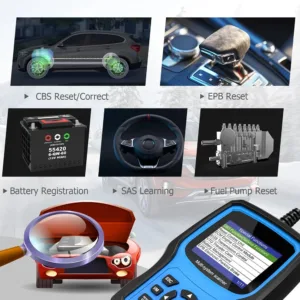
Mercedes-Benz (with M176/M177/M178 V8 Biturbo, M256 inline-6): Found in AMG and high-end Mercedes models. The sensors are part of a complex intake system. Failures can also be related to the hot-film mass air flow sensors, which incorporate the IAT function. Star Diagnosis (XENTRY) is typically required for accurate diagnosis and component coding.
Ford EcoBoost (2.7L, 3.5L V6 Twin-Turbo): Very common in Ford F-150, Explorer ST, and Lincoln models with twin-turbo V6 engines. The charge air temperature sensors are known failure points. Wiring harnesses near the hot turbos can also become brittle and fail. Using Ford’s IDS or a capable aftermarket obd code reader is important for accessing the correct PIDs.
Audi/Volkswagen (with 3.0L V6 TFSI, 2.9L/4.0L V8 TFSI): Affects Audi S4, S5, RS5, S6, etc. These engines use dual intercoolers. The GXX series charge air temperature sensors are prone to failure. A scan with VCDS or ODIS is essential to read values from both engine banks and perform output tests on the sensors.
Porsche (with 3.0L, 3.8L, 4.0L turbocharged engines): In models like the 911 Turbo, Panamera Turbo, and Cayenne Turbo. The sophisticated intake system requires precise sensor data. Porsche-specific diagnostic equipment (PIWIS) is often needed for in-depth diagnosis and to rule out issues with variable intake geometry or the turbocharger system itself.
P011D Frequently Asked Questions
Is it safe to drive with a P011D code?
It is not recommended. The ECM uses the temperature data to calculate the correct air density for proper fueling and ignition timing. Faulty data can cause the engine to run too rich or too lean, potentially leading to misfires, catalytic converter damage, or in severe cases, pre-ignition/detonation which can harm pistons and valves. Have it diagnosed promptly.
What is the difference between P011C and P011D?
P011C indicates a charge air cooler/intake air temperature correlation fault for Bank 1 of the engine. P011D indicates the exact same type of fault, but for Bank 2. The diagnostic process is identical, but you focus on the components and wiring specific to the affected bank.
Can I use a basic OBD2 reader to diagnose P011D?
A basic obd code reader can confirm the code exists, but it likely cannot show the live data from the two specific temperature sensors needed for diagnosis. You need a more advanced car code scanner that can display generic OBD2 PIDs (Parameter IDs) or, better yet, manufacturer-specific data streams.
How much does it cost to fix P011D?
Costs vary: Diagnosis: $100-$200. A new temperature sensor: $50-$250. Labor: 0.5-2 hours ($75-$250). Total for a simple sensor replacement typically ranges from $225 to $700. If the intercooler or turbo needs service, costs can rise to $1,500+.
Will disconnecting the battery clear P011D?
It may temporarily clear the code and turn off the light, but it will not fix the problem. The ECM will run its self-tests again during the next drive cycle, detect the correlation fault, and re-illuminate the light. The underlying cause must be repaired.
Can a dirty throttle body cause P011D?
Not directly. A dirty throttle body affects airflow but not the temperature correlation between the two sensors. However, any intake restriction (like a very dirty air filter) can indirectly affect system pressures and temperatures.
My car has P011D and is losing coolant. Are they related?
Potentially, yes. If the Bank 2 intercooler is a water-to-air type (as in some high-performance cars) and it has an internal leak, coolant could enter the intake tract. This would severely affect temperature readings and trigger this code. Check for coolant in the intercooler pipes or a low coolant level.
P011D Related OBD2 Errors
- P011C: Charge Air Cooler Temperature/Intake Air Temperature Correlation Bank 1
- P00AF: Charge Air Cooler Temperature Sensor Circuit Bank 1
- P00B0: Charge Air Cooler Temperature Sensor Circuit Bank 2
- P0112: Intake Air Temperature (IAT) Sensor Circuit Low Input
- P0113: Intake Air Temperature (IAT) Sensor Circuit High Input
- P0236: Turbocharger Boost Sensor A Circuit Range/Performance
- P0299: Turbocharger/Supercharger Underboost Condition
- P2263: Turbo Boost Pressure Not Detected – Mechanical
Important! Code P011D points to a problem in the critical air intake temperature monitoring system of a forced-induction engine. Ignoring it can lead to poor performance, increased emissions, and serious engine damage due to incorrect air/fuel mixtures. While the diagnosis often starts with the sensors, the root cause could be elsewhere in the intake or turbo system. Due to the complexity of modern twin-bank turbo engines and the safety risks of working with pressurized intake systems, it is strongly advised to have this diagnosis and repair performed by a qualified technician with the proper tools and expertise. A professional-grade obd2 diagnostic scanner is essential for accurate troubleshooting of this code.