
What does the P011B code mean?
The P011B is a generic OBD-II (Onboard Diagnostics II) trouble code. Its official definition is “Engine Coolant Temperature / Intake Air Temperature Correlation“.
Background Information: This code is set by the vehicle’s Engine Control Module (ECM) or Powertrain Control Module (PCM) when it detects an implausible relationship between the readings from the Engine Coolant Temperature (ECT) sensor and the Intake Air Temperature (IAT) sensor. The logic assumes that after the vehicle has been parked and the engine has cooled down for an extended period (typically over 7 hours), the temperature of the engine coolant and the intake air should be very close to each other and to the ambient temperature. If the difference between these two sensor readings exceeds a predetermined threshold (commonly 20-25°C or 36-45°F) during a specific monitoring window after a cold start, the ECM interprets this as a sensor correlation fault and stores code P011B. The first step in diagnosis is always to use a professional obd2 scanner to read the live data from both the ECT and IAT sensors.
Symptoms of Error Code P011B
- Illuminated Check Engine Light (MIL).
- Rough engine idle, particularly noticeable during cold starts.
- Poor engine performance and hesitation.
- Decreased fuel economy.
- Engine may run too rich (causing black exhaust smoke) or too lean.
- Inaccurate temperature gauge reading (in some vehicles).
- Other related temperature sensor codes (like P0112, P0113, P0115, P0117, P0118) may also be present.
Main Causes of Error Code P011B
- Faulty Engine Coolant Temperature (ECT) Sensor: The sensor provides a skewed or inaccurate reading.
- Faulty Intake Air Temperature (IAT) Sensor: The sensor, often integrated into the Mass Air Flow (MAF) sensor or mounted in the intake air duct, is defective.
- Wiring or Connector Issues: Damaged, corroded, or loose wires/connectors in the circuit for either the ECT or IAT sensor (open circuit, short to ground, or short to power).
- Low Engine Coolant Level: Insufficient coolant can cause the ECT sensor to be exposed to air/steam, giving a false reading.
- Air Pockets in the Cooling System: Trapped air can create localized hot spots, affecting the ECT sensor reading.
- Faulty Thermostat: A thermostat stuck open can prevent the engine from warming up properly, while one stuck closed can cause overheating, both affecting ECT readings.
- Faulty Water Pump: Inadequate coolant circulation can lead to uneven engine temperatures.
- Faulty PCM/ECM: A rare internal fault in the control module’s signal processing circuits.
How to Diagnose Error Code P011B?
- Connect an OBD2 Code Scanner: Use a capable car code scanner to confirm the presence of P011B and check for any related codes. Clear the codes and perform a test drive to see if P011B returns, confirming it’s a hard fault.
- Perform a “Cold Soak” Test: For an accurate diagnosis, the vehicle must meet the code’s enabling conditions. Park the vehicle for at least 7-8 hours to allow the engine to fully cool. This ensures the ECT and IAT should read close to ambient temperature.
- Observe Live Data with a Scanner: After the cold soak, turn the ignition to ON (without starting the engine). Use your obd2 diagnostic scanner to view the live data (PID) for both the ECT and IAT sensors. Their readings should be within 5-10°F of each other and match the ambient temperature. A discrepancy of over 45°F likely confirms the fault.
- Check the Cooling System: Visually inspect the coolant level in the reservoir and radiator (when cold). Look for signs of leaks. Ensure the cooling system is properly bled of air.
- Visual Inspection of Sensors and Wiring: Locate both the ECT sensor (usually on the engine block, cylinder head, or thermostat housing) and the IAT sensor. Inspect their electrical connectors for corrosion, damage, or looseness. Inspect the wiring harness for chafing or burns.
- Test Sensor Resistance: With the engine cool and the connectors disconnected, use a digital multimeter to measure the resistance of each sensor. Compare the readings to the manufacturer’s temperature-resistance specifications. A sensor reading significantly out of spec is faulty.
- Test the Wiring Circuits: Using a multimeter and a wiring diagram, check for continuity in the signal and ground wires from each sensor connector back to the ECM. Also check for shorts to power or ground.
Possible Causes and Diagnostic Methods
| Possible Cause | How to Check? |
| Failing ECT or IAT Sensor | Use a car code reader for live data comparison after a 7+ hour cold soak. Test individual sensor resistance with a multimeter. |
| Wiring/Connector Fault | Perform a visual inspection. Check for continuity and shorts in the sensor circuits with a multimeter. Perform a “wiggle test” on the harness while monitoring live data. |
| Low Coolant/Air Pocket | Check coolant level and condition. Perform a cooling system bleed procedure. |
| Faulty Thermostat | Monitor live ECT data during warm-up. An unusually slow temperature rise may indicate a stuck-open thermostat. |
| ECM/PCM Fault (Rare) | Check for consistent 5V reference voltage and good grounds at the sensor connectors. Swap sensors (if compatible) to see if the fault follows the sensor. |
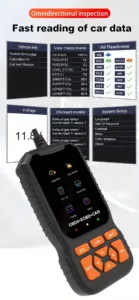
Tools needed: A professional-grade obd2 code scanner with live data capability is essential. You will also need a digital multimeter, basic hand tools, a cooling system pressure tester (optional), and access to vehicle-specific service information for wiring diagrams and sensor specs.
How do I fix error code P011B? (Solutions to the Problem)
Simple Fixes
- Top Up and Bleed Coolant: If coolant is low, refill with the correct type to the proper level and thoroughly bleed the cooling system to remove air pockets.
- Clean Electrical Connections: Disconnect the battery, then clean any corrosion from the ECT and IAT sensor connectors using electrical contact cleaner. Apply dielectric grease before reconnecting.
- Repair Minor Wiring Damage: Repair broken wires or damaged insulation with solder and heat-shrink tubing.
- After these checks, clear the code with your obd code reader and perform a cold soak test drive to see if it returns.
In-depth Diagnosis and Repair Solutions
- Replace the Faulty Sensor: Identify which sensor (ECT or IAT) is providing the erroneous reading through live data and resistance tests. Replace the faulty sensor with an OEM-quality part. For the ECT sensor, you may need to drain some coolant first.
- Repair or Replace the Wiring Harness: If wiring damage is found, repair or replace the affected section according to manufacturer standards.
- Replace a Faulty Thermostat: If diagnostics point to a faulty thermostat, replace it and the gasket, then refill and bleed the cooling system.
- Replace the Water Pump: If the pump is failing and causing poor circulation, it must be replaced.
- ECM/PCM Reprogramming or Replacement: As a last resort after all other components are verified, a software update (TSB) may be available. A faulty ECM itself may need replacement, but this is rare.
Fix faults based on symptoms
| Symptom Pattern | Recommended Repair Path |
| ECT reads -40°F or is frozen, IAT reads normal | Likely an open circuit in the ECT sensor or its wiring. Focus on ECT circuit repair/replacement. |
| IAT reads -40°F or is frozen, ECT reads normal | Likely an open circuit in the IAT sensor or its wiring. Focus on IAT circuit repair/replacement. |
| Both sensors read but with a large, constant offset (>45°F) | One sensor is likely degraded or skewed. Replace the sensor showing the less plausible temperature. |
| Code returns immediately after sensor replacement | The problem is likely in the wiring harness, connector, or ECM for that sensor’s circuit. |
| Code only sets in very cold or very hot weather | Suspect a sensor that is failing only at temperature extremes. Test sensor resistance at various temperatures. |
Common Error Code P011B in Vehicles
Toyota/Lexus: Very common in models like the Tundra, Venza, Camry, Highlander, and various Lexus models. Toyota’s system rigorously checks the correlation after a 7-hour soak. Diagnosis requires a capable scanner to view both sensor PIDs after the vehicle has sat overnight.
General Motors (Chevrolet, GMC, Buick, Cadillac, Pontiac): Frequent in many GM vehicles, including the Pontiac Vibe. The PCM monitors the correlation after a long soak. Wiring issues and sensor failures are typical culprits.
Mitsubishi: Common across many models. The diagnostic procedure often involves checking continuity at specific connectors (like A-07 for the IAT sensor) and using the M.U.T.-III scan tool for data comparison.
Ford: Found in various cars, trucks, and SUVs. As with other brands, the key is verifying the correlation during specific cold-start conditions using a professional obd2 diagnostic tool.
Honda/Acura: Can appear in models where precise temperature data is critical for engine management. Checking for technical service bulletins (TSBs) related to sensor updates is recommended.
Subaru: May occur, and it’s important to also check for underlying issues like head gasket leaks that could introduce air into the cooling system and skew ECT readings.
Nissan/Infiniti: Similar correlation monitoring is used. A thorough check of both sensor circuits is necessary.
Hyundai/Kia: A known issue in some models. Often resolved by replacing the sensor identified as faulty through live data comparison after a proper cold soak.
P011B Frequently Asked Questions
What is the first thing I should check with a P011B code?
The first and most critical step is to use an OBD2 scanner to view the live data from both the Engine Coolant Temperature (ECT) and Intake Air Temperature (IAT) sensors after the vehicle has been parked and completely cold for at least 7 hours. Observe if there is a large discrepancy (typically over 45°F) between the two readings.
Why does my vehicle need to sit for 7 hours to diagnose P011B?
The P011B monitor only runs under specific conditions: after a long “soak” time where the engine has cooled to ambient temperature. This ensures the ECT and IAT should read nearly the same value. If you try to diagnose it on a warm engine, the readings will naturally be different and won’t trigger the fault logic for testing.
Is it safe to drive with a P011B code?
It is not recommended for extended driving. Incorrect temperature readings can cause the engine to run on default, rich fuel maps, reducing fuel economy and performance, and potentially damaging the catalytic converter over time. It can also affect cooling fan operation.
Can a bad thermostat cause a P011B code?
Yes, indirectly. A thermostat stuck open will cause the engine to warm up very slowly, making the ECT reading much lower than expected compared to the IAT after startup. A thermostat stuck closed can cause overheating, which might also skew readings.
How much does it cost to fix a P011B code?
Costs vary. A DIY repair (replacing one sensor) typically costs $30 – $150 for parts. Professional repair at a shop averages $150 – $400, including diagnosis and labor. Cost increases if both sensors need replacement, wiring repair is needed, or other components like the thermostat are faulty.
Can I clear the P011B code by disconnecting the battery?
Disconnecting the battery may clear the code and turn off the Check Engine Light temporarily, but if the underlying fault condition persists, the code will return after the next drive cycle that meets the monitoring conditions (cold soak + drive).
What’s the difference between P011A and P011B?
P011A indicates a correlation fault between two Engine Coolant Temperature (ECT) sensors. P011B indicates a correlation fault between the Engine Coolant Temperature (ECT) sensor and the Intake Air Temperature (IAT) sensor.
My scan tool shows IAT at 85°F and ECT at 35°F after a cold night. Is this P011B?
Yes, a 50°F difference after a proper cold soak is a textbook example of what triggers P011B. The ECT reading of 35°F is likely faulty (unless it’s significantly colder than ambient), or there’s an issue with the cooling system around that sensor.
Do I need to replace both the ECT and IAT sensor?
Not necessarily. The diagnosis is to identify which sensor is providing the erroneous reading. Use your car code scanner’s live data and a multimeter to test each sensor. Typically, only one is faulty.
Why did the code come back after I replaced the sensor?
The most common reason is a problem in the wiring harness or connector for the sensor circuit you just replaced. You fixed the sensor, but the high resistance or intermittent open in the wiring remains. The other possibility is that the other sensor (which you didn’t replace) is also faulty or out of spec.
What tools do I absolutely need to diagnose P011B?
You need a quality OBD2 diagnostic scanner that can display live sensor data (PIDs). A basic code reader that only reads and clears codes is insufficient. You also need a digital multimeter for resistance and continuity testing, basic hand tools, and vehicle service information for specifications.
P011B Related OBD2 Errors
- P0112: Intake Air Temperature Sensor Circuit Low Input
- P0113: Intake Air Temperature Sensor Circuit High Input
- P0115: Engine Coolant Temperature Sensor Circuit Malfunction
- P0116: Engine Coolant Temperature Sensor Circuit Range/Performance Problem
- P0117: Engine Coolant Temperature Sensor Circuit Low Input
- P0118: Engine Coolant Temperature Sensor Circuit High Input
- P011A: Engine Coolant Temperature Sensor 1/2 Correlation
- P0125: Insufficient Coolant Temperature for Closed Loop Fuel Control
- P0128: Coolant Thermostat (Coolant Temperature Below Thermostat Regulating Temperature)
Important! Diagnosing P011B requires patience due to the required 7+ hour cold soak period for accurate testing. Do not skip this step. A basic car code reader is not enough; you need a scanner capable of live data streaming. Always prioritize safety: work on a cool engine and handle coolant properly. If you are not confident in performing electrical diagnostics, consulting a professional technician with advanced tools and information is highly recommended.