
What Does Fault Code P010F Mean?
Fault code P010F is a generic OBD-II diagnostic trouble code defined as “Mass or Volume Air Flow Sensor A/B Correlation.” This indicates that the vehicle’s Powertrain Control Module (PCM) has detected a significant discrepancy or inconsistency between the readings from two separate Mass Air Flow (MAF) or Volume Air Flow (VAF) sensors, typically labeled Sensor A and Sensor B.
Background: This code is specific to vehicles equipped with multiple throttle bodies, dual air intakes, or engines that utilize two independent MAF/VAF sensors to measure airflow for different banks or sections of the engine . The PCM continuously compares the data from both sensors to ensure accurate total airflow calculation. A correlation error occurs when the readings differ beyond a pre-programmed threshold, compromising the engine’s ability to maintain the correct air-fuel ratio.
Symptoms of Fault Code P010F
- Illuminated Check Engine Light (MIL).
- Diminished engine performance and reduced power, especially during acceleration .
- Rough engine idle or stalling.
- Noticeable decrease in fuel efficiency (MPG) .
- Engine hesitation or surging.
- In severe cases, the vehicle may enter a reduced-power “limp-home” mode or fail to start .
Main Causes of Fault Code P010F
- Faulty or Dirty MAF/VAF Sensor: One of the two sensors is contaminated with dirt, oil, or debris, or has failed internally, providing an incorrect reading .
- Intake System Vacuum Leaks: An air leak in the intake manifold, hoses, or connections on one bank allows unmetered air to enter, causing a discrepancy between the sensors’ measurements .
- Wiring or Connector Issues: Damaged, corroded, or loose wiring and connectors affecting one sensor’s circuit (open circuit, short to ground/power, high resistance) .
- Clogged or Restricted Air Filter: A severely dirty air filter can unevenly restrict airflow to one sensor more than the other .
- Incorrect Sensor Installation: A sensor that is not properly seated, has a failed seal, or is installed in the wrong location .
- Faulty Powertrain Control Module (PCM): A rare cause where the PCM itself has an internal fault preventing correct data comparison .
How to Diagnose Fault Code P010F?
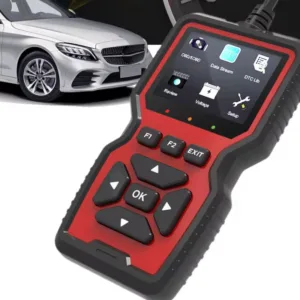
- Scan and Record: Connect an obd2 scanner to confirm code P010F and check for any related codes (e.g., lean/rich codes P0171/P0172). Record freeze frame data to see the conditions when the fault occurred .
- Visual Inspection: Inspect both MAF sensors, their wiring harnesses, and connectors for damage, corrosion, or disconnection. Check the air filter and all intake tract components for cracks, loose clamps, or leaks .
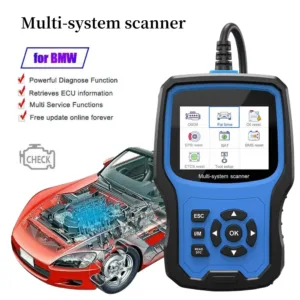
- Monitor Live Data: Using a capable car scanner or vehicle diagnostics tool, observe the live data stream for both MAF sensors (Sensor A and Sensor B). At idle and during gradual acceleration, their readings should be very close. A significant difference confirms the correlation fault .
- Test for Vacuum Leaks: Perform a thorough check for intake leaks using a smoke machine, which is the most effective method for finding small leaks .
- Clean and Test Sensors: Carefully clean both MAF sensors with specialized MAF cleaner. If the discrepancy persists, test each sensor’s output per manufacturer specifications or swap them (if possible) to see if the fault follows the sensor.
Possible Causes and Diagnostic Methods
Possible Cause | How to Check? |
|---|---|
Dirty/Failing MAF Sensor | Clean both sensors. Monitor live data before and after. Swap sensor positions if possible to see if the fault reading moves. |
Intake Vacuum Leak | Use a smoke machine to pressurize the intake system and visually identify leaks. Listen for hissing sounds or use carburetor cleaner spray (engine idling) around suspected areas—an RPM change indicates a leak. |
Wiring/Connector Fault | Perform a visual and physical inspection (wiggle test) of the harness. Use a digital multimeter to check for continuity, shorts, and correct voltage (5V reference, ground) at each sensor connector . |
Clogged Air Filter | Remove and inspect the air filter. Replace if heavily clogged or dirty. |
Faulty PCM | A last-resort diagnosis. Update PCM software if a Technical Service Bulletin (TSB) exists. Requires professional equipment to rule out all other causes definitively. |
Required Tools: OBD2 code reader/scanner, digital multimeter (DMM), MAF sensor cleaner, basic hand tools, smoke machine (for leak testing), vehicle-specific service information/diagrams.
How to Fix Fault Code P010F? (Solutions)
Simple Fixes:
- Clean MAF Sensors: Thoroughly clean both sensors with MAF cleaner and allow them to dry completely before reinstallation.
- Replace Air Filter: Install a new, clean air filter.
- Repair Intake Leaks: Seal or replace any cracked hoses, tighten all clamps, and repair leaking intake manifold gaskets.
- Repair Wiring: Fix any damaged wires, clean corroded connectors, and ensure all connections are secure.
In-Depth Diagnosis and Repair:
- Replace Faulty MAF Sensor: If diagnostics confirm one sensor is faulty, replace it. Use a high-quality or OEM part. In some cases, replacing both sensors as a pair is recommended for optimal correlation.
- Update PCM Software: Check for and install any available PCM software updates from the vehicle manufacturer, as these can sometimes resolve sensor calibration issues .
- Professional Diagnosis: For persistent or complex cases, especially involving potential PCM faults, consult a professional technician with advanced vehicle diagnostics tool.
Troubleshooting by Symptom
Symptom | Likely Solution |
|---|---|
Check Engine Light on with poor acceleration. | Focus on finding a vacuum leak on one bank or a failing sensor. |
Rough idle and stalling. | Likely a significant intake leak or a severely contaminated/failed MAF sensor affecting one bank. |
Code returns immediately after clearing. | Points to a hard fault: a permanent sensor failure, a major vacuum leak, or a wiring short/open circuit. |
Common Vehicles with Fault Code P010F
- Land Rover / Range Rover: Frequently logs P010F-00. Diagnosis mandates checking the entire intake air distribution system for leaks with a smoke tester, verifying MAF sensor seal integrity, and inspecting for carbon buildup on throttle blades per manufacturer procedure .
- Porsche (e.g., 911, Cayenne, Panamera): The engines are highly sensitive to precise air-fuel ratios. A P010F code requires checking for software updates for the Engine Control Unit (ECU) and a meticulous inspection of the complex dual-intake systems for even minor leaks .
- Mercedes-Benz (e.g., AMG models, V8/V12 engines): Vehicles with multiple throttle bodies or secondary air intake systems are prone to this code. Technicians must inspect the secondary air system and ensure both MAF sensor circuits are free from corrosion and high resistance.
- BMW / MINI (e.g., M models, S58/B58 engines): Common issues include corroded or damaged MAF sensor connectors. Diagnosis involves live data comparison and checking for intake leaks post-turbocharger, which can create erroneous sensor correlations.
- Audi (e.g., S/RS models, V6/V8 engines): The complex, often turbocharged, intake systems require checking all related sensors (like intake air temperature) and wiring. Leaks in intercooler piping or intake manifolds are frequent culprits.
- Jaguar (e.g., F-Type, XJ): Similar to Land Rover, these vehicles require checking for intake manifold air leaks and ensuring both MAF sensors are calibrated correctly, sometimes requiring a reset of fuel adaptations after repair.
- Dodge/Ram (e.g., HEMI V8 engines): Trucks and muscle cars with multi-displacement systems (MDS) may set this code if there’s a problem with the intake runner controls or a vacuum leak affecting one bank of cylinders.
- Toyota/Lexus (e.g., V8 models like LX570, LS460): While less common, it can occur in vehicles with dual air intake systems. The focus should be on checking for dirty sensors and ensuring the large intake ducts are properly sealed and not collapsed.
- Cadillac (e.g., Escalade V8, CT6): Some references note a manufacturer-specific definition for P010F related to oxygen sensor activity on Bank 2, highlighting the importance of consulting accurate, vehicle-specific repair information .
- European Performance Vehicles (General): Almost any high-performance European car with a twin-turbo or dual-intake setup is a candidate for this code. The diagnostic approach is universally methodical: inspect, clean, test for leaks, compare data, and then replace components.
P010F Frequently Asked Questions
What does “A/B Correlation” specifically mean for code P010F?
It means the Powertrain Control Module (PCM) is comparing the airflow data from two separate sensors (Sensor A and Sensor B). The code is set when their readings are too different, indicating one sensor or its associated intake path is not reporting accurately compared to the other .Is it safe to drive with a P010F code?
It is not recommended. The engine is running with incorrect airflow data, which can cause poor performance, increased emissions, reduced fuel economy, and potential long-term damage to components like the catalytic converters due to incorrect fuel mixtures.Can I fix a P010F code myself?
Yes, if you are comfortable with basic diagnostics. Start with a visual inspection, clean both MAF sensors and replace the air filter. If the code persists, you will need a vehicle code reader that can display live data from both sensors to identify the discrepancy and guide further checks for leaks or wiring issues.
Why is cleaning the MAF sensor often the first step?
Contamination (dirt, oil) is one of the most common causes of inaccurate MAF sensor readings. Cleaning is a low-cost, non-invasive procedure that resolves a significant percentage of P010F cases .What is the most common cause of P010F?
While a dirty or failing sensor is common, experienced mechanics often find that an intake vacuum leak on one side of the engine is the root cause, creating a real difference in airflow that the sensors accurately report, leading to the correlation fault .How much does it cost to fix a P010F code?
Costs vary widely:- DIY (Cleaning/Filter): 50.
- DIY (One MAF Sensor Replacement): 400 for the part.
- Professional Repair: 1000+. Diagnostic time (1-2 hours at 200/hr) plus parts. Complexity increases if intake manifold gaskets or hard-to-find leaks are involved.
Will disconnecting the battery clear P010F permanently?
No. It will clear the code and turn off the light temporarily, but the PCM’s self-tests will run again, and if the underlying fault condition persists, the code will return.What other codes are commonly seen with P010F?
Look for codes indicating a lean (P0171, P0174) or rich (P0172, P0175) condition on a specific bank, which directly points to which side has the problem. Misfire codes (P0300-P0308) on one bank may also accompany it.My car has a P010F code but runs fine. Should I worry?
Yes. The discrepancy may be small enough not to cause noticeable drivability issues yet, but it indicates an underlying problem that will likely worsen and can affect emissions and engine health over time.Do I need to replace both MAF sensors?
Not necessarily. The goal is to identify and replace only the faulty one. However, if the sensors are old, some technicians recommend replacing both to ensure matched performance and prevent a future correlation issue from the aging counterpart.Can a bad oxygen sensor cause P010F?
Indirectly, yes. A faulty oxygen sensor can cause the PCM to adjust fuel trims drastically on one bank, which may affect calculated airflow values and potentially trigger a correlation code, though the primary cause would be the O2 sensor .What’s the difference between P010F and P0101?
P0101 indicates a “MAF Sensor Circuit Range/Performance” problem with a single sensor’s output being implausible. P010F specifically indicates a disagreementbetween two sensors, implying a comparative fault within a dual-sensor system.
Related OBD2 Fault Codes
- P010A – Mass Air Flow Sensor B Circuit
- P010B – Mass Air Flow Sensor B Circuit Range/Performance
- P0101 – Mass Air Flow Sensor Circuit Range/Performance
- P0171 – System Too Lean (Bank 1)
- P0172 – System Too Rich (Bank 1)
- P0174 – System Too Lean (Bank 2)
Important Note!Code P010F is a comparative fault. The key to diagnosis is live data comparison using a capable scanner. Do not assume the sensor is bad immediately—always check for the most common cause: vacuum leaks. Ignoring this code can lead to poor performance, failed emissions tests, and potential engine damage. For complex intake systems, especially in European performance vehicles, professional diagnosis with a smoke machine and advanced vehicle diagnostics tool is often the most efficient path to a repair.