What Does Fault Code P010E Mean?
Fault code P010E is a generic OBD-II diagnostic trouble code defined as “Mass or Volume Air Flow Sensor B Circuit Intermittent/Erratic.” This indicates that the vehicle’s Powertrain Control Module (PCM) has detected an unstable, fluctuating, or sporadic signal from the secondary circuit (“Circuit B”) of the Mass Air Flow (MAF) sensor. Unlike hard circuit faults (low or high), an intermittent fault means the signal is unstable, dropping out, or spiking unpredictably .
Background: Modern engines use MAF sensors to precisely measure the volume and density of air entering the engine. Many vehicles employ sensors with dual signal paths (Circuit A and B) for redundancy and diagnostic purposes. Code P010E specifically flags an erratic signal on the “B” circuit, which can cause the PCM to receive unreliable airflow data, leading to incorrect fuel calculations and drivability issues.
Symptoms of Fault Code P010E
- Illuminated Check Engine Light (MIL). The light may flicker or come on intermittently.
- Intermittent engine performance issues, such as sporadic hesitation or stumbling during acceleration.
- Rough or fluctuating idle; the engine may occasionally stall.
- Noticeable drops in fuel economy.
- Lack of power that comes and goes.
- In some cases, the vehicle may intermittently enter a reduced-power “limp-home” mode.
Main Causes of Fault Code P010E
- Faulty MAF Sensor: The internal sensing element or circuitry for “Circuit B” is failing intermittently.
- Wiring and Connector Issues: This is the most common cause. Problems include:
- Loose, corroded, or damaged electrical connectors at the MAF sensor or PCM.
- Frayed, chafed, or broken wires in the MAF sensor harness, causing an intermittent open or short circuit.
- Poor ground connection for the sensor circuit.
- Vacuum Leaks: Unmetered air entering the intake system downstream of the MAF sensor can cause erratic airflow readings .
- Dirty or Contaminated MAF Sensor: Oil, dirt, or debris from a clogged air filter can coat the sensor’s hot wire or film, causing unstable readings .
- Problems in the Intake System: Damaged, cracked, or loose air intake ducts between the air filter and the throttle body can cause turbulent or unmetered air .
- Faulty Powertrain Control Module (PCM): A rare cause where the PCM itself has an internal fault intermittently affecting signal processing.
How to Diagnose Fault Code P010E?
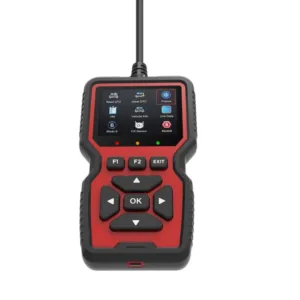
- Scan and Record: Use an obd2 scanner to confirm code P010E is present. Check for any related codes (e.g., P010A, P010B). Crucially, review and save the freeze frame data, which captures engine conditions (RPM, load, temperature) when the code set .
- Visual Inspection: Thoroughly inspect the MAF sensor, its wiring harness, and connectors. Look for corrosion, bent pins, loose connections, or physical damage to wires. Gently wiggle the harness and connectors while the engine is running to see if you can induce the fault.
- Check Live Data: Using a capable car code scanner that can display live data, monitor the MAF sensor readings, specifically for the “B” circuit if available. Look for the signal dropping to zero, spiking, or becoming unstable during idle and acceleration.
- Test Circuits and Sensor: With the ignition OFF, use a digital multimeter to check for continuity and resistance in the MAF sensor signal, reference voltage (5V), and ground wires. Look for high resistance or intermittent opens. Testing the sensor’s output per manufacturer specifications may require an oscilloscope to catch the erratic signal.
- Check for Vacuum/Intake Leaks: Inspect all intake hoses, clamps, and the intake manifold for cracks or leaks. A smoke machine is the most effective tool for this task.
Possible Causes and Diagnostic Methods
Possible Cause | How to Check? |
|---|---|
Intermittent Wiring/Connector Fault | Perform a thorough visual and physical inspection of the entire harness. Use a multimeter to perform a “wiggle test” on wires while monitoring resistance. |
Failing MAF Sensor | Monitor live MAF data with a car code reader while gently tapping the sensor. A change in readings indicates an internal fault. Substitution with a known-good sensor is a definitive test. |
Vacuum Leak | Listen for hissing sounds, use a smoke machine, or spray carburetor cleaner around intake gaskets and hoses while the engine is idling. A change in RPM indicates a leak. |
Dirty MAF Sensor | Remove the sensor and inspect the sensing element for contamination. Clean it carefully with MAF sensor cleaner (not other solvents). |
Faulty PCM | A last-resort diagnosis. Check for technical service bulletins (TSBs) related to PCM software updates. Swap the PCM only after exhaustive testing of all wiring and components. |
Required Tools: OBD2 code scanner, digital multimeter (DMM), basic hand tools, vehicle-specific wiring diagrams, MAF sensor cleaner, smoke machine (for leak testing, optional but recommended).
How to Fix Fault Code P010E? (Solutions)
Simple Fixes:
- Clean MAF Sensor: If the sensor is dirty, carefully clean it with specialized MAF sensor cleaner and allow it to dry completely before reinstalling.
- Repair Wiring/Connectors: Secure loose connectors. Clean corroded terminals with electrical contact cleaner. Repair any damaged wires with solder and heat-shrink tubing.
- Replace Air Filter: Install a new, clean air filter if the old one is clogged.
In-Depth Diagnosis and Repair:
- Replace the MAF Sensor: If cleaning and wiring repairs do not resolve the intermittent fault, replace the MAF sensor with a high-quality or OEM part.
- Repair Intake System Leaks: Replace any cracked hoses, tighten loose clamps, or repair leaking intake manifold gaskets.
- Update PCM Software: Check for manufacturer-released software updates (flash reprogramming) that may address sensor signal processing issues.
- Replace Wiring Harness: If the wiring damage is widespread, replacing a section of the harness may be necessary.
Troubleshooting by Symptom
Symptom | Likely Solution |
|---|---|
Check Engine Light comes on only during specific conditions (e.g., wet weather, rough roads). | Focus on wiring harness issues, likely a chafed wire that shorts intermittently or a connector susceptible to moisture. |
Engine runs fine most of the time but occasionally stumbles or hesitates. | Points to an intermittent sensor failure or a sporadic vacuum leak. Data logging with a scanner is key. |
Code clears but returns randomly after days or weeks. | Classic sign of an intermittent fault. Requires methodical checking of all connections and wiring, followed by component substitution. |
Common Vehicles with Fault Code P010E
- Toyota/Lexus (e.g., Camry, Prius, RX350): The hot-wire MAF sensors in these vehicles are notably susceptible to contamination from oil (often from a faulty PCV system) or aftermarket air filter oils . This contamination can cause erratic, intermittent signals. Cleaning may provide a temporary fix, but sensor replacement with an OEM unit is often the permanent solution.
- General Motors (GM) Vehicles (e.g., Chevrolet Silverado, GMC Sierra, Cadillac CTS): Some GM models, particularly those with active fuel management (AFM), may set P010E in conjunction with other codes. Engineering bulletins have noted issues with MAF sensor warranty returns showing “no fault found,” indicating challenging diagnostics often related to harness or connector issues rather than the sensor itself .
- Volkswagen/Audi (e.g., 2.0T TSI, TDI models): Known for specific wiring harness vulnerabilities. The wiring near the MAF sensor connector can become brittle and crack over time, leading to intermittent opens or shorts, especially in the “B” circuit . A thorough harness inspection is critical.
- BMW/MINI (e.g., N54, N55, B48 engines): The plastic intake ducts and charge pipes can develop hairline cracks or loose connections, creating intermittent vacuum leaks that cause erratic MAF readings . The turbocharged engines are highly sensitive to any unmetered air.

- Mercedes-Benz (e.g., M276, OM642 engines): May require MAF sensor calibration or adaptation after replacement using a factory-level scan tool. Intermittent faults can also stem from issues with the integrated intake air temperature (IAT) sensor within the MAF housing .
- Ford (e.g., F-150 EcoBoost, Mustang): The turbocharged engines place high demand on the MAF sensor. Intermittent faults are often traced to the sensor itself or oil contamination from the crankcase ventilation system coating the sensor element.
- Nissan/Infiniti (e.g., Altima, Maxima, Q50 with VQ engines): Service manuals emphasize checking for “uneven air flow” as a cause for MAF-related codes . This includes inspecting for crushed air ducts, improper air filter seals, and intake valve deposits, all of which can cause intermittent, turbulent airflow past the sensor.
- Dodge/Chrysler/Jeep Vehicles: Specific diagnostic procedures note that code P010E is enabled only after the ignition is on and a system voltage threshold is met for a set time (e.g., 0.5 seconds) . The causes are explicitly listed as opens, high resistance, or shorts in the MAF 2 signal or ground circuits.
- Older Vehicles (10+ years): Rubber intake and vacuum hoses can become brittle and develop intermittent cracks that open under certain engine loads or temperatures, leading to erratic MAF signals .
- Vehicles with Faulty PCV Valves or EGR Systems: A stuck-open EGR valve or a faulty Positive Crankcase Ventilation (PCV) valve can introduce unmetered or contaminated air into the intake stream, confusing the MAF sensor intermittently .
P010E Frequently Asked Questions
What does “intermittent/erratic” specifically mean for code P010E?
It means the signal from the MAF sensor’s “B” circuit is not stable. It may momentarily drop out (go to zero), spike, or fluctuate wildly outside the expected range before returning to normal. This is different from a consistent “low” or “high” signal fault.Is it safe to drive with a P010E code?
It is not recommended for extended driving. While the issue may be intermittent, when it occurs, the engine runs on incorrect data, which can cause poor performance, increased emissions, poor fuel economy, and potential long-term damage to the catalytic converter from incorrect fuel mixtures.What is the main difference between P010D and P010E?
P010D indicates a consistent “Circuit High” condition (signal voltage is constantly too high). P010E indicates an “Intermittent/Erratic” condition, where the signal is unstable and fluctuates between normal, low, and high states unpredictably.Can a dirty air filter cause P010E?
Yes, a severely clogged air filter can restrict airflow and cause turbulent, uneven airflow across the MAF sensor element, leading to erratic readings that may trigger P010E . Always inspect and replace the air filter as part of the diagnosis.How much does it cost to fix a P010E code?
Costs vary widely:- DIY (Cleaning/Simple Repair): 50 for cleaner and supplies.
- DIY (Sensor Replacement): 400 for the MAF sensor part.
- Professional Repair: 800+. Diagnostic time is higher for intermittent faults (1-3 hours at 200/hr) plus parts. Wiring repairs add to the cost.
Can I fix a P010E code myself?
Yes, if you are comfortable with basic automotive diagnostics. Start with a visual inspection, clean the MAF sensor and air filter, and check for obvious vacuum leaks. If the problem persists, you will need a multimeter and possibly a more advanced obd code reader for live data to trace the intermittent electrical fault.Why is an intermittent code like P010E harder to diagnose?
Because the fault is not always present. It may only occur under specific conditions (vibration, temperature, humidity). This requires data logging over a drive cycle or physically manipulating components (wiggle test) to reproduce the problem while monitoring live data.Will cleaning the MAF sensor fix P010E?
It might, if contamination is the sole cause. Use only MAF sensor cleaner. If cleaning temporarily fixes it but the code returns, the sensor is likely failing internally and needs replacement.Why does my P010E code come and go?
This is the hallmark of an intermittent fault. It’s caused by a loose connection, a wire that intermittently shorts due to vibration, a failing sensor that works sometimes, or a vacuum leak that only opens under certain engine loads or temperatures.Do I need to replace the MAF sensor for P010E?
Not necessarily. Always diagnose the wiring and connectors first, as they are the most common cause of intermittent faults. Only replace the sensor after confirming the wiring is good and the sensor itself is faulty.What should I focus on when checking the wiring?
Look for chafing where the harness rubs against the engine or body, corrosion inside connectors, loose pins, and broken wire insulation. Pay special attention to areas near heat sources or moving parts.Can a vacuum leak cause P010E?
Absolutely. A vacuum leak introduces unmetered air, causing the actual airflow to differ from what the MAF sensor measures. This discrepancy can be interpreted by the PCM as an erratic sensor signal .Will disconnecting the battery reset and fix P010E?
Disconnecting the battery will clear the code and turn off the Check Engine Light, but it will not fix the underlying problem. The code will almost certainly return once the PCM runs its diagnostics again and re-detects the intermittent fault.Should I take my car to a professional for P010E?
If you have performed basic checks (cleaning, visual inspection) and the code persists, or if you lack the tools (a good obd2 diagnostic scanner for live data, multimeter), then seeking professional help is advisable. Intermittent electrical faults can be time-consuming to diagnose.What other codes are commonly associated with P010E?
You may also see codes like P010A (MAF Sensor B Circuit), P010B (MAF Sensor B Circuit Range/Performance), P0171 (System Too Lean), or P0172 (System Too Rich), as the erratic airflow signal directly affects fuel trims.
Related OBD2 Fault Codes
- P010A – Mass Air Flow Sensor B Circuit
- P010B – Mass Air Flow Sensor B Circuit Range/Performance
- P010C – Mass Air Flow Sensor B Circuit Low Input
- P010D – Mass Air Flow Sensor B Circuit High Input
- P0101 – Mass Air Flow Sensor Circuit Range/Performance
Important Note!Code P010E signifies an elusive intermittent fault. The key to diagnosis is reproducing the problem. Use your obd2 scanner to monitor live data while driving or while performing a “wiggle test” on the wiring harness. Patience and a systematic approach are essential, as simply replacing the MAF sensor may not solve a wiring issue. Ignoring this code can lead to poor driveability and increased emissions.