
What Does Fault Code P0108 Mean?
Fault code P0108, applicable to all vehicle manufacturers, indicates “Manifold Absolute Pressure (MAP) Sensor Circuit High Input.”
Background: The Manifold Absolute Pressure (MAP) sensor measures the pressure inside the intake manifold. This data is critical for the Engine Control Module (ECM) to calculate the correct air-fuel mixture for optimal combustion, performance, and emissions. A “high input” signal means the voltage from the MAP sensor to the ECM is above the expected normal range, often indicating a short to voltage or a sensor failure .
Symptoms of Fault Code P0108
- Check Engine Light (MIL) illuminated on the dashboard.
- Poor engine performance, hesitation, or lack of power during acceleration.
- Rough idle, unstable RPM, or engine stalling.
- Noticeably increased fuel consumption.
- Black exhaust smoke (indicating a rich fuel mixture).
- The vehicle may enter a “limp mode,” limiting speed and power .
Main Causes of Fault Code P0108
- Faulty MAP Sensor: The sensor itself is defective, providing an incorrect high voltage signal.
- Wiring or Connector Issues: A short circuit to battery voltage (e.g., 12V) in the MAP sensor signal circuit or the 5-volt reference supply circuit .
- Open Ground Circuit: An open or high-resistance condition in the sensor ground circuit can cause the signal voltage to read high .
- Failed Engine Control Module (ECM/PCM): The ECM itself has an internal fault preventing it from correctly interpreting the sensor signal.
- Vacuum Supply Problem: A plugged or leaking vacuum hose/port connected to the MAP sensor can cause erroneous readings .
How to Diagnose Fault Code P0108?
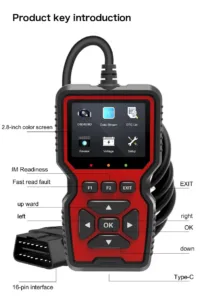
- Connect an OBD2 scanner to confirm the presence of code P0108 and check for any related codes.
- Record freeze frame data and monitor live data, specifically the MAP sensor voltage reading (should typically be below 4.7V with ignition on, engine off) .
- Perform a visual inspection of the MAP sensor, its electrical connector, and the associated wiring harness for damage, corrosion, or signs of chafing.
- Use a digital multimeter to test the MAP sensor circuits:
- Check for 5V reference voltage at the sensor connector.
- Check for continuity and low resistance (less than 5 ohms) on the ground circuit .
- Check the signal circuit for a short to battery voltage (12V) .
- Inspect the vacuum hose connected to the MAP sensor for cracks, leaks, or blockages.
- If possible, substitute the MAP sensor with a known-good unit to see if the fault clears.
Possible Causes and Diagnostic Methods
Possible Cause | How to Check? |
|---|---|
Wiring Short to Voltage | Use a multimeter to test the MAP signal circuit for continuity to battery positive (12V). |
Open Ground Circuit | Test resistance between the sensor ground terminal and a known good ground. Should be less than 5 ohms. |
Faulty MAP Sensor | Test sensor output voltage with a multimeter. With ignition ON (engine off), a reading consistently above 4.7V indicates a likely bad sensor . |
Bad Connector/Corrosion | Inspect the MAP sensor and ECM connectors for bent pins, moisture, or green corrosion. |
ECM/PCM Failure | Rule out all other causes first. Diagnose by checking if the 5V reference is correctly supplied and if the ground circuit is intact at the ECM pins. |
Required Tools: OBD2 scanner or car code reader, digital multimeter, basic hand tools, vehicle-specific wiring diagrams, smoke machine (optional for vacuum leak test).
How to Fix Fault Code P0108? (Solutions)
Simple Fixes:
- Clean the MAP sensor electrical connector and the sensor’s vacuum port.
- Repair minor wiring damage. If the signal wire is shorted to a 12V source, repair the insulation and reroute the wire.
- Replace a cracked or leaking vacuum hose. Clear the code with your obd code reader and test drive.
In-Depth Diagnosis and Repair:
- Replace the faulty MAP sensor. Ensure you get the correct OEM or high-quality aftermarket part.
- Repair damaged wiring harness. Locate and repair the short to voltage or the open ground circuit according to proper automotive standards.
- Fix vacuum leaks or blockages. Replace faulty hoses or clean out a plugged port on the intake manifold.
- Update or replace the Engine Control Module (ECM). This is a last resort after confirming all sensors and circuits are functional. Requires professional programming.
Troubleshooting by Symptom
Symptom | Likely Solution |
|---|---|
Check Engine Light on, poor acceleration | Diagnose for a short in the MAP sensor signal circuit or a faulty sensor. |
Rough idle, stalling, code returns after reset | Check for an open ground circuit or a failing ECM ground connection. |
Black smoke, high fuel consumption | MAP sensor is reporting incorrect high pressure, causing a rich mixture. Test sensor output. |
Common Vehicles with Fault Code P0108
- Volkswagen / Audi (Early 2000s models): Particularly prone to P0108 issues, often accompanied by rough idling. Common culprits are the MAP sensor itself or wiring harness problems due to age and heat exposure .
- BMW (Various models): The P0108 code indicates a high voltage signal from the MAP/Baro sensor circuit. Diagnosis involves checking the sensor, its wiring, and the Digital Motor Electronics (DME) module. A faulty sensor or a short in the wiring between the sensor and DME are typical causes .

- Mercedes-Benz: These vehicles may enter limp mode with this code. It’s crucial to check both the MAP sensor and the separate Barometric Pressure Sensor if equipped. Wiring issues in the engine bay are common .
- Chevrolet / GMC Trucks & SUVs (Silverado, Tahoe, Suburban, Yukon): For many GM vehicles, DTC P0108 sets when the BARO sensor signal voltage is excessively high (e.g., above 4.5V for 2 seconds) . Causes include a short to voltage on the signal circuit, an open ground, or a failed sensor.
- Ford Expedition (Ecoboost models): The turbocharged engines rely heavily on accurate MAP readings. A P0108 code can cause significant performance loss. Checking the turbocharger plumbing for leaks that could affect pressure readings is also recommended.
- Toyota Sequoia / Tundra: While known for durability, they can experience P0108 from a failing MAP sensor or, less commonly, from a poor electrical connection at the ECM .
- Chrysler/Dodge/Jeep vehicles: The official diagnostic procedure points to the 5-volt supply circuit being shorted to voltage, the MAP signal circuit being shorted to voltage, or an open/high resistance in the sensor ground circuit as primary causes .
- Older GM Cars (Buick Century/Regal, Pontiac Firebird/Trans Sport, Oldsmobile Silhouette): For these 1990s models, the diagnostic flowcharts are very detailed. A key step is checking if the MAP signal circuit is shorted to the 5V reference circuit or to battery voltage, which would require wiring repair .
P0108 Frequently Asked Questions
What exactly does the P0108 code mean?
It means your car’s computer (ECM) is seeing a voltage signal from the Manifold Absolute Pressure (MAP) sensor that is higher than the maximum expected value. This prevents the ECM from accurately calculating engine load and fuel needs.Is it safe to drive with a P0108 code?
You may drive short distances cautiously, but it is not recommended. The engine will not run efficiently, fuel economy will drop, and in many cars, performance will be severely limited (limp mode). Prolonged driving can potentially damage the catalytic converter due to a rich fuel mixture .Can I diagnose P0108 myself?
Yes, if you are comfortable with basic tools and a multimeter. Start by using a car code scanner to read the code. The most common fix—replacing the MAP sensor—is often straightforward. However, diagnosing electrical shorts or ECM issues requires more advanced skills.How much does it cost to fix a P0108 code?
Costs vary. A MAP sensor costs 250. DIY replacement might only cost the part. At a repair shop, with labor (300), expect to pay 500. If the issue is a wiring harness repair or an ECM replacement, costs can rise significantly to $800+.What’s the difference between P0107 and P0108?
P0107 indicates a “MAP Sensor Circuit Low Input” (voltage too low), while P0108 indicates a “High Input” (voltage too high). They are opposites but point to similar underlying systems: the sensor, its wiring, or its power/ground circuits.Can a vacuum leak cause P0108?
Typically, vacuum leaks cause a low pressure condition, which might trigger a P0107 (low input). However, a completely plugged or disconnected vacuum line to the MAP sensor could cause an abnormal reading, potentially leading to a P0108 depending on the sensor’s design and the ECM’s logic.How do I test a MAP sensor with a multimeter for P0108?
With the ignition ON (engine off), probe the sensor connector. You should find ~5V on the reference wire, ~0V on the ground (with good continuity), and a signal voltage. If the signal voltage is pinned high (e.g., 4.8V or 5V) and doesn’t change when you apply vacuum (with a hand pump), the sensor is likely faulty.Will disconnecting the battery clear P0108?
It may temporarily clear the code and turn off the Check Engine Light, but if the underlying electrical fault (like a short to voltage) is not repaired, the code will return immediately or after a short drive cycle.My car is in limp mode with P0108. What should I do?
Have the vehicle towed or carefully driven directly to a repair shop. Driving in limp mode for extended periods or under load can be stressful for the engine and transmission.Can a bad ECM cause P0108?
Yes, but it is less common. If the ECM’s internal circuitry for reading the MAP sensor signal is damaged, it could report a high voltage even if the sensor and wiring are perfect. This should only be suspected after all other components and circuits have been verified as good.
Related OBD2 Fault Codes
- P0106 – Manifold Absolute Pressure (MAP) Sensor Circuit Range/Performance Problem
- P0107 – Manifold Absolute Pressure (MAP) Sensor Circuit Low Input
- P0112 – Intake Air Temperature (IAT) Sensor Circuit Low Input
- P0113 – Intake Air Temperature (IAT) Sensor Circuit High Input
Important Note!P0108 is often an electrical fault, not just a bad sensor. Simply replacing the MAP sensor without checking for a short to voltage in the wiring may not fix the problem and will waste money. Always perform basic circuit tests with a multimeter. For complex electrical diagnostics, especially on modern European vehicles, consulting a professional with a high-end obd2 code scanner and wiring diagrams is highly recommended.