
What Does Fault Code P0116 Mean?
Fault code P0116, applicable to all vehicle manufacturers, indicates “Engine Coolant Temperature (ECT) Sensor Circuit Range/Performance Problem” . This generic powertrain code signifies that the vehicle’s Engine Control Module (ECM) or Powertrain Control Module (PCM) has detected that the signal from the Engine Coolant Temperature (ECT) sensor is outside the expected or plausible range for the current operating conditions .
Background:The Engine Coolant Temperature (ECT) sensor is a critical component typically threaded into the engine block or cylinder head, in direct contact with the engine coolant . It is a thermistor, meaning its electrical resistance changes with temperature. The ECM/PCM supplies a 5-volt reference signal to the sensor and monitors the returning voltage to calculate the coolant temperature . This data is vital for numerous engine management functions, including fuel mixture calculation, ignition timing, idle speed control, and electric cooling fan operation . Code P0116 is set when the ECM/PCM determines that the ECT sensor’s signal is irrational or does not change as expected compared to other inputs, such as the Intake Air Temperature (IAT) sensor, especially after a cold start .
Symptoms of Fault Code P0116
- Illuminated Check Engine Light (MIL) .
- Poor fuel economy due to incorrect fuel mixture .
- Engine overheating or inaccurate temperature gauge readings .
- Hard starting, particularly when the engine is cold .
- Rough idling, engine hesitation, or stalling .
- Black or dark exhaust smoke from an overly rich fuel mixture .
- Engine may run fine once fully warmed up, with symptoms most noticeable during warm-up .
Main Causes of Fault Code P0116
- Faulty Engine Coolant Temperature (ECT) Sensor: The sensor itself can fail internally, providing a static, skewed, or out-of-range signal .
- Wiring or Connector Issues: Damaged, frayed, corroded, or loose wires and connectors in the ECT sensor circuit can cause high resistance, shorts, or open circuits .
- Low Engine Coolant or Coolant Leaks: Insufficient coolant around the sensor can cause it to read inaccurately .
- Faulty Thermostat: A thermostat stuck open can prevent the engine from reaching normal operating temperature, causing a rationality fault when compared to other sensors .
- Faulty Intake Air Temperature (IAT) Sensor: Since the ECM compares ECT and IAT readings, a faulty IAT sensor can cause a false P0116 code .
- Faulty Engine Control Module (ECM/PCM): In rare cases, the computer itself may have an internal fault .
How to Diagnose Fault Code P0116?
- Connect an OBD2 scanner to read and confirm code P0116. Check for any related codes (e.g., P0115, P0117, P0118) and review freeze frame data to see the conditions when the code set .
- Perform a visual inspection of the ECT sensor and its wiring harness. Look for corrosion, damage, or coolant leaks at the sensor .
- Check the engine coolant level and condition. Top up or flush the coolant if necessary .
- With the engine cold and key on, use a car code reader capable of displaying live data to monitor the ECT sensor reading. It should closely match the ambient temperature. Start the engine and watch the temperature rise steadily to the thermostat opening point (typically around 195°F / 90°C) .
- Use a digital multimeter to test the sensor’s resistance. Compare the ohms reading at a specific coolant temperature to the manufacturer’s specifications. A common test is to check resistance when cold and when hot .
- Test the sensor’s wiring circuit for the correct 5-volt reference signal, a good ground, and continuity in the signal wire back to the ECM .
Possible Causes and Diagnostic Methods
Possible Cause | How to Check? |
|---|---|
Faulty ECT Sensor | Test with a multimeter: measure resistance when cold and hot, comparing to specifications. Monitor live data with a scan tool for erratic or static readings . |
Wiring/Connector Issue | Visually inspect for damage. Use a multimeter to check for 5V reference at the connector (key on, engine off), check ground continuity, and test the signal wire for shorts/opens . |
Low Coolant/Coolant Leak | Check the coolant reservoir and radiator level when cold. Inspect for leaks around the sensor, hoses, radiator, and water pump . |
Faulty Thermostat | Monitor live ECT data. The temperature should rise steadily to a point (e.g., 195°F), then drop slightly and stabilize as the thermostat opens. If it rises very slowly or never reaches operating temp, the thermostat may be stuck open . |
Faulty IAT Sensor | Use a scan tool to compare live data from the IAT and ECT sensors after the vehicle has sat overnight. They should read within a few degrees of each other . |
Faulty ECM/PCM | Diagnose only after ruling out all sensor, wiring, and cooling system issues. May require professional reprogramming or replacement . |
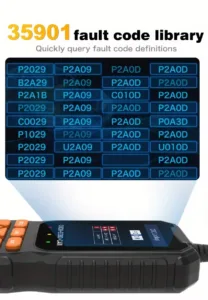
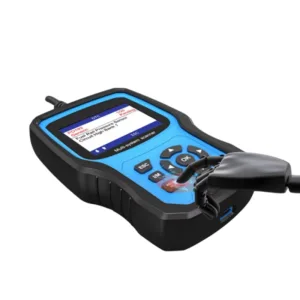
Required Tools: OBD2 scanner or car code scanner (for reading codes and live data), digital multimeter (DMM), basic hand tools, infrared temperature gun (optional, for verification).
How to Fix Fault Code P0116? (Solutions)
Simple Fixes:
- Top Up Coolant: If low, refill the cooling system with the correct type of coolant and bleed any air pockets .
- Clean Connectors: Disconnect the ECT sensor connector, clean any corrosion with electrical contact cleaner, and reconnect securely .
- Repair Wiring: Repair any damaged wires with solder and heat shrink tubing. Replace corroded connectors .
- After repairs, clear the codes with your obd code reader and perform a test drive to see if the code returns.
In-Depth Diagnosis and Repair:
- Replace the ECT Sensor: If testing confirms a faulty sensor, replace it. Be sure to refill coolant as needed and bleed the cooling system .
- Replace the Thermostat: If diagnostics point to a stuck-open thermostat, replace it and the coolant .
- Replace the IAT Sensor: If the IAT sensor is found to be faulty, replace it .
- In the rare event of a faulty ECM, professional reprogramming or replacement is required .
Troubleshooting by Symptom
Symptom | Likely Focus Area |
|---|---|
Check Engine Light on, but drives fine | Early-stage sensor failure or intermittent wiring issue. Monitor live data . |
Poor fuel economy and rough idle | Faulty ECT sensor providing a constantly “cold” signal, causing a rich fuel mixture . |
Hard cold starting | ECT sensor telling the ECM the engine is warm when it’s actually cold, preventing proper cold-start enrichment . |
Engine overheats or temperature gauge reads incorrectly | ECT sensor providing a false “cold” reading, preventing cooling fans from activating or misleading the driver . |
Black exhaust smoke | Severe case of a faulty “cold” signal, causing excessive fuel injection . |
Fault Code P0116 in Common Vehicles
- Toyota/Lexus (e.g., Corolla, Camry, Sienna): Prone to P0116 from failing ECT sensors and wiring connector issues. The sensor is often located near the thermostat housing .
- Honda/Acura (e.g., Accord, Civic, CR-V): Common causes include faulty ECT sensors and cooling system issues. Live data monitoring is key for diagnosis .
- Ford (e.g., Fusion, F-150, Escape): Frequently experiences P0116 due to ECT sensor failures, particularly in models like the 2010-2016 Fusion .
- General Motors (Chevrolet, GMC, Buick, Cadillac): GM vehicles have specific diagnostic logic comparing ECT and IAT sensors after a long ignition-off period. Wiring issues and sensor failures are common .
- Chrysler/Dodge/Jeep: Similar to GM, these vehicles use rationality checks between sensors. Faulty sensors and corroded connectors are typical culprits .
- Nissan/Infiniti: ECT sensor failures and related wiring problems can trigger P0116.
- Hyundai/Kia: Commonly sets P0116 due to failing ECT sensors or low coolant levels.
- BMW: The ECT sensor is critical for engine management. Failures can lead to poor performance and overheating.
- Mercedes-Benz: Sensitive to accurate temperature readings. Faults often stem from the sensor itself or wiring harness issues.
- Subaru: ECT sensor failures are common and can cause significant drivability issues.
- Volkswagen/Audi: Prone to electrical gremlins; P0116 often points to wiring faults or a failing sensor.
P0116 Frequently Asked Questions
What is the first thing I should check when I get a P0116 code?
First, use an obd2 code scanner to confirm the code and check freeze frame data. Then, visually inspect the ECT sensor and its wiring connector for obvious damage or coolant leaks .Can I drive my car with a P0116 code?
You may drive for a short time, but it is not recommended . The engine may run poorly, overheat, or suffer from reduced fuel economy. Driving for extended periods can potentially cause engine damage .Is a P0116 code serious?
It is considered a moderate to serious code . While the car may still run, incorrect temperature data can lead to poor performance, increased emissions, overheating, and long-term engine damage.How much does it cost to fix a P0116 code?
Repair costs typically range from 300 USD. The ECT sensor itself usually costs between 100. Labor adds 200, depending on the vehicle and shop rates.Can a bad thermostat cause a P0116 code?
Yes, a thermostat stuck open can prevent the engine from warming up properly. The ECM expects to see a certain rate of temperature increase; if it doesn’t happen, it can set a P0116 code .Can I test an ECT sensor with a multimeter?
Yes. Measure its resistance (ohms) when the engine is cold and compare it to the resistance when the engine is hot. The resistance should drop significantly as temperature increases. Refer to a vehicle-specific resistance chart .Will disconnecting the battery clear a P0116 code?
It may clear the code temporarily, but it will return once the ECM completes its monitoring cycle if the underlying problem is not fixed .My car has P0116 and is overheating. Could it be something else?
Yes. While P0116 points to a sensor circuit issue, the overheating itself could be caused by a separate problem like a clogged radiator, failed water pump, or a blown head gasket. The faulty sensor might just be reporting the overheating accurately.How do I know if it’s the sensor or the wiring?
Use a multimeter to check for 5 volts at the sensor connector (key on, engine off). If voltage is present, unplug the sensor and measure its resistance. If the resistance is within spec for its temperature, the wiring or ECM is likely at fault. If no voltage is present at the connector, there is a wiring or ECM problem .What tools do I need to diagnose P0116 myself?
You will need an OBD2 scanner or a dedicated car code reader capable of reading live data, a digital multimeter, basic hand tools, and possibly a infrared thermometer to verify actual coolant temperature .
Related OBD2 Fault Codes
- P0115: Engine Coolant Temperature (ECT) Sensor Circuit Malfunction.
- P0117: Engine Coolant Temperature (ECT) Sensor Circuit Low Input.
- P0118: Engine Coolant Temperature (ECT) Sensor Circuit High Input .
- P0125: Insufficient Coolant Temperature for Closed Loop Fuel Control – Often related to a thermostat stuck open .
- P0128: Coolant Thermostat (Coolant Temperature Below Thermostat Regulating Temperature) .
Important Note!Code P0116 indicates a rationality or performance issue with the cooling temperature sensor circuit. The problem is not always the sensor itself; it can be caused by low coolant, a faulty thermostat, or wiring problems . Using a quality OBD2 scanner to monitor live data is crucial for an accurate diagnosis. Never ignore this code, as incorrect engine temperature data can lead to poor performance, increased emissions, reduced fuel economy, and potentially severe engine damage from overheating.