
The Short Answer: Yes, absolutely. Using a pressure washer (or car wash gun) with excessive pressure or incorrect technique is one of the most common ways DIY car washers inadvertently cause permanent damage to their vehicle’s paint, trim, and seals. The key is understanding that it’s not just about power, but about pressure, distance, and technique.
Detailed Guide: How Pressure Washers and Car Wash Guns Can Harm Your Car & How to Use Them Safely
1. How Damage Occurs: The Mechanics of Paint Stripping
Modern clear coat paint is durable but not invincible. Here’s how a high-pressure stream from a car wash gun causes harm:
- Direct Abrasion & Peeling: A concentrated jet of water exceeding the paint’s adhesion strength can literally chip, peel, or etch the clear coat and underlying paint layers. This often appears as fine lines, dull spots, or “crazing” in the clear coat.
- Forcing Contaminants: Instead of blasting dirt off, excessive pressure can embed abrasive particles (sand, road grit) into the soft paint surface, creating swirl marks and scratches as you move the wand.
- Water Intrusion: High-pressure water can be forced past door seals, window trim, and around emblems. This leads to interior leaks, moisture in electrical components, and accelerated rust formation in panel gaps.
- Damage to Trim & Molding: Plastic trim, rubber seals, and vinyl graphics can be torn, deformed, or completely stripped off by a direct high-pressure blast.
2. The Critical Numbers: What Pressure is Safe?
- Danger Zone (High Risk): > 2,200 PSI (150 Bar). Industrial and some high-end electric models operate here. Never use these directly on your car’s body.
- Caution Zone (Requires Care): 1,800 – 2,200 PSI (124-150 Bar). Many gas-powered and strong electric units. Can cause damage if used too close or with a narrow nozzle.
- Safe & Recommended Zone (Ideal): 1,200 – 1,800 PSI (83-124 Bar). This is the sweet spot for most electric pressure washers and car wash guns designed for automotive use. It provides ample cleaning power without excessive risk.
- Key Takeaway: For car washing, a machine rated around 1,400-1,600 PSI with adjustable settings is ideal. The flow rate (GPM – Gallons Per Minute) is equally important; higher GPM (e.g., 1.8-2.0+) helps rinse away foam and dirt more effectively at a safer pressure.
3. Essential Safety Gear, Nozzle, & Car Wash Gun Selection
The nozzle on your car wash gun is your most important control. Never use the red 0-degree (pinpoint) nozzle on your car.
- 40° White Nozzle (Wide Fan): The safest for pre-rinse and final rinse. Provides a gentle, wide spray.
- 25° Green Nozzle (General Wash): A good balance for cleaning wheels, tires, and very dirty lower panels if kept at a distance.
- Foam Cannon/Lance (Essential): This attaches to your washer or car wash gun and is the #1 tool for paint safety. It applies a thick layer of shampoo foam that lubricates the surface, encapsulating dirt so it can be rinsed away without the need for high-pressure scrubbing.
4. Step-by-Step Safe Washing Technique with a Car Wash Gun
- Pre-Rinse: Use the 40° white nozzle from at least 2-3 feet (60-90 cm) away to loosen surface dirt.
- Apply Foam: Use your foam cannon attached to your car wash gun with a pH-neutral car wash shampoo to coat the entire vehicle. Let it dwell for 3-5 minutes to loosen grime.
- Contact Wash: Hand wash using the “two-bucket method” (one for soapy water, one with a grit guard for rinsing your mitt). The pressure from the car wash gun has done its job; now let the microfiber mitt gently lift the lubricated dirt.
- Final Rinse: Again, use the 40° nozzle on your car wash gun from a distance to rinse off soap.
- Wheels & Tires: Use a dedicated wheel brush and cleaner. You can use a 25° nozzle on stubborn brake dust, but keep the car wash gun moving and maintain distance.
- Dry: Use a soft, clean microfiber drying towel or a leaf blower to avoid water spots. Do not let water air-dry on hot paint.
5. Areas to Avoid or Use Extreme Caution
- Directly spray with the car wash gun: Decals, badges, side mirrors, window edges, convertible tops, rock chips, cracked paint, antennas, and sensors (parking sensors, radar cruise control).
- Always keep the car wash gun moving. Holding it in one spot is a guaranteed way to damage paint.
- Never use a car wash gun on the engine bay unless you are a professional who knows how to meticulously protect sensitive electronics, alternators, and intake systems.
6. Recommended Equipment for the DIYer
- Pressure Washer / Car Wash Gun: Looking for a handheld car wash gun like the Lithium Battery Portable High Pressure Car Washing Machine.
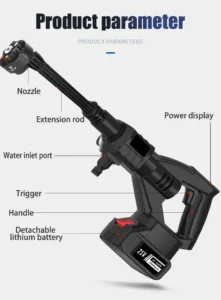
- Nozzle: Use the included 40° or 25° nozzles, or invest in an adjustable nozzle for more control for your car wash gun.
- Must-Have Accessory: A quality foam cannon that fits your car wash gun.
- Detergent: Always use car-specific shampoo. Never use dish soap or degreasers.
Conclusion
A car wash gun (pressure washer) is a fantastic tool for efficient car washing when used correctly. The goal is to use minimal necessary pressure and maximize chemical lubrication (foam) and mechanical agitation (wash mitt). By choosing a machine with appropriate pressure (~1500 PSI), always using a wide-angle nozzle on your car wash gun, maintaining a safe distance, and relying on a foam pre-wash, you can achieve a brilliant clean with zero risk of damaging your car’s paint and components.
Remember: If you have to get uncomfortably close with your car wash gun to remove dirt, your pressure is too high or your pre-wash foam isn’t doing its job. Adjust your process, not your proximity.