
What is the P00B1 Fault Code?
The P00B1 fault code, applicable to all vehicle manufacturers, stands for “Radiator Coolant Temperature Sensor Circuit.”
Background Knowledge: The radiator coolant temperature sensor uses the principle of a thermistor to transmit the radiator temperature signal as a voltage to the Engine Control Unit (ECU). This fault code appears if the ECU detects that the radiator coolant temperature sensor signal voltage is outside the calibrated normal range.
P00B1 OBD II Trouble Code Symptoms
Symptoms of the P00B1 diagnostic code may include:
- Difficult cold starts
- Unstable idle
- Engine stalling
- Poor fuel efficiency
- Smoky exhaust
- Symptoms of a fuel odor
- Erratic or false temperature readings
- Poor engine performance
Common Causes of the P00B1 OBD II Trouble Code
Causes of this code may include:
- Faulty radiator or other coolant temperature sensor (CTS)
- Dirty/clogged sensor pickup
- Leaking sensor O-ring/gasket
- Broken or damaged wiring harness
- Blown fuse
- Electronic interference issues
- Pin/connector problems (corrosion, melting, broken lock tab, etc.)
Diagnosing Code P00B1
Diagnosing P00B1 requires a systematic approach to rule out common causes. Here are general steps applicable to most vehicles:
- Visual Inspection: Check all wiring and connectors around the coolant temperature sensor for damage, corrosion, or loose connections.
- Verify Sensor Installation: Ensure the sensor is properly installed and seated securely in its housing.
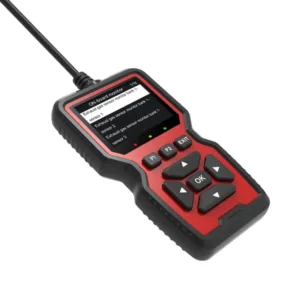
- View Live Data: Use an OBD2 scanner to observe the coolant temperature sensor reading during engine warm-up and operation to identify anomalies.
- Test Electrical Continuity: Use a multimeter to check wiring continuity and proper grounding of the sensor circuit.
- Measure Sensor Resistance: With the engine off, test the sensor’s resistance at different temperatures if OEM specifications are available.
- Check ECU Connection: Confirm the ECU wiring harness and connections are intact, with no corrosion or damage.
- Scan for Additional Codes: Check for other related fault codes that may provide context.
Possible Repairs for Code P00B1
The repair procedure varies based on the root cause determined during diagnosis. Common repairs include:
- Replace the Coolant Temperature Sensor: A simple and typically basic repair, often performed by a professional or experienced DIYer.
- Repair or Replace Damaged Wiring or Connectors: Restoring proper electrical continuity and ensuring secure connections requires some mechanical skill.
- Clean or Replace Connectors: Removing corrosion or debris to restore proper contact.
- Inspect and Repair the Cooling System: If cooling system components are compromised, a thorough repair should be performed, preferably by a professional technician.
- Reprogram or Replace the ECU: In rare cases, if an internal fault is suspected, the ECU may need to be reflashed or replaced.
Professional diagnosis is recommended to ensure the correct cause is accurately identified and fixed.
Common Misdiagnosis or Improper Repairs for Code P00B1
- Neglecting to Check Wiring and Connectors: Focusing only on the sensor without checking electrical connections can overlook simple issues.
- Premature Sensor Replacement: Installing a new sensor without verifying wiring or circuit integrity can lead to ongoing problems.
- Ignoring Other Related Codes: Failing to review additional fault codes may cause one to overlook underlying causes affecting multiple systems.
- Overlooking Environmental Factors: External factors like battery health or electrical interference can affect sensor signals, leading to false readings.
- Skipping Live Data Testing: Relying solely on code reading without observing live sensor data can lead to misdiagnosis.
Adhering to a structured, evidence-based approach helps ensure a lasting repair and prevents recurrence of the problem.
You may need some of the following tools: OBD Code Reader, Antifreeze/Coolant, Drain Pan, Multimeter, Basic Socket Set, Basic Ratchet Set, Basic Screwdriver Set, Battery Terminal Cleaner, Service Manual.
Vehicles Commonly Affected by Code P00B1
This fault code is relatively common across multiple makes and models equipped with electronic coolant temperature sensors.
- General Motors (Buick, Cadillac, Chevrolet, GMC): Listed as “Radiator Coolant Temperature Sensor Circuit.”
- Volkswagen Group: VW, Audi, SEAT, Škoda – especially with TDI and TFSI engines.
- Ford: Models with modern ECUs and radiator systems.
- Mercedes-Benz: Diesel and gasoline engines with electronic coolant sensors.
- BMW: Various engine series where engine temperature regulation is electronically monitored.
While P00B1 can appear in multiple models, the specific issues and repair procedures must always follow OEM recommendations.
Frequently Asked Questions About Code P00B1
How severe is the P00B1 code?
This code is viewed as a moderately severe issue. The CTS’s function directly impacts the engine’s air-fuel ratio, making it a problem you should not ignore. If neglected, you could face high engine repair costs.
Can this code disappear on its own?
Yes, in some cases, electrical glitches or temporary communication errors can cause the code to clear on its own. However, persistent issues usually require attention.
Is it safe to drive with it?
Many vehicles can be driven with this warning as the ECU will revert to default values, but prolonged driving without addressing the root cause can lead to engine damage or degraded emissions performance.
Why does the code return after clearing?
If the underlying circuit issue, such as damaged wiring or a faulty sensor, is not repaired, the code will typically return on subsequent drive cycles when the ECU rechecks the signals.
How much does it cost to diagnose the P00B1 code?
Diagnosing the P00B1 code typically requires about 1.0 hour of labor. Rates vary by location, vehicle, and repair shop. Many shops charge between 150 per hour; dealerships and metropolitan areas may charge more, independents possibly less.
Related P00B1 Fault Codes:
P00B1 is just one of many OBD-II fault codes that can indicate a problem with your car’s engine. If you receive this code, be sure to have it diagnosed and repaired by a qualified technician to ensure your vehicle is in optimal condition. Understanding what the specification means and its causes will better equip you to understand the issue and explain it to a mechanic with more confidence.