
What is the P00B0 Fault Code?
The P00B0 fault code, applicable to all vehicle manufacturers, stands for “Turbocharger/Supercharger Boost Control B Module Performance.”
Background Knowledge: A turbocharger uses the inertia of exhaust gases to drive a turbine, which in turn drives a co-axial impeller to pressurize the intake air, thereby increasing engine power. A supercharger is an air compressor that forces more air into an internal combustion engine. More air intake provides more oxygen to the engine, allowing the control module to deliver more fuel, thus increasing power output. The function of the turbo/supercharger boost controller is to divert some exhaust gas away from the turbine when boost pressure reaches the target value, typically by actuating a wastegate (pneumatic/mechanical), thereby reducing turbine speed and controlling boost levels. This fault code indicates a malfunction in the Turbo/Supercharger Boost Control B Module.
P00B0 OBD II Trouble Code Symptoms
- Poor, erratic, and/or abnormal power
- Poor overall driving performance
- Reduced throttle response
- Trouble driving uphill
- Vehicle entering “limp” mode (i.e., fail-safe)
- Intermittent driving symptoms
Common Causes of the P00B0 OBD II Trouble Code
- Defective or damaged boost control solenoid (e.g., stuck, broken, bent lever, etc.)
- High resistance due to corrosion (e.g., connectors, pins, ground, etc.)
- Wiring problems (e.g., chafing, open circuit, short to power, short to ground, etc.)
- Internal issue with the ECM (Engine Control Module)
- Excessive exhaust soot inside the boost vane, causing boost levels to be stuck, low, or incorrect
- Boost control module issue
- Exhaust leak
Diagnosing Code P00B0
- Visually inspect the intake system, hoses, intercooler piping, and wiring harness for signs of damage, leaks, or disconnections.
- Check for other DTCs that may provide clues or indicate multiple issues.
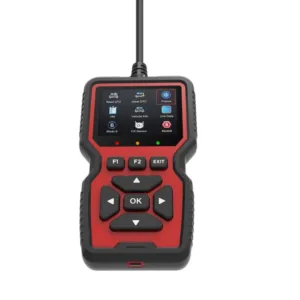
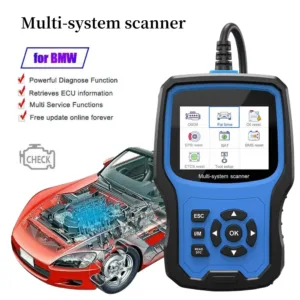
- Use an OBD2 scanner to view live data—monitor boost pressure readings, sensor voltages, and actuator response while the engine is running.
- Inspect the wiring and connectors of the boost pressure sensor for corrosion or damage. Test the sensor’s resistance with a multimeter if specifications are available.
- Test the operation of the boost control solenoid via the scanner’s command test, or perform continuity and power supply voltage checks.
- Perform a smoke test or leak test on the intake system to identify leaks that could affect boost pressure.
- Check the Engine Control Module (ECU) for software updates or internal faults if necessary.
Possible Repairs for Code P00B0
- Replace the Boost Pressure Sensor: A relatively easy repair with basic tools, suitable for most DIYers.
- Repair or Replace the Boost Control Solenoid: Typically involves removal and installation of a new solenoid, usually done by a professional.
- Seal or Replace Damaged Intake Piping or Intercooler Hoses: A basic repair for most skilled mechanics or DIYers with basic tools.
- Address Wiring or Connector Problems: Clean, repair, or replace damaged wiring harnesses or connectors.
- Reprogram or Update the ECU: Done using manufacturer-specific diagnostic tools and software.
- Replace or Overhaul the Turbocharger or Supercharger: A complex repair usually requiring professional skills and equipment.
Common Misdiagnosis or Improper Repairs for Code P00B0:
- Overlooking subtle sensor fluctuations: Leads to delayed repair and worsening symptoms.
- Replacing parts without proper testing: Buying parts based solely on symptoms, not diagnosis, can increase costs without fixing the root cause.
- Overlooking intake leaks or mechanical damage: These often cause boost pressure issues but are sometimes missed in initial diagnostics.
- Resetting the code without addressing the root problem: The code is likely to return without solving the underlying cause.
Vehicles Commonly Affected by Code P00B0
- Volkswagen Group (e.g., VW Golf, Audi A3, Škoda Octavia, SEAT León) – typically with TSI, TFSI, or TDI engines.
- Ford (e.g., Focus, Fiesta with EcoBoost engines)
- Mercedes-Benz (e.g., A-Class, C-Class with turbocharged gasoline engines)
- BMW (e.g., 3 Series, 5 Series with TwinPower Turbo engines)
Frequently Asked Questions About Code P00B0
How severe is the P00B0 code?
Severity is set to Medium-High. It is important to diagnose and address P00B0 promptly, as reliance on the turbocharger or supercharger system is crucial for vehicle performance, fuel efficiency, and emission control.
Can this code disappear on its own?
In most cases, no. The code will typically persist until the fault is repaired. However, occasional transient electrical glitches or sensor faults might temporarily clear the code, but it is very likely to reappear if unresolved.
Can I drive with this code?
While it may be possible to drive, it is not recommended for extended periods. The vehicle may enter limp mode or have reduced performance. Addressing the issue promptly helps prevent further damage and restores optimal function.
Why does the code return after clearing?
The root cause remains—such as a faulty sensor, leak, or actuator failure—which triggers the ECU to detect abnormal boost pressure again. Therefore, addressing the underlying problem is essential to prevent recurrence.
How much does it cost to diagnose the P00B0 code?
Diagnosing the P00B0 code typically requires about 1.0 hour of labor. Rates vary by location, vehicle, and repair shop. Many shops charge between 150 per hour; dealerships and metropolitan areas may charge more, independents possibly less.
Related P00B0 Fault Code:
- P00AF: Turbocharger/Supercharger Boost Control A Module Performance
P00B0 is just one of many OBD-II fault codes that can indicate a problem with your car’s engine. If you receive this code, be sure to have it diagnosed and repaired by a qualified technician to ensure your vehicle is in optimal condition. Understanding what the specification means and its causes will better equip you to understand the issue and explain it to a mechanic with more confidence.