
Rinsing Your Vehicle: Key Distances, Angles, and Operational Guide
Using the correct distance and angle when rinsing your vehicle with a pressure washer is crucial for effective cleaning and paint protection. The table below summarizes the key operational parameters and recommendations.
Operation Stage | Recommended Distance | Recommended Angle | Key Points & Explanation |
|---|---|---|---|
Main Body Rinsing | 15 – 30 cm | Approx. 45 degrees | This is the general safe distance for uniform water flow and avoiding paint damage . A 45-degree angle helps disperse water impact, removes dirt more effectively, and reduces the risk of damaging the clear coat . |
Wheels/Tires Rinsing | Can be slightly closer, with caution | Adjustable | These areas are dirtier and more resistant, allowing for slightly closer rinsing . Avoid prolonged stationary blasting on one spot. |
Fragile Areas Rinsing (e.g., lights, cameras, emblems) | Maintain safe distance | Adjustable | Do not directly impact fragile areas like charging ports, electronic components in the front compartment, cameras, or radar sensors with a high-pressure jet to prevent water ingress and malfunctions . Use a wet cloth for wiping instead. |
Operational Tips and Misconceptions
Understanding the principles behind these parameters and common mistakes can significantly improve your washing results.
- Keep the Water Moving: Always keep the nozzle moving steadily and consistently during rinsing. Avoid holding it in one spot for too long .
- Follow the Rinsing Sequence: Adopt a “top-to-bottom” sequence . Start from the roof, windshield, and engine hood, then move to the body sides, and finally address the wheels and undercarriage. This prevents dirty water from flowing down and re-contaminating already cleaned areas .
- Misconception: Closer = Cleaner: This is a common mistake. Holding the nozzle too close concentrates the full water pressure on a tiny area, which can easily scratch the clear coat and paint .
- Misconception: Vertical Spray is Best: A perpendicular (90-degree) spray doesn’t allow water to sheet off effectively, potentially reducing cleaning efficiency and concentrating impact force. A 45-degree angle allows the water to act like a squeegee, cleaning the surface more effectively .
Other Influencing Factors
Beyond distance and angle, several other factors affect the rinsing outcome:
- Water Pressure Selection: For home car wash guns, a pressure range of 40-80 bar is common and suitable . Use slightly higher pressure for initial pre-rinse or heavy soil, and medium pressure for the main rinse or for maintained vehicles .
- Nozzle Pattern: Use a fan nozzle for large body panels due to its wider, softer spray pattern . For stubborn grime in tire grooves, a direct jet stream can be used briefly for targeted cleaning, but exercise extreme caution and keep the nozzle moving .
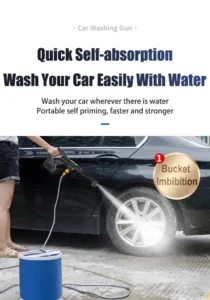
Brief Recap
The key to properly rinsing your vehicle lies in maintaining a distance of 15-30 cm and an angle of approximately 45 degrees, while always remembering the “top-to-bottom” sequence and keeping the water stream moving. Adjust your approach flexibly for different areas like wheels, the main body, and fragile zones .