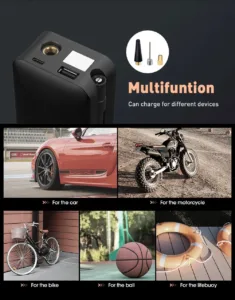
Foot Pump vs. Portable Electric Air Pump: Inflation Speed Comparison
The difference in inflation speed between foot-operated air pumps and portable electric tire inflators is indeed quite significant, mainly due to their different working principles.To help you quickly grasp the core differences, the key information is summarized in the table below.
Comparison Aspect | Foot Pump (Human-Powered) | Portable Electric tire inflator (Motor-Driven) |
|---|---|---|
Working Principle | Relies entirely on the user’s foot pressure to compress air into the tire. | Uses an electric motor to automatically compress air and provide continuous output. |
Typical Inflation Speed (Car Tire) | Slower, labor-intensive, and time-consuming; suitable for minor top-ups. | Fast. For example, some models can increase car tire pressure from 2.0 Bar to 2.5 Bar in about 35 seconds. |
Typical Inflation Speed (Bike Tire) | Speed depends on user stamina; relatively slow. | Very fast. Some models can fully inflate a bicycle tire in about 15 seconds, or reach 80 PSI in about 1 minute. |
Factors Affecting Speed | User’s physical strength; pump’s structural design (e.g., single or dual-cylinder). | Motor power (e.g., 74W or 108W); cylinder design (single/dual-cylinder); battery level. |
Pros | No power source needed, suitable for outdoor emergencies; usually more affordable. | Effortless and efficient, stable speed; often features smart functions like preset pressure and auto-stop. |
Cons | Slow, labor-intensive, can cause fatigue with prolonged use. | Dependent on a power source (car outlet or built-in battery); high-quality models can be more expensive. |
How to Choose the Right Pump for You
Understanding the speed differences allows you to decide based on your primary usage scenarios:
- Prioritize a foot pump if:
- You have a very low frequency of use, only needing an occasional top-up.
- You have a limited budget and seek the best cost-effectiveness.
- You are often in environments completely without a power source and need an absolutely reliable emergency tool.
- Prioritize a portable electric air pump if:
- Inflation efficiency and effortlessness are your top priorities.
- You need to frequently inflate car tires or multiple devices (e.g., bicycles, sports balls).
- You desire a more convenient experience with features like preset tire pressure, auto-stop, LED lighting, etc.