
What is Fault Code P0084?
Fault code P0084 applies to all vehicle manufacturers and means “Exhaust Valve Control Solenoid Circuit (Bank 2).”
Background Knowledge: The camshaft’s function is to control the opening and closing of the valves. In variable valve timing systems, the electronic camshaft adjustment valve (or oil control valve, OCV) adjusts the camshaft angle by changing the oil pressure to the camshaft adjuster (mechanical) based on instructions from the Engine Control Module (ECM), ensuring the valves open and close at the optimal time. This fault code appears if the exhaust camshaft adjustment valve circuit voltage exceeds the calibrated maximum range.
Symptoms of Fault Code P0084
- Check Engine light is on
- Increased fuel consumption
- Reduced engine power
- Poor dynamics during acceleration
- Unstable engine idle
- Increased emissions
Main Causes of Fault Code P0084
- VVT solenoid valve failure (Bank 2)
- Damaged or broken wiring
- Corroded connectors or poor contact
- Ground fault
- Engine Control Unit (ECU) failure
- Valve contamination due to wear products
How to Diagnose Fault Code P0084?
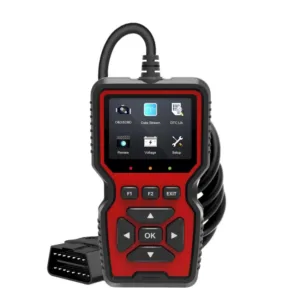
- Connect the OBD2 scanner to the OBD2 port and read the trouble codes.
- Check for other faults that may be related to the engine management system.
- Visually inspect connectors and wiring for damage, dirt, or corrosion.
- Measure resistance at the valve contacts and check voltage at the ECU control output.
- If necessary, replace the valve or repair damaged wiring sections.
Possible Causes and Diagnostic Methods
Possible Cause | How to Check? |
|---|---|
Solenoid valve failure | Check resistance, test with applied voltage |
Damaged wiring | Visual inspection, continuity test with tester |
ECU problem | Output signal test, diagnostic scanner analysis |
Poor connector contact | Clean, reconnect, load test |
Tools Needed: OBD2 diagnostic scanner, multimeter, wiring test kit (probes, clips), automotive technical documentation (wiring diagrams), contact cleaner
How to Fix Fault Code P0084? (Troubleshooting Methods)
Simple Repair Methods
- Clean and reinstall the valve connector.
- Reset the fault code with a scanner if it only appears once.
- Check and press the contacts firmly.
In-Depth Diagnosis and Repair Plan
- Replace the faulty exhaust valve control solenoid.
- Replace damaged wiring or connectors.
- Reprogram or replace the ECU (if necessary).
- Check the VVT system and oil passage condition.
Troubleshooting by Symptoms
Symptom | Possible Solutions |
|---|---|
Check Engine light | Diagnosis, connector cleaning, valve replacement |
Power loss | Replace solenoid, check circuit |
Unstable idle | Check VVT system, clean or replace valve |
Fault Code P0084 in Common Vehicles
The following describes the characteristics of P0084 occurrence and its resolution in popular car brands and models.
- P0084 in Audi A6: In Audi models with V6 and V8 engines, especially those with FSI, the P0084 fault is often caused by contamination or sticking of the VVT solenoid. Internal oil passages may also be problematic, affecting the operation of the valve timing system.
- P0084 in BMW 5 Series: For BMW models with inline and V-shaped engines, the P0084 fault can be caused either by the solenoid itself failing or by the control unit malfunctioning. Particular attention should be paid to oil purity and timely changes.
- P0084 in Ford Explorer: In Ford vehicles, especially Explorer models with EcoBoost engines, the cause of the fault is often unstable contact points in the wiring harness leading to the exhaust valve control valve. Replacing the connector or insulation is often helpful.
- P0084 in Toyota Camry: For Toyotas with V6 engines, this fault may indicate a failure of the exhaust valve control solenoid. Sometimes the cause is improper or contaminated engine oil level, affecting the performance of the VVT-i system.
- P0084 in Mercedes-Benz E-Class: In Mercedes-Benz vehicles, the P0084 fault is more often related to the control circuit or a fault in the ECU itself. There may also be issues with the hydraulic part of the valve timing system.
P0084 FAQ
What to do if I encounter fault code P0084?
Fault P0084 is related to the exhaust valve control solenoid circuit and can lead to decreased engine performance. You should not ignore this code—it can result in increased fuel consumption, unstable engine operation, and VVT system failure.
Can I drive with fault code P0084?
It is not recommended. Fault P0084 indicates a malfunction in the valve control system, which can cause engine instability, increased fuel consumption, and component damage.
Can fault P0084 appear due to poor oil quality?
Yes. Contaminated or old engine oil can affect the VVT system, leading to valve control solenoid failure.
How can I reset fault code P0084 myself?
The code can be reset using a diagnostic scanner or by temporarily disconnecting the battery terminals. However, if the underlying cause is not addressed, the fault may reappear.
Does the ECU need to be replaced for fault P0084?
In most cases, no. The ECU should only be replaced if its failure is confirmed after all other causes have been ruled out.
Can I drive myself to a service center if the P0084 fault is still active?
It is possible if the vehicle remains under control and there is no severe loss of power, but it should be driven in a gentle mode. Avoiding high loads is recommended.
P0084 Related OBD2 Faults
It is not uncommon for fault code P0084 to be accompanied by other codes indicating similar or related issues.
- P000D – B Camshaft Position Slow Response (Bank 2)
- P0024 – “B” Camshaft Position – Timing Over-Advanced (Bank 2)
- P0083 – Exhaust Valve Control Solenoid Circuit High (Bank 2)
Important Notes! If the P0084 fault appears intermittently, it may indicate inconsistent connector contact or temporary solenoid failure. A comprehensive diagnosis is necessary even if the fault appears only briefly. If you receive fault code P0084, first check the condition of the engine oil and electrical connections. The problem is often a simple one—oxidized contacts or a contaminated valve. Regular maintenance and attention to detail can help avoid major repairs in the future.