
What does the P006C fault code mean?
The P006C fault code, applicable to all car manufacturers, means “MAP – Turbocharger/Supercharger Inlet Pressure Correlation“.
Background Information: The Manifold Absolute Pressure (MAP) sensor measures the pressure (vacuum) in the intake manifold. The Powertrain Control Module (PCM) then uses the difference between the intake manifold pressure and atmospheric pressure (which is linearly related to engine load) as a basis for determining the basic fuel injection quantity to help the engine achieve the optimal air-fuel ratio under different loads. This fault code will appear if the Electronic Control Unit (ECU) detects that the difference between the Manifold Absolute Pressure (MAP) sensor and the turbocharger/supercharger inlet pressure sensor (downstream of the throttle valve) signal exceeds the calibrated value (usually 10.35 KPa) for a set period of time (2.5 seconds).
What are the common symptoms of the P006C code?
Symptoms of the P006C engine fault code may include:
- Reduced engine performance
- Reduced fuel efficiency
- Sluggish or delayed engine acceleration
- Rich or lean conditions
- Louder than usual hissing/suction sound during acceleration
What are the common causes of the code?
The causes of this engine code may include:
- Faulty MAP sensor
- Faulty turbocharger/supercharger inlet pressure sensor
- Open or shorted wiring or connectors
- Insufficient engine vacuum
- Restricted air intake
- PCM or PCM programming error
How to diagnose a P006C fault?
- First, visually inspect all wiring and connectors for the MAP sensor and turbocharger inlet pressure sensor. Ensure that the turbocharger/supercharger intake hose is securely attached and functioning correctly. Check the air filter. It must be relatively clean and unobstructed.
- Diagnosing fault code P006C requires a manual vacuum pressure gauge, an OBD2 diagnostic scanner, a digital voltmeter/ohmmeter (DVOM), and a reliable vehicle information source.
- A reasonable prerequisite for any MAP-related specifications is a manual engine intake vacuum pressure test. Use a vacuum pressure gauge and obtain specification guidelines from a vehicle information source. If the engine vacuum is insufficient, there is an internal engine fault that must be addressed before proceeding.
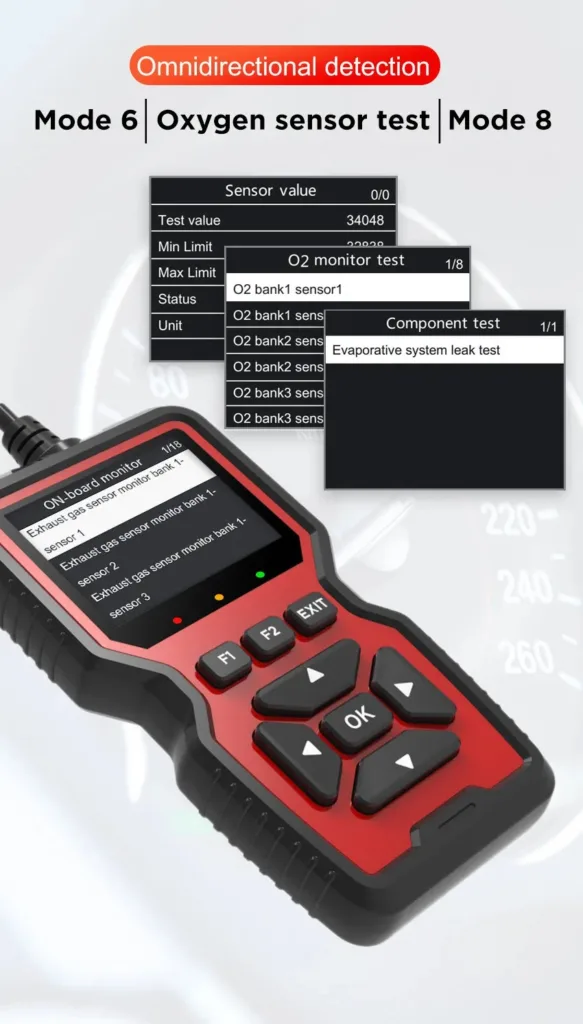
- Connect the OBD2 scanner to the vehicle’s diagnostic port and retrieve all stored codes and freeze frame data. The freeze frame data shows the specific conditions at the moment the fault that caused code P006C occurred. It is recommended that you write down this information, as it may be helpful during the diagnostic process. Next, I will clear the fault codes and test drive the vehicle to see if the fault code is reset.
- If so:
- Test the reference signal (usually 5 volts) and ground at the MAP sensor and turbocharger/supercharger intake pressure sensor connectors using a DVOM.
- This can be done by connecting the positive test lead of the DVOM to the reference voltage pin of the sensor connector and the negative test lead to the ground pin of the connector.
- If the correct reference voltage and ground are found:
- Test the MAP sensor and turbocharger/supercharger intake pressure sensor using a DVOM and my vehicle information source.
- The vehicle information source should provide wiring diagrams, connector face views, connector pinout diagrams, diagnostic flowcharts, and component test specifications.
- Test the sensors with the power disconnected, with the DVOM set to ohms.
- MAP and/or turbocharger/supercharger intake pressure sensors that do not meet manufacturer specifications should be considered defective.
- If the relevant sensors meet manufacturer specifications:
- With the key on and engine running (KOER), reconnect the sensors and test the individual sensor signal circuit wiring behind each sensor connector using a DVOM.
- To determine if the corresponding sensor signal is correct, refer to the pressure vs. voltage chart (this chart should be located in the vehicle information source).
- If the voltage reflected by any sensor does not meet manufacturer specifications (based on manifold absolute pressure and turbocharger/supercharger boost pressure), the sensor is considered defective.
- If the MAP sensor and turbocharger/supercharger intake pressure sensor voltage signals are correct:
- Access the PCM and test the corresponding signal circuits at the PCM connector (for each sensor). If there is a sensor signal at the sensor connector but not at the PCM connector, an open circuit between the two components is suspected.
- You can disconnect the PCM (and all related controllers) and test the individual system circuits with a DVOM. Please test the resistance and/or continuity of individual circuits according to the wiring diagram and connector pinout.
- If all MAP/turbocharger/supercharger intake pressure sensors and circuits are within specifications, suspect a PCM fault or PCM programming error.
- Checking relevant Technical Service Bulletins (TSBs) can greatly assist in your diagnosis.
- The turbocharger/supercharger intake pressure sensor is often disconnected after air filter replacement and other related maintenance. If the vehicle has recently been serviced, check this connector first.
How to fix P006C
- Check and test the MAP sensor and the turbocharger/supercharger intake pressure sensor for proper operation.
- Check the intake system for vacuum leaks and repair if necessary.
- Check wiring and connectors for damage or corrosion and repair or replace if necessary.
- Perform a software update or calibration on the sensors and engine control module.
- Clear the DTC and test drive the vehicle to ensure the problem is resolved.
P006C Code Frequently Asked Questions
1. What does OBDII code P006C mean?
P006C indicates a discrepancy between the Manifold Absolute Pressure (MAP) sensor and the turbocharger/supercharger intake pressure sensor readings, suggesting a correlation issue.
2. What are the common symptoms of code P006C?
Symptoms may include reduced engine performance, poor acceleration, black smoke from the exhaust, increased fuel consumption, or the engine malfunction indicator light illuminating.
3. What causes the P006C code?
Possible causes include a faulty MAP sensor, a faulty turbocharger/supercharger intake pressure sensor, wiring or connector issues, vacuum leaks, or a faulty turbocharger/supercharger.
4. Can I drive my vehicle with a P006C code active?
While it is possible to drive with this code, doing so may result in reduced performance and fuel efficiency. Driving for extended periods without addressing the issue may cause further damage.
5. How do I diagnose a P006C code?
Start by using an OBDII scanner to confirm the code, check the MAP and turbocharger/supercharger intake pressure sensors, check for wiring or connector damage, and check for vacuum leaks. 6. How do I fix a P006C trouble code?
Repairs may include replacing the MAP sensor or turbocharger/supercharger intake pressure sensor, repairing damaged wiring or connectors, fixing vacuum leaks, or servicing the turbocharger/supercharger.
7. Can a dirty air filter cause a P006C code?
Yes, a clogged air filter can restrict airflow and affect pressure readings, potentially leading to a P006C code.
8. How much does it cost to fix a P006C code?
Repair costs vary depending on the problem. Sensor replacement typically costs $100 to $300, while turbocharger repairs can be more expensive.
9. Can a software issue cause a P006C code?
Yes, outdated or faulty engine control module (ECM) software can sometimes cause sensor correlation issues. Updating the ECM may resolve the problem.
10. Is the P006C code related to other OBDII codes?
Yes, the P006C code may appear alongside other codes related to the MAP sensor, turbocharger, or supercharger system, such as P0068 or P0299.
11. How much does it cost to diagnose a P006C code?
Diagnosing a P006C code typically requires 1.0 hour of labor. Rates vary depending on location, vehicle, and repair shop. Many shops charge between $80 and $150 per hour; dealer and metropolitan area rates may be higher, while independent shops may be lower.
12. How much does it cost to repair a P006C code?
The cost of repairing MAP-turbocharger/supercharger intake pressure-related issues varies depending on the specific cause. Generally, replacing a faulty sensor costs between $100 and $300, while addressing wiring or connector issues costs between $50 and $150. Software updates or calibrations may vary in cost but are typically between $100 and $200. Labor costs can also affect the overall repair cost, with hourly rates ranging from $80 to $150. It is recommended to consult a qualified mechanic or dealer to obtain an accurate estimate specific to your vehicle and location.