
I. Should Cars Be Warmed Up Before Starting in Winter?
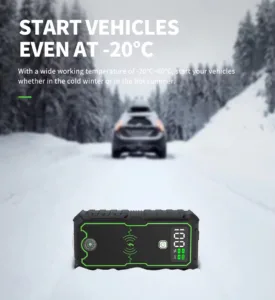
Cold winter days can be a real hassle for car owners, who often encounter issues with their vehicles failing to start. The culprit is cold starting. Cold starting refers to starting the engine when the coolant temperature is low, typically after the car has been idle for an extended period. Each time the vehicle is started, the oil settles in the oil pan and doesn’t reach the engine components quickly enough. This leaves the engine in a “dry friction” state without sufficient oil, causing friction resistance to skyrocket. This not only leads to failed starts but also severely damages the engine. Battery drain is also a significant issue in winter. It’s advisable to keep a car jump starter handy for situations where the battery is too weak to start the engine.
1. Why Warm Up the Engine?
Many people know they should warm up their car but don’t understand why. The primary reason is this: After prolonged parking, the engine oil drains back into the oil pan at the bottom of the engine. Therefore, after ignition, the upper part of the engine lacks oil and lubrication. It takes about 30 seconds after starting for the oil pump to circulate oil to the most critical lubrication points—the pistons, connecting rods, and crankshaft.
2. The Dangers of Driving Without Warming Up
Have you noticed that when starting a vehicle, the tachometer needle often spikes to over double the normal idle RPM (more pronounced in automatic transmissions)? This occurs because the engine control unit (ECU) automatically increases fuel injection into the cylinders to boost engine speed, facilitating rapid warming during cold starts. The extent of this cold-start RPM increase depends on the vehicle’s external temperature and ECU settings, meaning it varies between models.
Under normal conditions, the engine RPM drops significantly within the first minute after a cold start. If you can’t even wait this brief minute and floor it immediately, This undoubtedly accelerates engine component wear. While it may not cause serious problems in the short term, doing this long-term will shorten the engine’s lifespan.
With lower winter temperatures, warming up the engine is essential. However, most owners believe that after starting the engine early in the morning or after prolonged disuse, idling it in place for three to five minutes before driving is best for the vehicle.
After starting the engine, lubrication isn’t fully distributed during idle, making this phase most prone to wear. Statistics show over 90% of engine component wear occurs within the first three minutes after a cold start. Therefore, idling in place during winter—especially severe cold—can easily damage the engine. It’s recommended to warm up by driving slowly at low RPM instead.
3. Idling in Place Is Not Recommended
Some might argue: Since driving immediately after starting the engine in winter isn’t advisable, wouldn’t it be better to idle until the engine speed stabilizes and the coolant temperature gauge rises before driving? While prolonged idling does allow the engine to fully warm up, it carries significant drawbacks.
The correct warm-up procedure is to begin driving 30 seconds to one minute after starting the engine. Crucially, avoid high speeds initially—maintain low speeds with engine RPMs capped at 3000 RPM (ideally around 2000 RPM). Exceeding this threshold risks irreversible wear on the engine and transmission. Once the engine reaches normal operating temperature (typically 3–5 minutes), resume normal driving.
4. Proper Warm-Up Procedure
After starting in winter, coolant temperature will be below normal. Wait until it reaches proper temperature before gradually accelerating. After ignition, idle briefly (the duration depends on when the RPM stabilizes after dropping, generally no longer than one minute). For example, if the RPM is above 2000 immediately after starting, wait approximately 30 seconds to 1 minute. Once the engine RPM gauge needle drops to around 1200 RPM (though still below the normal idle range of 800–1000 RPM), and the RPM remains stable with no significant fluctuations, while the vehicle body shows no noticeable shaking, you can then shift gears and begin driving.
II. Winter Car Starting Basics
The following starting procedures apply to both vehicle types:
For manual transmission vehicles:First, engage first gear without pressing the accelerator. Let the engine idle at low RPM for 3–5 minutes. If the vehicle is heavily loaded or emerging from an underground garage ramp, you may feel insufficient power. In such cases, gently press the accelerator slightly (remember to press gently, keeping engine RPM below 2000). Once the water temperature gauge needle moves slightly upward, shift to second gear (maintain speed between 20–30 km/h) and proceed slowly. Only when the needle approaches 60°C (beyond the first third of the gauge) should you gradually accelerate and shift up through the gears.
For automatic transmission vehicles: In winter, the viscosity of the automatic transmission fluid increases. During initial starts, even when the oil pump is operational, many vehicles experience delayed upshifts. For instance, while the vehicle typically shifts up at 2000 RPM under normal conditions, a cold start may require reaching 3000 RPM or higher before shifting up. It is highly inadvisable to abruptly depress the accelerator to force an upshift by rapidly increasing engine RPM.
When driving in winter, keep the engine RPM below 2000 after starting. For automatic vehicles, maintain driving in Drive (D) gear at under 2000 RPM for 3–5 minutes. Generally, a well-maintained automatic transmission vehicle can slowly move forward even without pressing the accelerator, as its low idle RPM is sufficient (many experienced drivers actually use this low-speed movement to warm up the engine—heh, this is a handy tip). During this period, the automatic transmission will not upshift, allowing the transmission fluid to circulate fully and gradually restore its viscosity to normal levels. Similarly, only when the water temperature gauge needle rises close to 60°C (above one-third of the gauge) should you accelerate normally.
It’s worth noting that frequently stomping the accelerator in a cold car during winter, rapidly revving to 3000-4000 RPM to force an automatic upshift, will undoubtedly cause abnormal wear on the clutch plates, brake pads, and the spool valve mechanism inside the automatic transmission. This practice will also shorten the transmission’s lifespan.
Summary: In reality, winter warm-up procedures vary slightly depending on vehicle model, engine displacement, load capacity, and climate conditions. There is no universal template, and rigid adherence to fixed methods is inadvisable. The key principle to remember is that winter warm-up should be a dynamic process involving steady temperature increase and gradual acceleration. Avoid prolonged idling in place. After starting, always begin with low-speed cruising. Crucially, refrain from aggressive maneuvers like prematurely flooring the accelerator, sudden acceleration, or abrupt braking.