
I. How to Choose a Car Jump Starter
Safety
Because a car requires a large current to start, this is different from ordinary digital product power banks (usually 1A-3A). The starting current of a car needs to be at least 150A, and can reach 400 amperes. Therefore, both the power supply itself and the connecting cables require extremely high standards. Improper handling can lead to safety accidents.
Battery Capacity
Car emergency jump starters use high-end materials, and typically retain their charge for several months without significant power loss.
Functionality and Size
Since the need for an emergency power supply is relatively infrequent under normal circumstances, adding new functions can increase the product’s usability. For example, it can be used to charge tablets and mobile phones, start motorcycles, or even yachts. Most importantly, while ensuring product safety, the size should be small enough to fit in a woman’s handbag, making it more versatile.
II. Which Type of Car Emergency Power Supply is Best?
Traditional lead-acid battery car emergency jump starters use maintenance-free lead-acid batteries, which are larger and heavier, with correspondingly larger battery capacity and starting current. However, car emergency jump starters using lithium polymer batteries are easy to operate, convenient to carry, small in size, and lightweight. They also have overcurrent, overload, overcharge, and reverse connection protection functions, and can charge various electronic products. Some products also have inverter functions.
III. Features of Car Emergency Jump Starters
1. Exquisite craftsmanship, impeccable from the inside out, with a piano-finish body that is not only beautiful but also super wear-resistant.
Polymer lithium-ion battery cells ensure a long service life for the car emergency jump starter.
The core protection circuit packs great power in a small size and provides an extra layer of protection.
Equipped with 4 charging heads to cover most digital products on the market.
Can withstand over 1000 charge and discharge cycles.
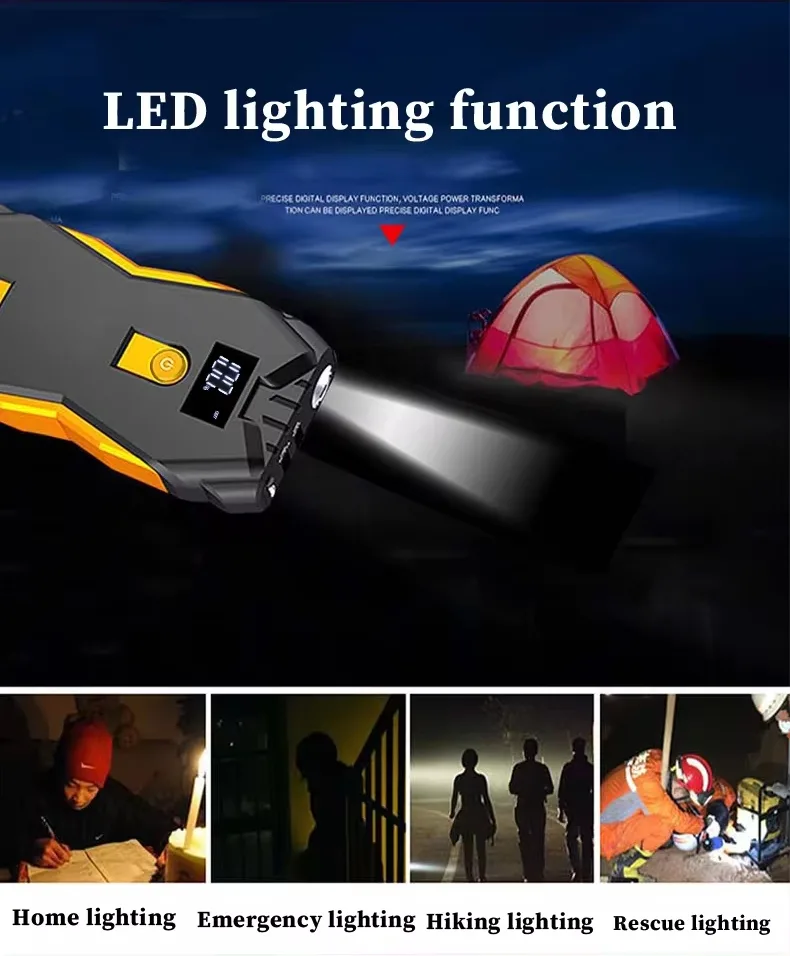
Suitable for passenger cars, capable of continuous starting 30 times, providing strong light illumination for 20 hours, emitting a rescue signal for 20 hours, and charging mobile phones and tablets.
Emergency lighting: Features 3 lighting modes—illumination, strobe, and SOS—which can be used as a distress signal in emergencies.