
What does the P0047 code mean?
The P0047 fault code is a generic OBD-II code that means “Turbocharger/Supercharger Boost Control A Circuit Low“.
Background Information: This code indicates the Powertrain Control Module (PCM) or Engine Control Module (ECM) has detected that the voltage in the primary boost control solenoid circuit (Circuit A) is below the normal operating range. The PCM monitors the electrical signal used to control the boost control solenoid, which regulates turbocharger or supercharger boost pressure via a wastegate or variable geometry mechanism. A “Low” circuit condition typically points to a short to ground, excessive resistance, or a faulty component that is pulling the circuit voltage down. This prevents the PCM from properly commanding the boost control system, often resulting in a lack of boost, reduced engine power, and the activation of a limp mode to protect the engine.
Symptoms of Error Code P0047
Signs of error P0047 may include:
- Illuminated Check Engine Light (MIL).
- Severe loss of power and poor acceleration, as the turbocharger may not produce boost.
- Engine enters a “limp home” or reduced power mode to prevent potential damage.
- Decreased fuel economy due to inefficient engine operation without forced induction.
- Lack of turbocharger spooling sound under acceleration.
- Possible black smoke from exhaust (especially in diesel engines) from an imbalanced air-fuel ratio.
- Other related fault codes such as underboost (P0299) may also be present.
Main Causes of Error Code P0047
- Short to Ground in Wiring Harness: The control wire for the boost solenoid has damaged insulation and is touching the engine block or chassis.
- Faulty Boost Control Solenoid/Actuator: An internal short or failure within the solenoid itself creates a low-resistance path to ground.
- High Resistance or Poor Connection: Corroded, loose, or damaged connectors and wires cause a significant voltage drop, interpreted as a low circuit.
- Faulty Engine Control Module (ECM/PCM): An internal failure in the module’s driver circuit for the boost control system (less common).
- Problem with Integrated Turbo Actuator: On modern vehicles with electronic actuators, a failed motor or internal circuit can cause this code.
- Blown Fuse: A blown fuse in the power supply circuit for the boost control solenoid or the ECM driver.
How to Diagnose Error Code P0047?
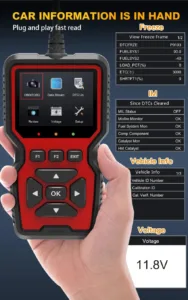
- Use an obd2 scanner to confirm the P0047 code and check for any related codes (e.g., P0045, P0046, P0299). Note the freeze frame data.
- Perform a thorough visual inspection of the boost control solenoid, its wiring harness, and all connectors. Look for chafed wires, especially where the harness passes near the hot turbocharger or sharp edges.
- Locate the boost control solenoid (refer to service manual). It is often mounted on the turbocharger, intake manifold, or firewall.
- With the ignition OFF and the solenoid disconnected, use a digital multimeter to check for a short to ground. Test for continuity between the solenoid control pin (signal wire) and the vehicle chassis. Any continuity indicates a short.
- Measure the resistance of the solenoid coil across its two terminals. Compare to manufacturer specifications (typically between 10-30 ohms). A reading near 0 ohms indicates an internal short.
- Check for power and ground at the solenoid connector with the ignition ON. Verify the presence of battery voltage (~12.6V) on the power supply wire.
- Using a capable car code scanner with bidirectional controls, attempt to command the boost control solenoid ON and OFF while observing related PIDs (like desired boost pressure). Lack of response or an error may confirm the circuit fault.
- If the solenoid and wiring test good, suspect a faulty ECM. Professional diagnosis, potentially checking the control signal at the ECM connector with an oscilloscope, may be required.
Possible Causes and Diagnostic Methods
| Possible Cause | How to Check? |
| Wiring Short to Ground | Disconnect the solenoid and PCM. Check for continuity between the control wire and chassis ground. Repair any found short. |
| Faulty Boost Control Solenoid | Measure solenoid resistance. A reading significantly below specification indicates an internal short. |
| High Resistance Connection | Perform a voltage drop test on the control circuit with the solenoid commanded ON. A drop exceeding 0.5V indicates a problem. |
| Faulty ECM Driver Circuit | Back-probe the ECM connector pin for the control circuit. Command the solenoid with a scan tool; the voltage at the pin should change. No change suggests a faulty ECM. |
Tools needed: A reliable obd2 code scanner, digital multimeter (DMM), basic hand tools, vehicle-specific wiring diagrams, safety glasses.
How do I fix error code P0047? (Solutions to the Problem)
Simple Fixes
- Repair wiring damage: If a short to ground is found, carefully repair the damaged section of wire using solder and heat-shrink tubing. Ensure the harness is rerouted away from hot or sharp objects.
- Clean and secure connectors: Disconnect, clean with electrical contact cleaner, apply dielectric grease, and reconnect all associated electrical connectors firmly.
- Replace a blown fuse: Locate and replace the fuse with the correct amperage. Investigate the cause of the blown fuse to prevent recurrence.
In-depth Diagnosis and Repair Solutions
- Replace the faulty boost control solenoid/actuator: This is the most common repair. Ensure the replacement part meets OEM specifications.
- Repair or replace the wiring harness section: For extensive damage, a new harness section may be necessary.
- Replace the Engine Control Module (ECM/PCM): This is a last-resort, costly repair. It should only be done after all other components and wiring have been conclusively verified as functional. The new module requires programming.
- After repairs, use your car code scanner to clear all codes and perform a test drive to ensure the code does not return and that boost pressure is restored.
Troubleshooting Based on Symptoms
| Symptom | Possible Solution |
| Check Engine Light on with P0047, severe power loss. | Focus on a hard electrical short: inspect wiring near turbo and test solenoid resistance. |
| Code is intermittent, appears in wet conditions. | Look for moisture intrusion in connectors or an intermittent short caused by a moving harness. |
| Code returns immediately after clearing. | Indicates a persistent hard fault like a permanent short or a completely failed component. |
Common Error Code P0047 in Vehicles
Ford P0047 (EcoBoost engines): Common in F-150 (2.7L, 3.5L), Explorer, Mustang EcoBoost. The turbocharger wastegate solenoid or electronic wastegate actuator is prone to failure. Wiring harnesses near the turbo are susceptible to heat damage, leading to shorts. Diagnosis benefits from using a professional obd2 diagnostic scanner to monitor boost parameters.
Volkswagen/Audi P0047 (TSI/TFSI engines): Frequent in Golf GTI, Audi A4, Q5. The N75 boost pressure control solenoid or the integrated turbo actuator on newer EA888 engines can fail. VAG-specific diagnostics (VCDS/OBDeleven) are highly recommended for precise testing.
General Motors (GM) P0047 (Duramax Diesel, 2.0L Turbo): In Chevrolet Silverado/Sierra HD with Duramax, and cars with the LTG 2.0T engine. On Duramax, issues often relate to the Variable Geometry Turbo (VGT) actuator control circuit. A bidirectional scan tool is crucial for diagnosis.
BMW P0047 (N54, N55, B58 engines): In 335i, 540i, X3 M40i. The electronic wastegate actuator (EWG) integrated into the turbocharger is a known failure point. Diagnosis typically requires ISTA software for guided functions and component testing.
Mercedes-Benz P0047 (OM642, M276 engines): In E-Class, GLE, Sprinter. Can be caused by a faulty charge pressure control solenoid valve or a short in the actuator wiring. The STAR Diagnostic system is needed for accurate component activation and data analysis.
Subaru P0047 (FA20DIT, FA24DIT engines): In WRX, STI, Ascent. The turbocharger wastegate control solenoid is a common culprit. Inspect the vacuum lines (if applicable) and the electrical connector for corrosion or damage.
Hyundai/Kia P0047 (Theta II 2.0T, Smartstream engines): In Sonata N-Line, Kia Stinger, Sorento X-Line. Check the turbocharger wastegate actuator and the associated control solenoid. Consult TSBs for known electrical issues.
Honda/Acura P0047 (1.5T, 2.0T engines): In Civic Si, Accord 2.0T, RDX. The wastegate valve actuator or the boost control solenoid valve can fail. A capable obd code reader can be used to monitor boost solenoid duty cycle.
Chrysler/Dodge/Jeep P0047 (2.0L Turbo, 3.0L EcoDiesel): In Jeep Wrangler 2.0T, Ram 1500 EcoDiesel. On the EcoDiesel, this code frequently relates to the VGT turbo actuator circuit. On the 2.0L, inspect the wastegate solenoid.
P0047 Frequently Asked Questions
What is the first thing I should do when I see code P0047?
The first step is to use an obd2 scanner to confirm the code and check for others. Then, perform a detailed visual inspection of all wiring and connectors for the turbo boost control system, focusing on areas near heat sources.
Is it safe to drive my car with the P0047 code?
It is not recommended. The vehicle will likely have very little power and may be in limp mode, making it unsafe for merging or passing. Continued driving could also prevent other fault detection.
How much does it typically cost to repair a P0047 error?
Costs vary: Wiring repair might be $150-$400. Replacing a boost control solenoid typically costs $250-$600. If the turbo actuator or ECM needs replacement, costs can range from $1,000 to over $3,000.
Can I fix a P0047 code myself?
Yes, if you are comfortable with electrical diagnostics. You’ll need a multimeter, basic tools, and an obd2 scanner. The process involves testing for shorts and checking component resistance. Replacing a solenoid is often straightforward.
What’s the difference between P0045, P0046, P0047, and P0048?
All relate to the “Boost Control A Circuit.” P0045: Open Circuit. P0046: Range/Performance. P0047: Circuit Low (short to ground/low voltage). P0048: Circuit High (short to power/high voltage).
Will disconnecting the battery clear the P0047 code?
It may turn off the light temporarily, but the code remains stored in the ECM’s memory. To properly clear it, you must use an obd code reader after the repair is complete.
Can a bad turbocharger cause code P0047?
Indirectly. A seized turbo mechanism can cause the actuator to stall and draw excessive current, potentially leading to a circuit low condition. However, P0047 primarily indicates an electrical fault in the control circuit itself.
My car failed emissions inspection with P0047. Will fixing it guarantee a pass?
Yes, once the code is repaired, cleared, and the vehicle completes a drive cycle to reset all readiness monitors, it should pass the OBD-II scan portion of the test, barring any other issues.
After replacing the boost control solenoid, do I need a relearn?
On most vehicles, clearing the code is sufficient. However, on many European and some modern vehicles, a turbo actuator adaptation or calibration procedure using a professional-level car code scanner may be required.
What does “Circuit Low” specifically mean electrically?
It means the Powertrain Control Module detects that the voltage on the control circuit is lower than expected for the commanded state, usually due to a short to ground (creating a low-resistance path) or high resistance causing a large voltage drop.
How can I prevent P0047 from happening again?
Ensure all wiring harnesses are properly secured away from exhaust components and sharp edges. Use protective loom in high-heat areas. Address any engine issues promptly to avoid excessive under-hood temperatures.
Can a basic code reader diagnose P0047?
A basic car code reader can confirm the code’s presence. For diagnosis, you need a scanner that can read live data and preferably command components, making a more advanced obd2 code scanner highly recommended.
P0047 Related OBD2 Errors
- P0045 – Turbocharger/Supercharger Boost Control A Circuit Open
- P0046 – Turbocharger/Supercharger Boost Control A Circuit Range/Performance
- P0048 – Turbocharger/Supercharger Boost Control A Circuit High
- P0299 – Turbocharger/Supercharger Underboost Condition
- P0234 – Turbocharger/Supercharger Overboost Condition
- P2563 – Turbocharger Boost Control Position Sensor Circuit
Important Note: Code P0047 indicates a fault that disables the boost control system, leading to significant performance loss. Diagnosis should begin with a careful visual inspection for wiring damage. Using a professional-grade obd2 scanner greatly aids in diagnosis. If you are not confident in performing electrical diagnostics, seeking assistance from a qualified technician is strongly advised. Always allow the exhaust and turbocharger system to cool completely before beginning any work.