
Complete Car Tool Guide: What are the Essential Emergency Tools for Driving?
Tire Inflator
A tire inflator is an essential tool for every car owner, ensuring tires maintain optimal pressure for vehicle safety and performance. This device helps maintain proper tire pressure, prevents blowouts, improves fuel efficiency, and extends tire life.
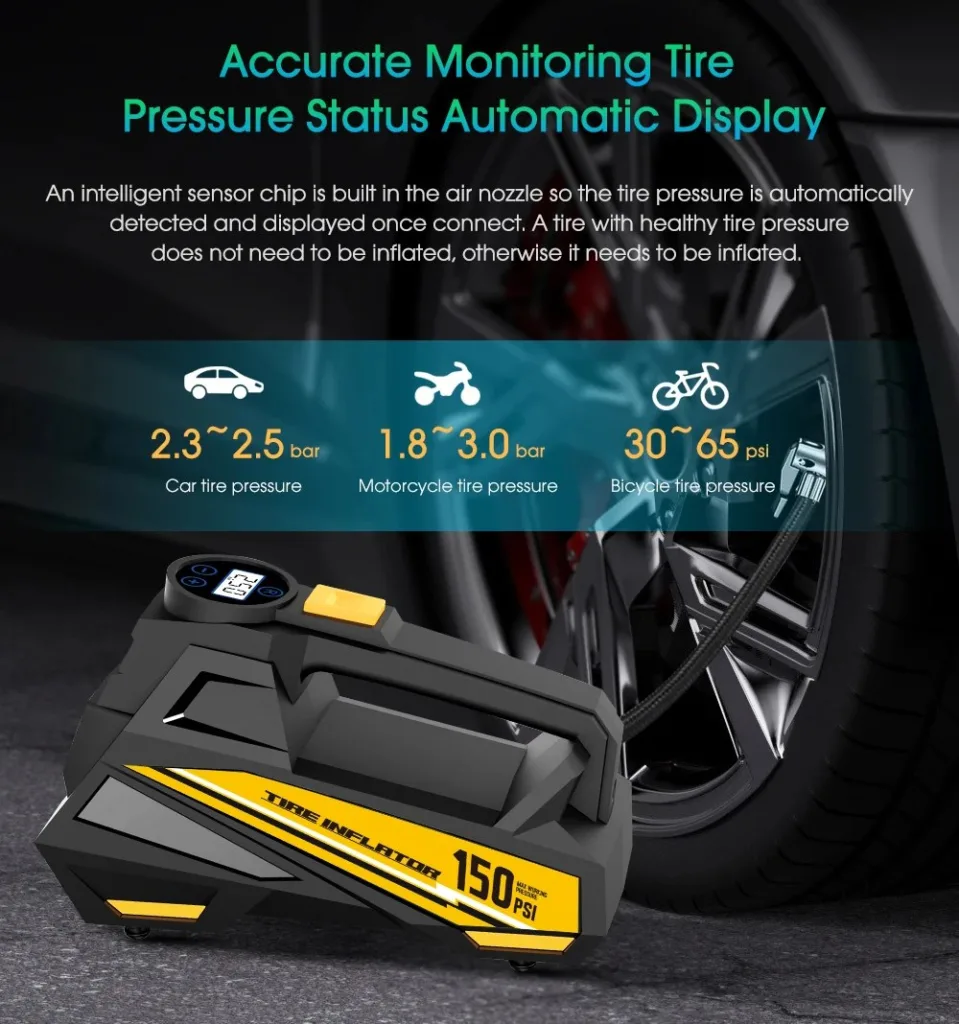
Tire Inflator Usage Guide
Using a tire inflator is simple once you understand the steps, but careful operation is essential for safety and effectiveness.
First, park your vehicle on a level surface and turn off the engine to avoid accidents. Next, locate the tire valve; this is where you connect the inflator. Connect the tire inflator’s hose to the valve, ensuring it’s securely fastened to prevent leaks. If you are using a digital tire inflator, set the desired pressure level on the device before starting. Turn on the inflator to begin inflating the tires and use the built-in tire pressure gauge to monitor the pressure. Once the tires reach the pressure recommended in your vehicle’s manual, stop inflating immediately. For analog tire pressure gauges, you will need to manually check the dial and stop inflating when the pointer points to the correct mark. After inflation, carefully remove the hose to avoid leaks, and then repeat this process for each tire. This gradual approach not only maintains proper tire pressure but also helps extend tire life.
Spare Tire
A spare tire is essential in case of a tire blowout. It allows you to at least drive to the nearest repair shop, so always carry a spare tire when driving. Car spare tires come in full-size and non-full-size versions, usually stored in the trunk, though some are rear-mounted. As an emergency device, car owners must regularly check the tire pressure.
How to Change a Tire?
If you have a tire blowout, be sure to place a warning triangle behind the car to ensure safety before changing the tire. A jack and wrench are the main tools for changing a tire. However, don’t rush to lift the car, as you’ll need to loosen the lug nuts first.
After loosening the lug nuts, you can easily find the two small recesses for the jack by leaning slightly. The rest is mostly manual labor.
Remember to loosen or tighten the lug nuts diagonally from top to bottom.
Car Jack
A car jack is kept in the car’s toolbox and is used to lift the car body when changing a spare tire. Hydraulic and mechanical jacks are commonly used. A car jack is used to change a spare tire, making it convenient to change a flat tire while driving. When using a vehicle jack, always align it with the vehicle’s load-bearing points.
Jack Usage Precautions:
Aim at the vehicle’s chassis support points: Generally, there are support points for the jack on both sides of the vehicle’s chassis near the tires. The lifting part of the jack must be aligned with these support points to prevent slippage; otherwise, it will be difficult to secure the vehicle, and the jack may slip, damaging itself or even the vehicle’s chassis.
Place a spare tire under the car for added safety: After lifting the vehicle, don’t rush to remove the wheel lug nuts. Place the spare tire under the car. This provides a safety cushion in case the jack fails and the vehicle falls. Safety is paramount.
Lift steadily and slowly: When using a jack to lift the vehicle, the movements should be steady and slow. Avoid using excessive force or sudden movements to prevent damage to the jack and ensure safety.
Jumper Cables
Car jumper cables are used to start a car when its battery is dead, allowing it to jump-start using another vehicle’s battery. It’s crucial that the two vehicles are not in contact, and their electronic systems must have the same voltage.
How to Jump-Start Cables
To connect jumper cables, first clamp the red end of the jumper cable to the positive terminal of the red battery in the vehicle being jumped from. Then clamp the other end of the red cable to the positive terminal of the red battery in the vehicle being jumped from. Next, clamp the black end of the jumper cable to the negative terminal of the black battery in the vehicle being jumped from, and then clamp the black end of the black cable to the negative terminal of the black battery in the vehicle being jumped from. Start the engine of the vehicle being jumped from first, then start the engine of the vehicle being jumped from. If the vehicle being jumped from still doesn’t start, check the metal contacts for poor contact.
Car Jump Starters
Many people have encountered situations where their car battery is dead. If you can’t find a second vehicle to jump-start it, the usual solution is to call roadside assistance. Calling roadside assistance and waiting for it can be very time-consuming. Having a car jump starter in your car would be very helpful. A car jump starter is a type of car battery that assists in starting the vehicle when the battery is depleted or has insufficient power. It can also be used for fast charging. It is an indispensable accessory for automobiles.
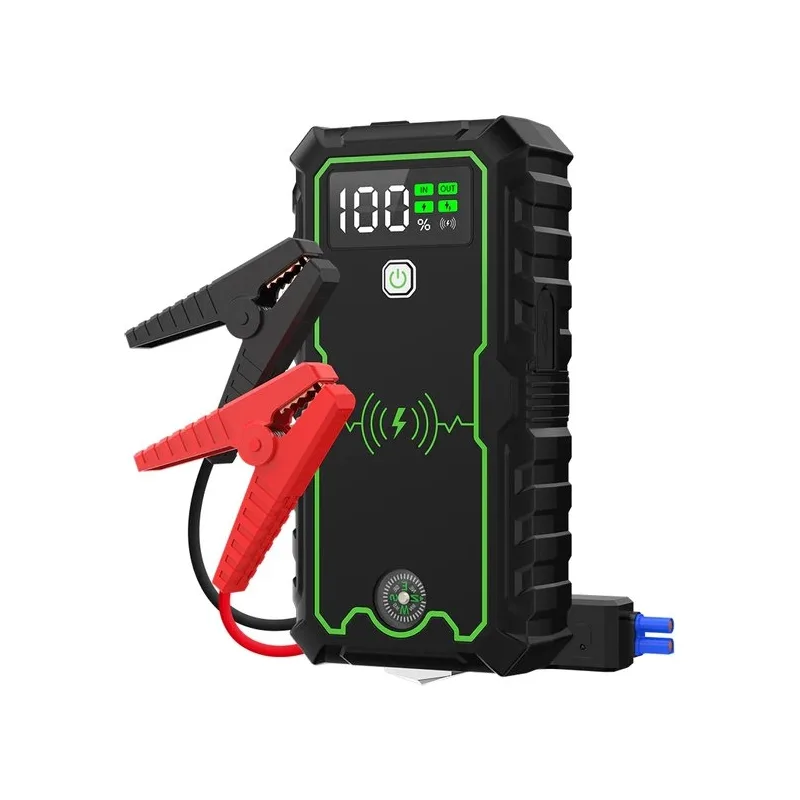
How to use a car jump starter:
- First, turn off high-power devices such as navigation and air conditioning. Then, clean the dust from the car’s power connectors. The jump starter’s power indicator should show at least three bars.
- Use the red clip on the jump starter to connect to the positive terminal of the car’s power supply; use the black clip to connect to the negative terminal.
- Start the car within 30 seconds. Immediately disconnect the battery clips and remove the jump starter. Note: If the indicator lights go out after one attempt to start the car, creating a false impression of no power, this is because some cars have excessive output current. The jump starter’s internal protection system will activate. Charging the jump starter for 3 seconds will reactivate it.
- After starting, charge the battery at 1500 RPM. After 20 minutes, it can start the car once; after 30 minutes, it can start the car once the next day.
Fire Extinguisher
A car fire extinguisher is an essential vehicle tool, yet many car owners don’t equip their cars with one, leaving them helpless in case of an emergency. If the fire extinguisher’s gauge is in the “refill” zone, it means the gas pressure inside the canister is lower than the normal operating pressure; if it’s in the “overfill” zone, it means the pressure is higher than the normal operating pressure. In either case, remember to replace the fire extinguisher.
How to Use a Fire Extinguisher Correctly?
Open the engine hood with one hand and immediately locate the fire. Then, quickly spray the fire extinguisher to extinguish it. If you find that one fire extinguisher isn’t enough to put out the fire, ask nearby drivers for help or abandon the attempt and evacuate to a safe area.
Special Note: It is crucial to understand that car fire extinguishers have a limited capacity. If the fire is large, don’t expect it to completely extinguish it. If you find the fire is still not under control after 3 minutes, immediately evacuate to a safe place. The car may burn, but your safety is paramount.
Wrench
A wrench is a commonly used tool for installation and disassembly. A lever-operated hand tool for tightening bolts, screws, nuts, and other threaded fasteners with open or recessed holes. Like a jack, most new cars come equipped with a tire wrench. If the owner has some repair knowledge, it’s advisable to also carry a set of common repair tools. This allows for quick tire replacement in case of a problem.
Tow Rope
A tow rope is the most direct tool for on-site roadside assistance. Regardless of the environment or vehicle type, a tow rope should be kept in the trunk. Car tow ropes are generally made from cloth straps, steel wire, or nylon rope, and come in various lengths. Choose a brightly colored tow rope, such as yellow, blue, fluorescent green, or fluorescent red. It’s also important that the disabled vehicle be driven by an experienced driver to better handle emergencies.
Safety Hammer
Previously, car windows were hand-cranked, so safety hammers were rarely found in cars, usually only on buses. However, with electronic window lifts replacing mechanical ones, driving through flooded areas in rainy weather poses a safety hazard, as the windows cannot be opened after the engine stalls in water. Currently, there are single-function and multi-function safety hammers on the market. In an emergency, if you need to break a window, use the safety hammer to strike one of the four corners, as the center of tempered glass is the strongest part.
High-powered flashlight
A flashlight is a very useful tool. It can be a great help when you need to check your vehicle or look for something at night. It’s also useful during the day for checking areas like the lower engine compartment, suspension, or interior corners, which are difficult to see even in daylight. A flashlight makes checking these areas much easier. A flashlight that can be charged directly in the car is even better, eliminating the need for battery replacements and being both environmentally friendly and convenient. For outdoor activities, it’s best to buy one with a brightness of 100 lumens or more, sufficient for both outdoor use and in the car.
Warning triangle
A warning triangle is a very important tool. In the event of an emergency, it is placed behind the vehicle to warn other vehicles and prevent secondary accidents. In case of an emergency on a regular road, a warning triangle is typically placed about 50-100 meters behind the vehicle. If it is at night or on a highway, the distance needs to be greater.