
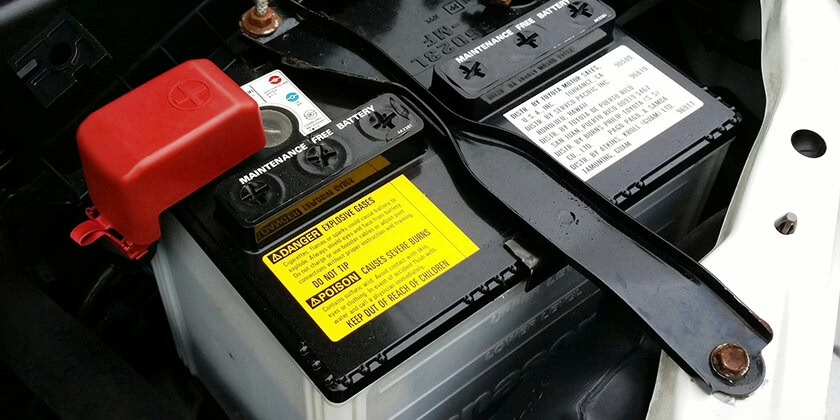
Car Battery Introduction
A car battery is a type of battery that converts chemical energy into electrical energy. Generally, the term “battery” refers to a lead-acid battery, a type of battery primarily made of lead and its oxides, with sulfuric acid as the electrolyte. The main functions of a car battery are:
- Providing a strong starting current (around 10A) to the starter motor when starting the engine;
- Assisting the alternator in supplying power to electrical equipment when the alternator is overloaded;
- Supplying power to electrical equipment when the engine is idling;
- Acting as a large-capacity capacitor to protect the car’s electrical appliances;
- When the alternator terminal voltage exceeds the electromotive force of the lead-acid battery, converting some electrical energy into chemical energy for storage, i.e., charging.
The working principle equation of a car battery is as follows:
Overall reaction: b(s) + PbO2(s) + 2H2SO4(aq) (Reversible reaction) 2PbSO4(s) + 2H2O(l)
During discharge: Negative Pb(s) – 2e- + SO42-(aq) = PbSO4(s)
Positive PbO2(s) + 2e- + SO42-(aq) + 4H+(aq) = PbSO4(s) Pb(s) + 2H₂O(l)
Total Pb(s) + PbO₂(s) + 2H₂SO₄(aq) = 2PbSO₄(s) + 2H₂O(l)
Rechargeable Electrolytic Cell
Cathode: PbSO₄(s) + 2e⁻ = Pb(s) + SO₄²⁻(aq)
Anode: PbSO₄(s) + 2H₂O(l) – 2e⁻ = PbO₂(s) + SO₄²⁻(aq) + 4H⁺ (a)
Note: (The cathode is the negative terminal during discharge)
Automotive Battery Classification
Nickel-Cadmium Battery
Voltage: 1.2V
Lifespan: 500 cycles
Discharge Temperature: -20°C to 60°C
Charging Temperature: 0°C to 45°C
Remarks: Strong overcharge resistance.
Nickel-Metal Hydride Battery
Voltage: 1.2V
Lifespan: 1000 cycles
Discharge Temperature: -10°C to 45°C
Charging Temperature: 10°C to 45°C
Remarks: Currently, the highest capacity is around 2100mAh.
Lithium-ion Battery
Voltage: 3.6V
Lifespan: 500 cycles
Discharge Temperature: -20°C to 60°C
Charging Temperature: 0°C to 45°C
Remarks: 30% to 40% lighter than nickel-metal hydride batteries, and with a capacity more than 60% higher. However, it is not resistant to overcharging; overcharging will cause overheating. Excessive heat damages the structure => explosion.
Lithium Polymer Battery
Voltage: 3.7V
Lifespan: 500 cycles
Discharge Temperature: -20°C to 60°C
Charging Temperature: 0°C to 45°C
Note: An improved version of lithium batteries, it uses a polymer electrolyte instead of electrolyte, allowing it to be made into various shapes and is more stable than lithium batteries.
Lead-Acid Battery
Voltage: 2V
Lifespan: 200-300 cycles
Discharge Temperature: 0°C to 45°C
Charging Temperature: 0°C to 45°C
Note: This is a typical car battery (it consists of six 2V cells connected in series to form a 12V battery). Water-free batteries have a lifespan of up to 10 years, but are the largest and heaviest.
Car Battery Charging Methods
- Car Battery Charging Time
There are two methods for charging batteries: fast charging and slow charging.
- Fast Charging Charging (Constant Current Charging)
Many car owners believe that fast charging saves time, requiring only 3-5 hours; however, this is not the case. Fast charging only quickly activates the surface of the battery, while the internal components are not fully charged.
- Slow Charging (Constant Voltage Charging)
Another charging method for car batteries is slow charging, which takes 10-15 hours. Deeply discharged batteries must be slow-charged; otherwise, insufficient charging time and charge will directly affect the car’s performance.
How Long Does a Car Battery Generally Last?
Currently, car batteries can be broadly divided into two categories: maintenance-free and ordinary batteries (non-maintenance-free). Most models sold on the market use maintenance-free batteries.
Ordinary batteries, also known as lead-acid batteries, have electrodes made of lead and lead oxides, and the electrolyte is an aqueous solution of sulfuric acid. The main advantages are stable voltage and low price; the disadvantage is frequent routine maintenance. Older, ordinary batteries generally have a lifespan of about 2 years and require regular checks of the electrolyte level and the addition of distilled water.
Maintenance-free batteries, as the name suggests, are characterized by being “maintenance-free.” They require virtually no distilled water replenishment during their lifespan. They also feature shock resistance, high-temperature resistance, small size, and low self-discharge. Of course, they are also more expensive than ordinary batteries. Regarding lifespan, the recommended replacement cycle for maintenance-free batteries is approximately 3 years under normal circumstances.
Reasons Affecting Car Battery Lifespan
Forgetting to Turn Off Electrical Equipment
Forgetting to turn off interior lights when parking and turning off the engine is a common mistake many car owners make. After a night of use, the battery may be dead, leading to difficulty starting the car. In such cases, if conditions permit… In this case, you can simply charge it. If it still doesn’t work, the battery may need to be replaced. Try to avoid using electrical devices such as CD players and cigarette lighters when the vehicle is not running, and minimize the use of various in-car electrical appliances while driving.
Forgetting to turn off the air conditioner before turning off the engine
“Forgetting to turn off the air conditioner before turning off the engine” is another common mistake. Most car owners are used to leaving the air conditioner on or letting it automatically start when the vehicle is started. This causes the air conditioning system to automatically start working every time the ignition is turned on, resulting in an excessively high instantaneous power load on the vehicle and causing invisible wear and tear on the battery.
Correct practice: Before reaching your destination, turn off the A/C button and let the cold air run for a few minutes to ensure the air conditioning system is dry and reduces bacterial growth. Then, turn off the air conditioner before turning off the car. Turn the air conditioner back on after each time you start the car.
Car Battery Maintenance Car Maintenance
- Avoid parking your car in open-air parking lots for extended periods. If long-term parking is necessary, remove the battery and take it with you to prevent it from freezing and being damaged.
- Car engines are difficult to start in winter. Each attempt to start the car should not exceed 5 seconds, with at least a 15-second interval between attempts. If the car still cannot start after multiple attempts, check the electrical system, ignition coil, or fuel system for possible causes. Avoid repeated, uninterrupted starting, as this can cause the battery to over-discharge and burn out.
- Car batteries need to be charged regularly. If a battery is left unused for a long time, it will slowly self-discharge until it is unusable. Therefore, the car should be started periodically to charge the battery. If the car battery self-discharges and the car cannot start, a car jump starter can be used.
- Clean the battery terminals periodically and apply a special disinfectant. Use grease to protect the wiring harness. Regularly check the battery components and connections.
- Do not use car electrical appliances after the engine is off. Using the battery alone when the engine is not generating power will damage it.
- Turn off the lights and audio before turning off the engine. After driving, always turn off the lights and audio before turning off the engine. This will not drain the battery, especially parking lights and turn signals. Check these after getting out of the car; don’t overlook this. Leaving lights on for extended periods is very detrimental to the battery. When driving at night, also remember to start the vehicle before turning on the lights and audio.
- Avoid leaving the air conditioning on after turning off the engine. Air conditioning consumes a lot of power. Some drivers habitually leave the air conditioning on after turning off the engine. When starting the car again, the air conditioning will automatically start, putting excessive power load on the vehicle, which will damage the battery over time.