
A car diagnostic tool is a specialized instrument for vehicle inspection. It can monitor vehicle performance in real time and detect faults. A car diagnostic tool is a tool that determines the technical condition of a vehicle and identifies the location and cause of faults without disassembling it (or only removing individual parts). This includes the inspection and diagnosis of the car engine, chassis, body and accessories, and exhaust pollutants and noise. A car diagnostic tool is an essential tool for vehicle inspection.
Automotive OBD2 scanner tools are divided into two main categories.
- Car diagnostic tools for individual car owners: Primarily designed for individual car owners, these tools use integrated technology, are compact, and have multiple functions. Car owners can view the test data in real time via their mobile phones, making them a great help for car owners to understand vehicle performance and faults.
- Car diagnostic tools for professionals: Primarily designed for professionals and auto repair shops, these tools have multiple diagnostic functions.
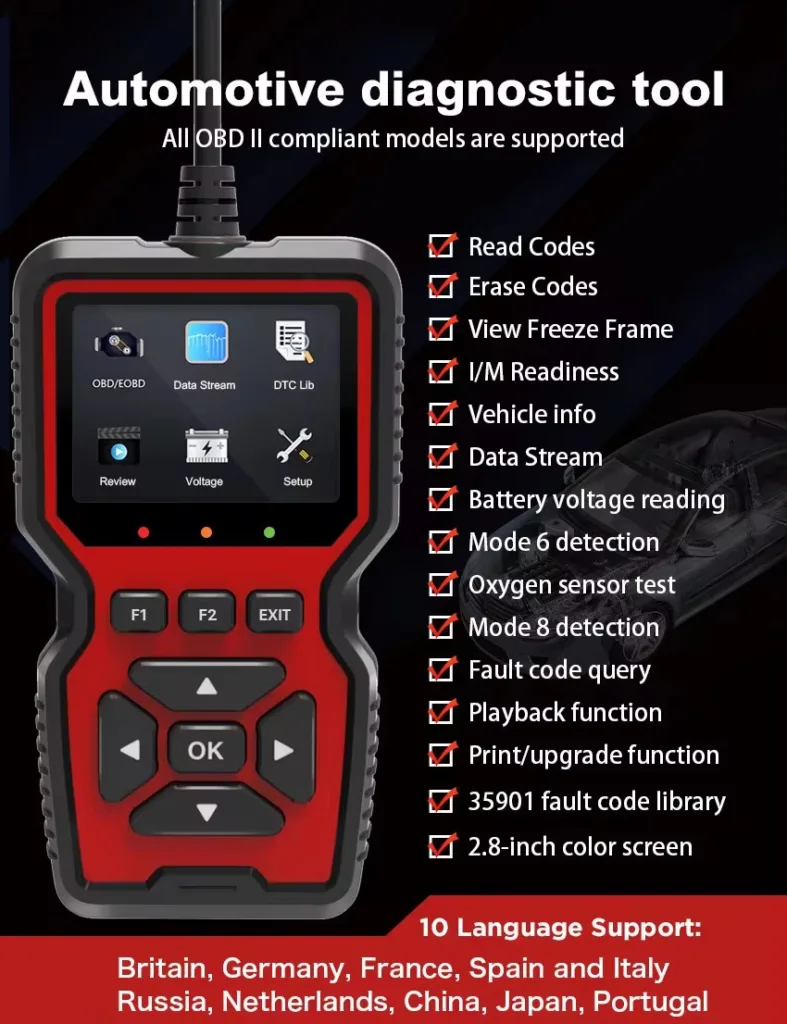
Common car diagnostic tool functions:
- Fault code reading: Reads fault codes and detailed fault code information stored in the engine system, and provides the cause of the fault and repair guidance information based on the read fault codes.
- Clear Fault Codes: Clears all fault codes in the system.
- Read Dynamic Data Stream: Reads all operating parameters related to the ECU system.
- Freeze Frame Data: When an emissions-related fault occurs, the ECU sets a fault code and records the vehicle’s operating status information at the moment the fault occurs to confirm the fault. This recorded information is called a freeze frame.
- Sensor Test: This service provides access to oxygen sensor monitoring test results.
- Read Vehicle Information: Reads vehicle information such as the Vehicle Identification Number (VIN), Calibration Identifier (CALID), and Calibration Verification Number (CVN).
Advantages of Automotive Diagnostic Tools
1. Beautiful Appearance
The design features smoother, more rounded lines and a refined texture. Upgraded chips and components make the diagnostic tool lighter and more portable, giving it a high-tech look and a better feel in the hand. It uses an industrial-grade sunlight-readable screen, allowing for easy use outdoors and in sunlight.
2. Powerful Performance
The operating speed has been greatly improved, the system stability is high, the software response is faster, the operation is smoother and lag-free, and the speed of data streaming and action testing is improved, saving waiting time and increasing work efficiency.
3. High Intelligence
One-click recognition of vehicle VIN code, automatic and accurate vehicle model diagnosis, avoiding the errors and tediousness of manual input and selection of year and model; supports fault guidance function, quickly decrypting fault codes and providing repair references; one-click upgrade, easily updating to the latest vehicle models, eliminating the need for card upgrades, eliminating complicated steps, saving time and effort, allowing repair technicians to focus more on diagnosis and repair.
4. More Comprehensive Functions
Complete original factory diagnostic functions, supporting new energy vehicles, making it more practical. The car diagnostic tool also innovatively adds on-board voltage display and flashlight illumination functions, truly considering the needs of the usage environment.
How to Choose a Car Diagnostic Tool
1. Consider the Brand
Car diagnostic tools from major brands have advanced technology, good system stability, are less prone to problems, have high accuracy in test results, are fast, and have guaranteed quality.
2. Consider Functionality
If your shop focuses on quick car repair and maintenance, choose a diagnostic tool with basic fault diagnosis functions plus more specialized features. Each additional feature translates to an extra chargeable service. If you want to perform major repairs, you’ll need a more comprehensive, professional diagnostic tool with programming capabilities. With the increasing prevalence of new energy vehicles, some diagnostic tools can work on both gasoline and new energy vehicles, making it cost-effective to handle even occasional new energy vehicle requests.
3. Consider Upgrade Speed
New cars are released every year, often incorporating many new technologies. However, it’s impractical to replace the diagnostic tool every year. Therefore, the manufacturer’s upgrade speed is crucial. A diagnostic tool that promptly updates vehicle models, enhances functionality, and updates data is a valuable asset.
4. Consider Compatibility
Many car diagnostic tools on the market come with limited software that is incompatible with the technologies and platforms of various testing instruments. Therefore, it’s best to choose a diagnostic tool with strong compatibility.
Common Automotive Diagnostic Procedures
1. Visual Inspection
Inspect the engine, undercarriage, electrical system, steering system, and all pedal mechanisms to ensure they are functioning properly; check fluid levels for appropriate levels; and inspect for leaks of oil, water, air, or electricity. This type of inspection is primarily visual.
2. Safety Component Inspection
Test the vehicle’s braking performance, steering performance, and headlights; verify front wheel alignment and wheel balancing. Key testing equipment includes brake test benches, front wheel alignment machines, sideslip test benches, headlight testing equipment, and wheel balancing testing equipment.
3. Performance Inspection
Use an engine performance analyzer to check the technical condition of the engine’s ignition and fuel supply systems; use an oil analyzer to determine the wear of certain parts; and use a chassis comprehensive test bench to measure the vehicle’s performance, including acceleration, coasting performance, and drive wheel output power.
4. Exhaust and Noise Inspection
This mainly involves using a gas analyzer to measure the content of harmful substances such as carbon monoxide, carbon dioxide, hydrocarbons, and nitrogen oxides in engine exhaust, as well as the concentration of diesel engine smoke; and using a sound level meter to measure the vehicle’s noise level.
How to Use a Car Diagnostic Tool (Car Diagnostic Tool Usage Procedure)
- Turn on the car diagnostic tool
- Adjust the display brightness
- Select the test connector
- Test for fault codes
- Review previously tested fault codes
- Check fault codes
- Clear fault codes
- Print test results
Tips for Using a Car Diagnostic Tool
- Combine fault description and symptoms for analysis to quickly determine the cause of the fault
Using the fault code lookup function of the diagnostic tool, you can scan the electronic control system of the faulty vehicle. In most cases, the fault record does not indicate the cause of the fault. However, the content of the fault record provides information on the scope of the fault. Combined with the fault symptoms and other auxiliary checks, the fault can be quickly eliminated.
- Analyze and discover common causes based on stored fault information.
In most cases, fault code reading will retrieve multiple related fault records. Sometimes these fault records are not isolated; they are often caused by a hidden fault or have a causal relationship. Analyzing the stored information from this perspective, combined with other testing methods and maintenance experience, can quickly diagnose the fault.
- Fully utilize data stream query functions.
By querying the data stream, you can obtain data information collected by the control unit from relevant sensors and actuators, as well as switch status information, displayed in specific numerical values. Fully utilizing this data helps in the correct analysis and diagnosis of faults.
- Pay attention to the meaning of data status information.
The data information read by the fault diagnostic instrument from the control unit is represented in various ways, and the units are also different. Understanding the expression and meaning of this data information helps in a more comprehensive understanding of the control unit’s operating status and information from some sensors and actuators.