
What does the P0036 code mean?
The P0036 fault code, applicable to all car manufacturers, means “HO2S Heater Control Circuit (Bank 1, Sensor 2)” .
Background Information: This is a generic OBD2 code indicating a malfunction in the heater control circuit for the downstream Heated Oxygen Sensor (HO2S) located after the catalytic converter on Bank 1 (the side of the engine containing cylinder #1) . The heater element inside the oxygen sensor is crucial for bringing the sensor up to its minimum operating temperature (typically 570°F to 750°F / 300°C to 400°C) quickly after a cold start, allowing it to provide accurate voltage signals to the Engine Control Module (ECM) for optimal air-fuel ratio control . A fault in this circuit prevents the sensor from functioning correctly, leading to potential emissions and drivability issues.
Symptoms of Error Code P0036
Signs of error P0036 may include:
- The Check Engine Light (CEL) or Malfunction Indicator Lamp (MIL) is illuminated on the dashboard .
- Reduced fuel economy (decreased MPG), often a drop of 2-5 MPG, especially noticeable in city driving .
- Rough engine idle or hesitation during cold starts, as the engine may run in open-loop mode without proper sensor feedback .
- Sluggish acceleration or delayed throttle response until the engine warms up .
- Increased exhaust emissions, which will likely cause the vehicle to fail an emissions test .
- In some cases, the vehicle may enter a failsafe or “limp” mode, limiting performance to protect the engine and catalytic converter .
- No noticeable symptoms in some vehicles, with the Check Engine Light being the only indicator .
Main Causes of Error Code P0036
- A faulty or failed Heated Oxygen Sensor (HO2S) – the internal heater element is the most common culprit .
- Damaged, frayed, shorted, or corroded wiring and connectors in the sensor’s heater circuit harness .
- A blown fuse supplying power to the oxygen sensor heater circuit .
- A poor or corroded ground connection for the exhaust system or sensor circuit .
- A faulty Engine Control Module (ECM) or Powertrain Control Module (PCM) with an internal driver circuit failure .
- High resistance in the heater circuit due to corrosion at connectors or damaged wires .
- An open circuit in the wiring between the ECM and the oxygen sensor .
How to Diagnose Error Code P0036?
- Use an obd2 scanner or a capable car code reader to retrieve and confirm the P0036 code. Note any freeze frame data (engine temperature, RPM) and check for related codes (e.g., P0035, P0037, P0141) .
- Perform a thorough visual inspection of the wiring harness and connector for the Bank 1, Sensor 2 oxygen sensor (located after the catalytic converter). Look for damage from heat, chafing, corrosion, or rodent chewing .
- Check the relevant fuse for the oxygen sensor heater circuit in the vehicle’s under-hood or interior fuse box .
- With the ignition ON and engine OFF, use a digital multimeter to check for system voltage (approx. 12V) at the heater circuit power wire at the sensor connector. A reading below 9V indicates a power supply issue .
- Disconnect the oxygen sensor and measure the resistance across its heater terminals (usually the two white wires). Compare to manufacturer specifications (commonly between 2 and 10 ohms at 68°F/20°C). An infinite reading (OL) indicates an open circuit; a very low reading indicates a short .
- Check for continuity and shorts to ground or voltage in the wiring between the sensor connector and the ECM connector using a wiring diagram .
- Inspect the exhaust system ground strap for corrosion or damage, as a poor ground can cause circuit malfunctions .
- If all wiring, fuses, and the sensor check out, the issue may be a faulty ECM driver circuit, requiring professional diagnosis with an advanced obd2 code scanner .
Possible Causes and Diagnostic Methods
| Possible Cause | How to Check? |
| Faulty Oxygen Sensor Heater | Measure the heater element resistance with a multimeter. Replace if outside spec (e.g., 2-10Ω). |
| Open or short circuit in wiring | Perform a visual inspection, then test for continuity and shorts to ground/voltage with a multimeter. |
| Blown fuse | Locate and visually inspect the fuse for the O2 sensor heater circuit (check owner’s manual). |
| Poor ground connection | Inspect the exhaust ground strap and sensor ground wire for corrosion and secure connection. |
| High resistance at connector | Inspect the sensor and ECM connectors for green/white corrosion, bent pins, or looseness. Clean with contact cleaner. |
| Faulty ECM/PCM output | Using a scan tool, check if the ECM provides proper voltage and ground control to the heater circuit. |
Tools needed: OBD2 code scanner or car code scanner, digital multimeter, basic hand tools (sockets, wrenches), safety glasses, wiring diagram for your specific vehicle, electrical contact cleaner.
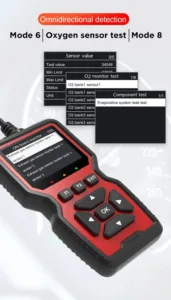
How do I fix error code P0036? (Solutions to the Problem)
Simple Fixes
- Replace a blown fuse for the oxygen sensor heater circuit.
- Repair damaged wiring or replace corroded connectors in the heater circuit. Use solder and heat shrink for permanent repairs .
- Clean corroded connector pins with electrical contact cleaner and reseat connections securely .
- Tighten or repair a loose or corroded exhaust system ground strap .
- Clear the code with your obd code reader after making repairs and perform a test drive to see if it returns .
In-depth Diagnosis and Repair Solutions
- Replace the faulty downstream oxygen sensor (Bank 1, Sensor 2). Always use a part that meets OEM specifications .
- If the ECM’s driver circuit is faulty, the Engine Control Module may need to be repaired or replaced and reprogrammed with a VIN-matched unit .
- Repair or replace sections of the wiring harness that have been damaged by heat or abrasion, using high-temperature wire where necessary .
Troubleshooting Based on Symptoms
| Symptom | Possible Solution |
| Check Engine Light is on with code P0036. | Focus diagnosis on the downstream O2 sensor (Bank 1, Sensor 2) heater circuit: wiring, fuse, ground, then the sensor itself. |
| Code returns immediately after clearing. | Indicates a persistent hard fault. Likely a failed sensor heater, severe wiring short/open, or faulty ECM. |
| Poor fuel economy and rough cold starts. | Classic signs of a non-functioning O2 sensor heater. Test sensor heater resistance first. |
| Intermittent Check Engine Light. | Often caused by an intermittent wiring issue, loose connector, or corroded ground that makes poor contact. |
| No symptoms other than the light. | The heater circuit may have failed, but the sensor itself is still functional once hot. Diagnosis is still required. |
Common Error Code P0036 in Vehicles
Toyota/Lexus P0036: Common in models like Camry, Corolla, RAV4, Highlander, Tacoma, Tundra, and Lexus ES, RX, IS. Toyota’s system is sensitive to wiring harness damage near the hot exhaust. The downstream sensor is often located under the vehicle and susceptible to road debris and corrosion. Using a professional-grade obd2 code scanner is recommended for Toyota/Lexus to monitor sensor heater activity and resistance .
Honda/Acura P0036: Frequent in Civic, Accord, CR-V, Odyssey, Pilot, and Acura TL, MDX, RDX. Check the wiring harness where it passes near the exhaust manifold for heat damage. A common issue is the connector at the sensor becoming brittle or filled with road grime. Also, inspect the fuse in the under-hood fuse box .
Ford P0036: Found in F-150, Escape, Focus, Fusion, Explorer, and Mustang. Ford’s PCM closely monitors heater circuit resistance. Wiring chafing where the harness is secured near the transmission or catalytic converter is a frequent cause. A thorough visual inspection along the entire harness route from the PCM to the sensor is crucial .
Chevrolet/GMC P0036: Appears in Silverado, Equinox, Malibu, Sierra, Terrain, and Tahoe. GM vehicles are sensitive to aftermarket exhaust work that may damage sensor wiring or connectors. Diagnose by checking circuit resistance and voltage at the sensor connector. Refer to specific service manuals for wiring diagrams .
Nissan/Infiniti P0036: Seen in Altima, Rogue, Sentra, Pathfinder, Frontier, and Infiniti Q50, QX60. The downstream oxygen sensor connector, often located underneath the vehicle, is susceptible to moisture and corrosion from road splash. A multimeter test of the heater circuit is recommended after a visual inspection .
Hyundai/Kia P0036: Common in Elantra, Sonata, Santa Fe, Sorento, Sportage, and Kia Optima, Sorento. Issues often stem from a failed sensor or wiring problems due to the sensor’s exposed location. A capable car code scanner can access live data to monitor the heater circuit duty cycle and resistance .
BMW P0036: Occurs in numerous BMW models (3 Series, 5 Series, X3, X5). BMW’s definition is “Heated oxygen sensor 2, bank 1, heater circuit” . Diagnosis typically requires advanced diagnostic software (like ISTA) to perform guided tests and read live data from the DME (ECU). The sensor is often a wideband type with a specific heater resistance value.
Mercedes-Benz P0036: In Mercedes models across various classes. Requires the STAR Diagnostic system for accurate fault reading and component activation tests. Can be linked to faults in the downstream Lambda sensor (LSH) heater circuit. The control unit monitors heater current draw precisely.
Subaru P0036: In Outback, Forester, Impreza, Legacy, and Crosstrek. Subaru’s system monitors the downstream oxygen sensor heater. Check for wiring issues along the transmission tunnel and near the rear catalytic converter. Also, inspect for water intrusion damaging connectors, especially in vehicles used in wet climates .
Volkswagen/Audi P0036: Affects numerous VAG models (Golf, Jetta, Passat, A4, A6, Q5). VW/Audi vehicles often require a diagnostic tool like VCDS or OBDeleven for in-depth scans of the Engine Control Module. Faults can be in the post-cat Lambda sensor (G39) heater or its wiring to the ECU .
Chrysler/Dodge/Jeep/Ram P0036: Found in Pacifica, Charger, Grand Cherokee, Wrangler, and Ram 1500. A common cause is a poor connection at the PCM itself or wiring issues where the harness passes over the transmission. A proper OBD2 scanner is needed to clear the code after repair and perform readiness tests.
Mazda P0036: Common in Mazda3, Mazda6, CX-5, CX-9. Diagnosis follows standard steps: visual inspection, fuse check, resistance measurement of the downstream oxygen sensor heater, and wiring continuity tests back to the PCM. The sensor is often accessible from underneath the vehicle.
Land Rover/Range Rover P0036: In Discovery, Range Rover Sport, Evoque. Land Rover’s definition aligns with “Heated oxygen sensor heater control circuit bank 1 sensor 2” . Professional diagnosis with Land Rover’s specific diagnostic equipment (SDD/Pathfinder) is often required due to complex wiring and module communication.
Volvo P0036: In turbocharged Volvo models (S60, XC60, XC90 with Drive-E engines). Volvo’s system uses a specific heater control module for the oxygen sensors. Diagnosis requires VIDA (Volvo’s diagnostic software) to properly test the heater circuit parameters and sensor functionality.
Mitsubishi P0036: In Outlander, Lancer, Eclipse Cross. Referencing service manuals, the probable causes are a failed downstream oxygen sensor, an open/short in its heater circuit, or a blown fuse. The sensor’s heater resistance should be checked against specifications (often around 6-10 ohms at 20°C).
P0036 Frequently Asked Questions
What is the first thing I should do when I see code P0036?
The first step is to use a reliable obd2 scanner to confirm the code and check for any other related codes (like P0030 or P0141). Do not ignore it, as it can affect fuel economy and emissions. Record the freeze frame data if your scanner supports it, as it can provide clues about when the fault occurs (e.g., during a cold start) .
Is it safe to drive my car with the P0036 code?
Yes, you can usually drive, but with some caveats. The vehicle will default to a pre-programmed fuel map, which may reduce fuel efficiency and increase emissions. Performance may be slightly affected, especially during cold starts. However, driving for an extended period is not recommended as it can potentially damage the catalytic converter over time due to an incorrect air-fuel mixture .
How much does it typically cost to repair a P0036 error?
Costs vary. A simple wiring repair or fuse replacement might cost $100-$300. Replacing the downstream oxygen sensor typically ranges from $200 to $500 for parts and labor, depending on the vehicle’s make and model and sensor accessibility. If the ECM requires replacement, costs can exceed $1,000 including programming. Always get a proper diagnosis first .
Can I replace the oxygen sensor myself to fix P0036?
Yes, if you have basic mechanical skills and proper tools (oxygen sensor socket, wrench set, penetrating oil). You will need an obd code reader to confirm the code and clear it after repair. The sensor is usually located downstream of the catalytic converter and can be rusted in place. Always disconnect the battery and ensure the exhaust is cool before working.
Why did P0036 appear after my car battery died or was disconnected?
When the ECM loses power, it resets and performs comprehensive self-tests upon restart. During these tests, if it detects a momentary anomaly or resistance value out of specification in the oxygen sensor heater circuit, it may store P0036. Using your car code reader to clear the code once may resolve it if it was a transient glitch, but if it returns, a physical fault exists.
What’s the difference between P0036 and P0035 or P0037 codes?
All three codes relate to the heater control circuit for Bank 1, Sensor 2 (downstream oxygen sensor). P0035 specifically means the circuit voltage is detected as High. P0036 indicates a general circuit malfunction. P0037 means the circuit voltage is detected as Low . The diagnostic approach is similar but focuses on high voltage, general fault, or low voltage conditions respectively.
Will disconnecting the battery clear the P0036 code?
It may temporarily turn off the Check Engine Light, but the code is stored as a Diagnostic Trouble Code (DTC) in the ECM’s non-volatile memory. To properly clear the code and turn off the light, you need to use an OBD2 scanner after the underlying issue has been fixed. Some vehicles may also clear codes after a certain number of successful drive cycles without the fault recurring.
Can a problem with the catalytic converter cause code P0036?
Not directly. P0036 is specific to the oxygen sensor heater circuit. However, a severely failed catalytic converter can cause extreme temperatures or contamination that might damage the adjacent oxygen sensor over time, but it would not directly cause a heater circuit fault code.
My car passed inspection with the Check Engine light on for P0036. Is that okay?
In most U.S. states and regions with emissions testing (OBD2 testing), an illuminated Check Engine Light is an automatic failure. The vehicle should not pass a safety or emissions inspection with an active P0036 code, as it indicates a fault in the emissions control system.
After fixing the issue, do I need a special tool to reset the Check Engine light?
You will need an OBD2 scanner, car code reader, or obd2 code scanner that can clear codes. Most basic code readers have this function. After repairs, clear the code, drive the vehicle through a complete drive cycle (which varies by manufacturer), and ensure the light does not return. Some vehicles may require multiple drive cycles to reset readiness monitors.
Could a blown fuse cause the P0036 code?
Yes, absolutely. A blown fuse for the oxygen sensor heater circuit is a common cause of P0036. This cuts power to the heater element, which the ECM detects as a circuit malfunction. Always check the relevant fuse in the fuse box as one of the first diagnostic steps .
How critical is it to use OEM (Original Equipment Manufacturer) parts for repair?
For oxygen sensors, using OEM or high-quality OEM-equivalent parts is highly recommended. Aftermarket sensors may have different heater resistance values or response times, which can cause driveability issues, poor fuel economy, or even trigger other codes. The ECM is calibrated for specific sensor characteristics.
What does “Bank 1, Sensor 2” mean in the code definition?
“Bank 1” refers to the side of the engine that contains cylinder #1. In V6, V8, or V10 engines, there are two banks of cylinders. “Sensor 2” refers to the downstream oxygen sensor, located after the catalytic converter. So, P0036 points to the heater circuit for the oxygen sensor that is downstream of the catalytic converter on the engine bank containing cylinder #1.
Can I clean an oxygen sensor to fix P0036?
No, cleaning will not fix a P0036 code. This code indicates an electrical fault in the heater circuit inside the sensor or its wiring. The heater element cannot be cleaned; if it has failed (open or short circuit), the entire sensor must be replaced.
Will P0036 affect my vehicle’s fuel economy?
Yes, significantly. When the downstream oxygen sensor heater is not working, the sensor takes much longer to reach operating temperature. During this warm-up period, the ECM uses a default fuel map, which is often richer than optimal, leading to decreased fuel efficiency. You may notice a drop of 10-15% in MPG until the issue is resolved .
P0036 Related OBD2 Errors
- P0030 – HO2S Heater Control Circuit (Bank 1, Sensor 1)
- P0031 – HO2S Heater Control Circuit Low (Bank 1, Sensor 1)
- P0032 – HO2S Heater Control Circuit High (Bank 1, Sensor 1)
- P0035 – HO2S Heater Control Circuit (Bank 1, Sensor 2) – High Voltage
- P0037 – HO2S Heater Control Circuit Low (Bank 1, Sensor 2)
- P0050 – HO2S Heater Control Circuit (Bank 2, Sensor 1)
- P0056 – HO2S Heater Control Circuit (Bank 2, Sensor 2)
- P0135 – O2 Sensor Heater Circuit Malfunction (Bank 1, Sensor 1)
- P0141 – O2 Sensor Heater Circuit Malfunction (Bank 1, Sensor 2)
Important Note! While a P0036 code may not cause immediate drivability problems, ignoring it can lead to reduced fuel efficiency, increased harmful emissions, and potential long-term damage to the catalytic converter. Always address emissions-related fault codes promptly. When working on the exhaust system, allow components to cool completely and follow all safety procedures. The use of a professional-grade obd2 code scanner is recommended for accurate diagnosis and verification of repairs.