
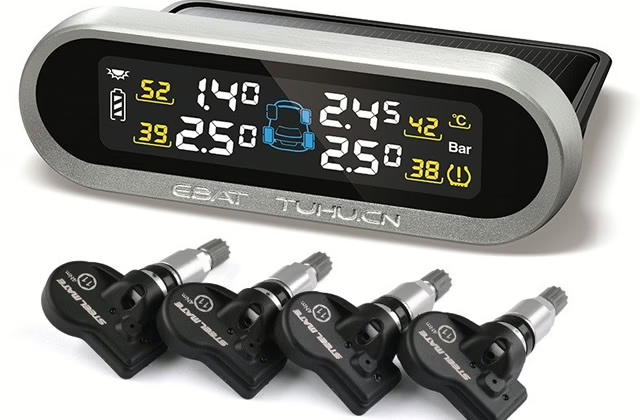
As a crucial component of a vehicle, tire performance is primarily determined by tire pressure. Both excessively low and high tire pressure negatively impact tire performance and lifespan, ultimately affecting driving safety.
TPMS, short for Tire Pressure Monitoring System, is a system that automatically monitors tire pressure in real time during vehicle operation. It alerts drivers to leaks and low pressure to ensure driving safety.
Types of Automotive Tire Pressure Monitoring Systems
Indirect Tire Pressure Monitoring System: Also known as WSB, this system uses wheel speed sensors from the vehicle’s ABS system to compare tire rotation speeds. ABS uses these sensors to determine wheel lock-up and activate the anti-lock braking system. When tire pressure decreases, the vehicle’s weight causes the tire diameter to shrink, resulting in a change in vehicle speed. This speed change triggers the WSB’s alarm system, alerting the driver to insufficient tire pressure. Therefore, indirect TPMS is a passive type of TPMS.
Direct Tire Pressure Monitoring System: A direct tire pressure monitoring system (Pressure-Sensor Based TPMS, or PSB for short) uses pressure sensors mounted on the tires to measure tire pressure. A wireless transmitter sends the pressure information from inside the tire to a central receiver module, which then displays the tire pressure data. The system will alert the system when the tire pressure is low or there is a leak. Therefore, direct TPMS is a type of active TPMS.
Comparison of WSB and PSB Advantages and Disadvantages
Both WSB and PSB have their advantages. PSB offers more advanced functionality, continuously measuring the actual instantaneous pressure inside each tire, making it easy to identify the faulty tire. WSB systems are relatively cheaper than PSB, requiring only a software upgrade to the four-wheel ABS system. However, WSB is not as accurate as PSB, and it cannot determine the true condition of the faulty tire.
In addition to PSB and WSB, there is also a hybrid TPMS on the market that combines the advantages of both PSB and WSB systems. It equips direct sensors in two diagonally opposite tires and installs a four-wheel indirect system. Compared to direct systems, this composite system reduces costs while overcoming the limitation of indirect TPMS, which cannot detect multiple tires simultaneously with low pressure. However, this composite TPMS still cannot provide real-time data on the actual pressure of all tires like PSB.
Direct tire pressure monitoring systems use batteries that power the sensors, with lifespans ranging from 3 to 10 years.
Benefits of Installing a Tire Pressure Monitoring System
1. Proactive Safety System
Existing automotive safety systems, such as anti-lock braking systems, electronic speed locks, electronic power steering, and airbags, only function after an accident, acting as “remedial” safety systems. TPMS, however, is different. It alerts the driver to take safe measures when tire pressure is about to become problematic, preventing potential accidents; it is a “proactive” safety system.
2. Increased Tire Lifespan
Statistical data shows that if a car’s tire pressure is consistently 25% below the standard value, the tire’s lifespan will only reach 70% of its design requirement. Conversely, excessively high tire pressure accelerates wear in the center of the tire. If tire pressure exceeds the normal value by 25%, tire lifespan will decrease to 80-85% of the design requirement. Tire strength decreases as tire temperature rises, and the tire’s elasticity increases; for every 1°C increase in temperature, tire wear increases by 2%.
3. Reduced Fuel Consumption and Environmental Protection
According to statistics, when tire pressure is 30% lower than normal, the engine requires more horsepower to achieve the same speed, increasing fuel consumption to 110%. Excessive fuel consumption not only increases driving costs but also produces more exhaust fumes, impacting air quality. With a TPMS (Tire Pressure Monitoring System), drivers can monitor tire pressure in real time, reducing fuel consumption and mitigating air pollution from vehicle exhaust.
4. Avoid Unusual Wear and Tear on Vehicle Components
Driving a car with excessively high tire pressure will lead to severe wear and tear on the engine and chassis over time. Uneven tire pressure can cause brake pull, thus increasing unusual wear and tear on the suspension system.