What does the P000E fault code mean?
The P000E fault code, applicable to all car manufacturers, means “Fuel Volume Regulator Control Exceeded Learning Limit.”
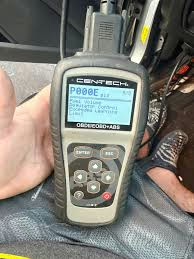
Background: The Electronic Control Unit (ECU) has detected that the adaptive learning of the fuel volume regulator has reached its maximum or minimum limit.
Symptoms of the P000E engine fault code may include:
- Reduced engine performance
- Excessive black smoke in the exhaust
- Reduced fuel efficiency
- Other drivable codes may also be stored
If any of the above symptoms occur, the vehicle should be diagnosed as soon as possible to prevent further engine damage.
Possible causes of the P000E code include:
- Fuel volume control valve malfunction
- Fuel pump malfunction
- Fuel volume sensor malfunction
- Open or short circuit in the fuel volume control system
- PCM malfunction or PCM programming error
How to troubleshoot the P000E fault?
Tools that may be needed to diagnose the P000E code include: OBD2 diagnostic scanner, digital volt/ohm meter (DVOM), manual fuel pressure gauge with adapter, reliable vehicle information source
First, locate the vehicle’s diagnostic connector and connect the scanner. Retrieve all stored codes and related data for use during the diagnostic process. Next, clear the fault codes and test drive the vehicle (if possible) to see which fault codes (if any) return. Search technical service bulletins for information relevant to the symptoms, stored codes, and vehicle. If the P000E immediately resets, use a fuel pressure gauge to check the fuel system pressure and measure the fuel volume. Use your vehicle information source to obtain fuel pressure and fuel volume specifications. Strictly follow fuel volume and fuel pressure testing guidelines, as high-pressure fuel systems can cause serious injury if handled improperly.
The following steps can be taken to repair OBD-II code P000E:
- Diagnostic Scan: The first step is to use an OBD2 car scanner to read the fault codes and identify the root cause of the problem. Once the problem is identified, it can be repaired.
- Fuel Pressure Check: The mechanic must check the fuel pressure to ensure it is within the manufacturer’s recommended range. If the fuel pressure is too high or too low, the fuel pressure regulator must be repaired or replaced.
- Fuel System Cleaning: If the fuel system is contaminated, it must be thoroughly cleaned to eliminate the contamination causing the problem.
- Replace Fuel Filter: A clogged fuel filter is also a possible cause of the problem. If the fuel filter is clogged, it must be replaced.
- Fuel Flow Regulator Replacement: If the root cause of the problem is the fuel flow regulator, the technician must disassemble the fuel system to replace the faulty part.
Can a car with OBD-II code P000E still be driven?
It is not recommended to drive a vehicle with OBD-II code P000E, as it may cause damage to the engine if not addressed promptly.