The P0176 is a generic OBD-II powertrain trouble code. Its official definition is “Fuel Composition Sensor Circuit Malfunction”.

Unlimited Choices, Easy Shopping
Unlimited Choices, Easy Shopping
The P0176 is a generic OBD-II powertrain trouble code. Its official definition is “Fuel Composition Sensor Circuit Malfunction”.
The P0175 is a generic OBD-II powertrain trouble code. Its official definition is “System Too Rich (Bank 2)”.
A 12V car wash pump does NOT inherently damage your battery—but it CAN, under the wrong conditions. The determining factors are: (1) the pump’s power draw, (2) whether the engine is running, and (3) how long you run it. A small 25–45W pump (≈2–4A) used for 10–15 minutes with the engine running will have virtually zero impact on battery health. A 100–150W pump (8–15A) run for 20+ minutes with the engine OFF will drain the battery significantly and can cause permanent damage if it drops below 10.8V.
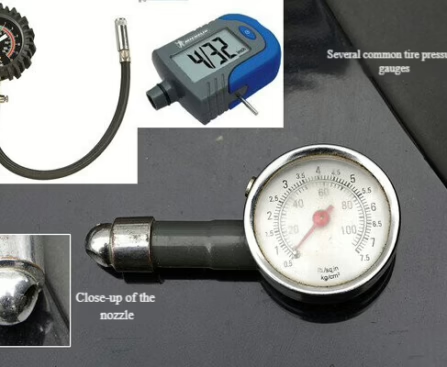
Proper tire inflation follows a fixed sequence: park safely → read the vehicle’s recommended cold PSI from the door jamb placard → start the engine in an open, well-ventilated area → connect the 12V tire inflator → set target pressure → inflate → verify with a standalone gauge → disconnect and stow. The most common mistakes are using the tire sidewall’s maximum PSI instead of the vehicle’s recommended PSI, failing to start the engine, and running the tyre pump past its duty-cycle limit until it overheats.

Run the engine. A running engine lets the alternator hold system voltage at ~13.8–14.4V, delivering steady power to the inflator while simultaneously recharging the battery. With the engine off, the inflator draws directly from the 12V battery, which sags to ~11.5–12.0V under load, reduces the inflator’s efficiency, and risks discharging the battery to the point where the vehicle won’t restart.
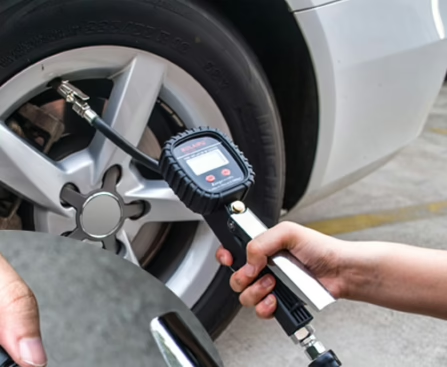
A tire inflator’s cable length and weight are important for real-world usability, but they rank below max PSI, airflow (L/min or CFM), amp draw, cylinder material, and duty cycle. A 9–11 ft power cord and an 18–26 inch air hose are the sweet spot for most cars and SUVs; anything shorter forces you to reposition the vehicle or the pump. Weight typically lands between 2–6 lbs for portable units—lighter is better for storage and handling, but a heavier tire pump usually means a metal cylinder, higher CFM, and better heat management. Match the size to your vehicle: a compact tire inflator for a sedan, a heavier tire pump for a truck.

At minimum, a tire inflator should ship with a spare fuse, a set of nozzle adapters (cone + ball needle + Presta valve adapter), an air hose long enough to reach all four tires, and a user manual. A quality tire pump adds a carry bag or hard case, battery clamps as an alternative power path, an LED work light, and an extension hose coupling. If the box is missing the spare fuse or the adapter set, that is a red flag regardless of brand.
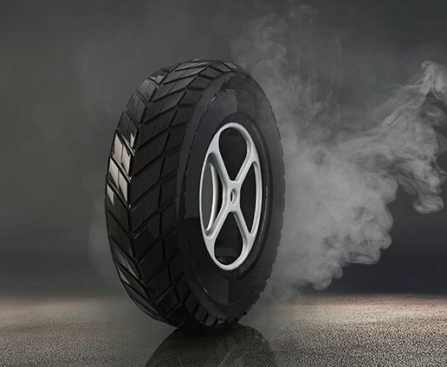
For any driver who inflates tires more than once a month, owns an SUV/truck, or cares about not having the pump die halfway through the fourth tire, a metal cylinder is objectively better. Period. A plastic cylinder tire inflator is lighter and cheaper and perfectly adequate for occasional emergency top-offs on a compact car—but it will warp, leak, and lose performance under sustained heat. The catch: “metal housing” is NOT the same as “metal cylinder.” You must check what the cylinder block itself is made of, not just the outer shell.
We use cookies to improve your experience on our site. By using our site, you consent to cookies.
Websites store cookies to enhance functionality and personalise your experience. You can manage your preferences, but blocking some cookies may impact site performance and services.
Essential cookies enable basic functions and are necessary for the proper function of the website.
These cookies are needed for adding comments on this website.
Google Tag Manager simplifies the management of marketing tags on your website without code changes.
Statistics cookies collect information anonymously. This information helps us understand how visitors use our website.
Google Analytics is a powerful tool that tracks and analyzes website traffic for informed marketing decisions.
Service URL: policies.google.com (opens in a new window)
SourceBuster is used by WooCommerce for order attribution based on user source.