
Anatomy of a 12V Cigarette Lighter Air Compressor: Core Components Explained
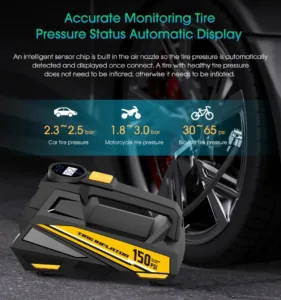
The 12V cigarette lighter air compressor is a compact and portable tire inflator, portable device designed to inflate tires, sports equipment, and inflatables using your vehicle’s electrical system. Its core functionality relies on a precise integration of mechanical, electrical, and control components. Primarily, it consists of five key subsystems: the Electric Motor, the Compression Mechanism (Cylinder & Piston), the Cooling System, the Control & Measurement Unit (Pressure Switch, Gauge, Circuitry), and the Air Delivery System (Hose, Nozzle, Connectors).
1. Electric Motor
This is the heart of the unit, converting electrical energy from your car into mechanical motion.
- Type: A direct current (DC) brushed motor is most common due to its simplicity, high starting torque, and cost-effectiveness for intermittent use.
- Power Source: It draws power through a standard 12V DC plug (cigarette lighter socket) via a cable, typically 10-15 feet long. Higher-end models may include alligator clips for direct connection to the car battery for more consistent power delivery.
- Function: The motor’s rotating shaft drives the compression mechanism. Its power rating (usually 100-180 watts) determines the compressor’s maximum pressure (PSI) and air flow (CFM or L/PM), which directly affects inflation speed.
2. Compression Mechanism: Cylinder & Piston Assembly
This is the core mechanical assembly where air is physically compressed.
- Cylinder: A small, durable chamber, often made of aluminum alloy or high-grade plastic, where the piston moves. Its internal volume and finish are critical for efficiency and heat dissipation.
- Piston: A reciprocating component driven by the motor via a connecting rod and crankshaft (or a wobble plate mechanism in very small units). It moves up and down within the cylinder.
- Intake & Exhaust Valves: Typically simple reed or flapper valves. The intake valve opens on the piston’s downstroke to draw in atmospheric air. On the upstroke, it closes, and the exhaust valve opens to force the compressed air into the hose.
3. Cooling System
Essential for managing the significant heat generated during compression, which is the primary limiter for continuous run time.
- Passive Cooling: Most units rely on metal fins or a ribbed housing on the cylinder to increase surface area for heat dissipation into the surrounding air.
- Active Cooling (in some models): A small fan attached to the motor shaft pulls air over the cylinder and motor housing. The fan is often integrated into the flywheel or is a separate plastic blade assembly.
- Duty Cycle: This refers to the ratio of run time to rest time (e.g., 20% duty cycle = 12 minutes of rest for every 3 minutes of operation). It is a direct specification of the cooling system’s effectiveness.
4. Control & Measurement Unit
This subsystem manages operation, safety, and user feedback.
| Component | Primary Function | Key Details |
|---|---|---|
| Pressure Switch (Auto-Shutoff) | The most critical feature for safety and convenience. It automatically stops the motor when the preset pressure is reached. | Uses a mechanical diaphragm or electronic sensor. The user sets the desired pressure (e.g., 35 PSI) via a dial or digital interface. Once the tire reaches that pressure, the switch cuts power to the motor. |
| Pressure Gauge | Provides visual feedback of the current pressure in the item being inflated. | Can be an analog dial (Bourdon tube type) or a digital LCD display. Digital gauges are generally more accurate and easier to read. The gauge may be integrated into the unit’s body or inline on the hose. |
| Circuit Board & Wiring | Manages electrical flow, connects the switch, gauge, motor, and power input. | Includes basic circuitry, often with a thermal overload protector that cuts power if the motor overheats, preventing burnout. May also include an LED work light. |
| On/Off Switch | Manual control for the user. | Often integrated with the pressure switch dial or as a separate button. In auto-shutoff models, it may only need to be turned on to start the cycle. |
5. Air Delivery System
This is the interface between the compressor and the item being inflated.
- Flexible Hose: A reinforced rubber or PVC hose that carries compressed air from the cylinder’s exhaust port to the nozzle. Length is typically 12-20 inches.
- Chuck / Connector: The fitting at the end of the hose. A standard tire chuck with a locking lever is most common for securing it to a tire’s valve stem.
- Accessory Nozzles & Adapters: Many compressors include additional nozzles for inflating sports balls, air mattresses, pool toys, etc., stored in a compartment on the unit or the hose.
- Quick-Connect Fittings: Some models have a quick-release coupling where the hose attaches to the body, making storage easier.
6. Housing & Additional Features
- Housing: A durable plastic or metal case that protects all internal components. It often includes handles, storage for the hose and power cord, and non-slip feet.
- Integrated LED Light: A valuable feature for emergency tire changes at night.
- Digital Display & Memory: On advanced models, allows for precise pressure setting and may remember settings for different tires.
Key Considerations for Selection & Use
- Performance Specs: Match the compressor’s maximum pressure (PSI) and air flow (CFM/LPM) to your needs. Inflating large SUV tires requires a more robust unit than for bicycle tires.
- Build Quality: Metal cylinder/piston assemblies are more durable and dissipate heat better than plastic ones for frequent use.
- Duty Cycle: For inflating multiple tires or large items, a higher duty cycle (e.g., 30%+) is crucial to avoid overheating and long cool-down waits.
- Power Connection: For consistent performance, especially at higher pressures, direct battery connection via alligator clips is superior to the cigarette lighter socket, which may have a lower current fuse (usually 10-15A).
Final Verdict: A 12V portable air compressor is a deceptively simple device that integrates precise mechanical action with essential electrical controls. Understanding its components—from the motor and piston that create pressure, to the cooling system that manages heat, and the auto-shutoff switch that ensures safety—allows you to select a reliable model and operate it effectively for years of service. When choosing one, prioritize units with a metal compression chamber, an accurate auto-shutoff feature, and a duty cycle that matches your intended use.