
The question of whether a motorcycle needs a Tire Pressure Monitoring System (TPMS) is fundamentally about risk management. Given the severe consequences of incorrect tire pressure on a motorcycle’s stability and safety, a strong case for necessity can be made. However, this necessity is not absolute for every rider in every scenario; it is a spectrum defined by the level of risk mitigation required and the capabilities of the available technology.
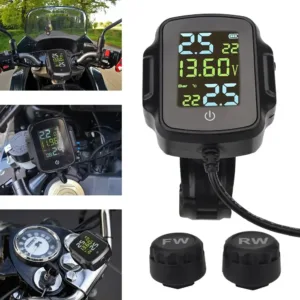
The Argument for Necessity: A Risk-Based Imperative
The physics of motorcycling create a non-negotiable truth: tire pressure is a primary safety variable. Unlike a car, a motorcycle has minimal margin for error. A pressure loss of just 20% can significantly degrade handling and increase stopping distance, often imperceptibly until a critical moment.
From this perspective, continuous, accurate pressure monitoring is necessary because:
- Human Checks Are Inadequate: Manual gauges are sporadic, often inaccurate, and cannot detect a puncture that occurs minutes after a check.
- The Stakes Are High: The cost of failure is a crash. A TPMS, particularly a Direct TPMS, acts as a critical early-warning system for the single most common cause of tire failure: under-inflation.
- It Manages a Dynamic Variable: Pressure changes with temperature. A TPMS provides the data needed to ensure tires are in their optimal operating range throughout a ride.
Analyzing “Necessity” Through Technological Capability
The necessity of having some form of monitoring is high. The necessity of a specific type of TPMS depends on the safety standard one wishes to meet.
| System & Its Role | Does it Address the Core Necessity? | Analysis of Necessity Level |
|---|---|---|
| 1. Direct TPMS (dTPMS) – Provides actual PSI & temperature per tire. – Works stationary and moving. | Fully. It is the only technology that provides the proactive, preventive data required for complete tire pressure management and risk mitigation. | High Necessity. For riders who prioritize active safety management, performance optimization, and long-distance touring, a dTPMS transitions from an accessory to a necessary instrument. It solves the problem definitively. |
| 2. Indirect TPMS (iTPMS) with Display – Estimates pressure via wheel speed algorithms. – Provides a calculated readout or percentage. | Partially. It offers enhanced situational awareness over a simple light, but its data is inferred, not measured. It cannot provide pre-ride status or detect all failure modes. | Moderate/Pragmatic Necessity. For a rider whose new motorcycle includes this as a standard feature, it provides a valuable and more informative safety net than nothing. It addresses the necessity for a basic alert system, but not for a precision management tool. |
| 3. Indirect TPMS (Warning Light Only) – Basic alert for significant pressure difference. | Minimally. It fulfills a bare-minimum function of alerting to a major, asymmetric pressure loss after it occurs and the bike is moving. | Low Threshold of Necessity. It is better than no system, but its limitations are so pronounced that it does not significantly reduce the necessity for vigilant manual checks. It serves as a last-resort backup. |
| 4. Manual Gauge & Discipline Only – No electronic monitoring. | No. This method cannot provide the continuous monitoring that the risk profile of motorcycling justifies as necessary. | Relies entirely on rider habit and gauge accuracy. Leaves a critical risk gap between checks, which many safety-conscious riders find unacceptable. |
Synthesized Conclusion: A Graded Framework for Necessity
Therefore, the necessity of installing a TPMS is best understood on a graded scale:
- For Optimal Safety & Performance (High Necessity): Installing an aftermarket Direct TPMS is necessary. It is the only way to achieve proactive, data-driven tire safety management. This is the recommended choice for any rider who views risk mitigation as a priority.
- For Leveraging Integrated Safety Systems (Moderate Necessity): Utilizing a factory-fitted Indirect TPMS (especially with a display) meets a baseline level of necessity. It provides a useful, always-on warning system that adds a layer of safety over manual checks alone. It is a necessary and valuable feature of a modern motorcycle’s electronics suite, but riders must understand its limits and continue manual checks.
- For Minimalist or Budget-Conscious Riders (Acknowledged Risk): Forgoing any TPMS and relying solely on manual checks is a choice that accepts a higher, continuous risk. In the context of modern safety technology, this approach is increasingly difficult to justify as “sufficient,” thus elevating the relative necessity of at least an indirect system.
Final Perspective: The technological capability to continuously monitor a critical safety parameter exists. Given the severe consequences of that parameter failing, the prudent and responsible choice—which defines a practical form of necessity—is to utilize the best monitoring system available and applicable to one’s riding. For most riders, this means a Direct TPMS is highly necessary; for all riders, having some form of electronic monitoring (including improved indirect systems) is a significant and necessary step beyond the era of the manual gauge alone.