
What Does Fault Code P0106 Mean?
Fault code P0106, applicable to all vehicle manufacturers, indicates “Manifold Absolute Pressure/Barometric Pressure Circuit Range/Performance Problem”. This generic powertrain code signifies that the vehicle’s Powertrain Control Module (PCM) or Engine Control Module (ECM) has detected that the signal from the Manifold Absolute Pressure (MAP) sensor is outside the expected or plausible range for the current operating conditions.
Background: The Manifold Absolute Pressure (MAP) sensor is a critical component typically mounted on the intake manifold. Its primary function is to measure the absolute air pressure inside the intake manifold. The PCM/ECM uses this real-time data, along with inputs from other sensors like the Throttle Position (TP) sensor and engine speed, to calculate engine load, determine the optimal air-fuel mixture, and adjust ignition timing. The sensor receives a 5-volt reference signal from the PCM and returns a variable signal voltage (typically 1-4.5 volts) based on manifold pressure. Code P0106 is specifically a rationality or performance code. The PCM calculates a predicted MAP value based on throttle position and engine speed and compares it to the actual sensor reading. If the actual signal falls outside the predicted range for a set duration (e.g., 2 seconds), the code is set.
Symptoms of Fault Code P0106
- Illuminated Check Engine Light (MIL).
- Rough engine performance, hesitation, or lack of power during acceleration.
- Black or dark exhaust smoke, indicating an overly rich air-fuel mixture.
- Rough or unstable idle, potentially leading to engine stalling.
- Noticeably reduced fuel economy.
- Engine misfire, especially at higher speeds.
- Unusual engine sounds or vibrations.
Main Causes of Fault Code P0106
- Faulty MAP Sensor: The sensor itself can fail internally, providing erratic, stuck, or out-of-range voltage signals.
- Electrical Issues: Damaged, frayed, corroded, or loose wires and connectors in the MAP sensor circuit (5V reference, ground, or signal wire) can cause shorts, opens, or high resistance.
- Vacuum Leaks: Leaks in the intake manifold, vacuum hoses, or the MAP sensor’s own vacuum supply line can cause incorrect and fluctuating pressure readings.
- Clogged or Restricted MAP Sensor Port: A blockage in the vacuum port or hose connecting the intake manifold to the MAP sensor can prevent accurate pressure measurement.
- Malfunctioning Exhaust Gas Recirculation (EGR) System: A stuck or leaking EGR valve can introduce unmetered exhaust gas into the intake, skewing manifold pressure readings.
- Faulty Powertrain Control Module (PCM/ECM): In rare cases, a malfunction in the computer itself can cause it to misinterpret a valid sensor signal.
How to Diagnose Fault Code P0106?
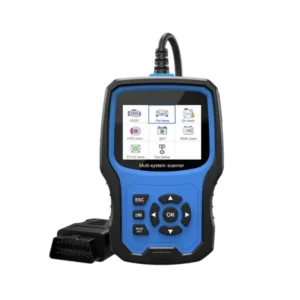
- Connect an OBD2 scanner to read and confirm code P0106. Record freeze frame data (RPM, load, MAP voltage) when the fault occurred. Check for any related codes like P0105, P0107, or P0108.
- Perform a detailed visual inspection of the MAP sensor, its electrical connector, and the associated wiring harness. Look for damage, corrosion, or loose connections.
- Inspect all vacuum hoses and the intake manifold for cracks, leaks, or disconnections. A smoke test is the most effective method for finding small vacuum leaks.
- Check the small vacuum hose/port on the MAP sensor for blockages.
- With the key on (engine off), use a digital multimeter to test the MAP sensor’s wiring harness. Check for the presence of the 5-volt reference signal, a good ground, and continuity in the signal wire back to the PCM.
- Start the engine and use your scan tool to monitor the MAP sensor’s live data (reported in kPa, inHg, or volts). At idle (high vacuum), the reading should be low (e.g., 20-48 kPa or ~1-1.5V). Quickly opening the throttle should cause a rapid increase in the reading (e.g., ~100 kPa or ~4.5V). A reading that is static, erratic, or does not respond correctly to throttle input indicates a problem.
Possible Causes and Diagnostic Methods
| Possible Cause | How to Check? |
|---|---|
| Faulty MAP Sensor | Test with live data using a scan tool. The voltage/pressure should change rapidly and predictably with throttle input. A known-good sensor can be substituted for testing. |
| Wiring/Connector Issue | Visually inspect for damage. Use a multimeter to check for 5V reference, ground, and signal wire continuity/shorts. |
| Vacuum Leak | Perform a smoke test on the intake system. Listen for hissing sounds or use a propane torch (carefully) to detect changes in idle speed. |
| Clogged MAP Sensor Port | Remove the sensor and inspect the small vacuum port for carbon buildup or obstruction. |
| Faulty EGR System | Use a scan tool to command the EGR valve and monitor its operation. A stuck open EGR valve can cause a vacuum leak. |
| Faulty PCM/ECM | Diagnose only after ruling out all sensor, wiring, and vacuum issues. May require professional reprogramming or replacement. |
| Carbon Buildup in Throttle Body | In some GM vehicles, excessive carbon can cause erratic idle and trigger P0106. Cleaning the throttle body bore and plate may resolve the issue. |
Required Tools: OBD2 scanner or car scanner (capable of reading live data), digital multimeter (DMM), basic hand tools, smoke machine (for professional leak detection), manual vacuum pump (for sensor testing).

How to Fix Fault Code P0106? (Solutions)
Simple Fixes:
- Clean the MAP Sensor Port/Throttle Body: Remove the sensor and clear any carbon or debris from its vacuum port. For some vehicles, cleaning the throttle body may resolve the issue.
- Repair Vacuum Leaks: Replace cracked or brittle vacuum hoses. Reseal leaking intake manifold gaskets.
- Repair Wiring/Connectors: Clean corrosion from the MAP sensor connector with electrical contact cleaner. Repair any damaged wires with solder and heat shrink tubing.
- After repairs, use your obd2 code reader to clear the code and take a test drive to see if it returns.
In-Depth Diagnosis and Repair:
- Replace the MAP Sensor: If testing confirms a faulty sensor, replace it. Ensure the new sensor is correct for your vehicle’s make and model.
- Repair Wiring Harness: If damage is found in the wiring, repair or replace the affected section.
- Repair or Replace EGR Valve/System: If diagnostics point to a faulty EGR system, repair or replace the necessary components.
- In the rare event of a faulty PCM, professional reprogramming or replacement is required.
Troubleshooting by Symptom
| Symptom | Likely Focus Area |
|---|---|
| Rough idle and stalling | Significant vacuum leak, faulty MAP sensor, or carbon-clogged throttle body. |
| Lack of power and black smoke | Faulty MAP sensor providing a consistently high signal (low vacuum reading), causing a rich fuel mixture. |
| Poor fuel economy only | MAP sensor providing an incorrect signal, leading to suboptimal fuel trims. |
| Intermittent Check Engine Light | Loose electrical connection, corroded connector, or an intermittent wiring fault. |
| Hesitation during acceleration | MAP sensor not responding quickly enough to changes in engine load, or a vacuum leak under load. |
Fault Code P0106 in Common Vehicles
- General Motors (GM) Vehicles (Chevrolet, GMC, Buick, Cadillac): Many GM vehicles are prone to P0106 due to carbon buildup in the throttle body, which can cause erratic idle and sensor readings. Wiring harness issues and failing MAP sensors are also common. The PCM uses complex logic models comparing MAP, MAF, and TP sensor data to set this code.
- Toyota/Lexus: Toyota’s ECM strategy for P0106 involves comparing the MAP sensor signal against an expected value based on throttle position and engine speed. Common causes include faulty sensors, vacuum leaks, and wiring problems.
- Ford Vehicles: Frequently experiences P0106 from similar causes: faulty MAP sensors, vacuum leaks (especially in intake manifold gaskets on older models like the Triton V8), and wiring harness problems.
- Honda/Acura: Prone to P0106 from vacuum leaks in the intricate intake system (e.g., PCV hoses, intake manifold gaskets) and failing MAP sensors. Live data monitoring is crucial for diagnosis.
- Chrysler/Dodge/Jeep: Similar to GM, these vehicles use rationality checks between sensors. Faulty sensors and corroded connectors are typical culprits.
- Nissan/Infiniti: Common causes include failed MAP sensors and vacuum leaks from deteriorated intake hoses or gaskets.
- Hyundai/Kia: Frequently sets P0106 due to failing MAP sensors and vacuum leaks.
- Volkswagen/Audi Group (VAG) Vehicles: Sensitive to MAP sensor performance and vacuum system integrity. Wiring issues and sensor failures are common triggers.
- BMW/Mercedes-Benz: These vehicles have sophisticated engine management systems. P0106 often points to wiring faults, a failing sensor, or vacuum leaks in the complex intake system.
- Subaru: MAP sensor failures and intake system vacuum leaks are common causes.
P0106 Frequently Asked Questions
What is the first thing I should check when I get a P0106 code?
The first step is to use a vehicle code reader or OBD2 scanner to confirm the code and check for any related codes (like P0105 or P0107). Then, perform a thorough visual inspection of the MAP sensor, its connector, and all associated vacuum hoses for obvious damage or disconnections.
Can I drive my car with a P0106 code?
It is not recommended to drive for an extended period. The engine may run poorly, have reduced power, and suffer from significantly increased fuel consumption and emissions. Driving could potentially cause damage to the catalytic converter from a consistently incorrect air-fuel mixture.
Is a P0106 code serious?
Yes, it is considered a serious code. Incorrect manifold pressure data can lead to poor drivability, increased emissions, reduced fuel economy, and can cause long-term engine or catalytic converter damage if left unresolved.
How much does it cost to fix a P0106 code?
The repair costs vary greatly. If it is just cleaning a port or repairing a vacuum tube, the cost may be less than $50. A new MAP sensor usually costs between $50 and $250. The shop’s diagnostic and repair labor costs may add $80 to $200, bringing the total cost from about $130 to over $450.
Can a vacuum leak cause a P0106 code?
Yes, vacuum leaks are a very common cause of P0106. A leak introduces unmetered air, changing the manifold pressure and causing the MAP sensor reading to be inaccurate or out of the expected range compared to the PCM’s calculated value.
Can I test a MAP sensor with a multimeter?
Yes, to an extent. With the key on (engine off), check for 5 volts on the reference wire and a good ground. You can also measure the signal voltage at idle and at wide-open throttle (engine off, apply vacuum). However, the best test is using a scan tool to monitor live data while the engine runs.
Will disconnecting the battery clear a P0106 code?
It may clear the code temporarily, but if the underlying fault remains, the code will return once the vehicle completes its drive cycles and the monitor runs again.
My car has P0106 and is running rough. Could it be something else?
Yes. While P0106 points to the MAP circuit, the root cause could be a large vacuum leak, a faulty Throttle Position (TP) sensor providing conflicting data, a malfunctioning EGR system, or even excessive carbon buildup in the throttle body (common in some GM vehicles).
What tools do I need to diagnose P0106 myself?
You will need an OBD2 scanner or a dedicated vehicle diagnostics tool capable of reading live data, a digital multimeter (DMM) for electrical testing, basic hand tools, and possibly a smoke machine or vacuum gauge for leak detection.
How do I know if it’s the sensor or the wiring?
Use a multimeter to check for 5 volts at the sensor connector (key on, engine off). If voltage is present and the ground is good, unplug the sensor and test its resistance or back-probe the signal wire to monitor voltage change with a vacuum pump. If the sensor responds correctly to applied vacuum, the wiring or PCM is likely at fault.
Related OBD2 Fault Codes
- P0105: Manifold Absolute Pressure (MAP) Sensor Circuit Malfunction.
- P0107: Manifold Absolute Pressure (MAP) Sensor Circuit Low Input.
- P0108: Manifold Absolute Pressure (MAP) Sensor Circuit High Input.
- P0101: Mass Air Flow (MAF) Sensor Circuit Range/Performance Problem (often related).
- P0506: Idle Air Control System RPM Lower Than Expected (can be triggered alongside P0106 in some cases).
Important Note! Code P0106 indicates a rationality or performance issue with the MAP sensor circuit. The problem is not always the sensor itself; it is very often caused by vacuum leaks, wiring problems, or even a dirty throttle body. Using a quality OBD2 scanner to monitor live data is crucial for an accurate diagnosis. Never ignore this code, as incorrect manifold pressure data can lead to poor performance, increased emissions, reduced fuel economy, and potential engine damage over time. Always perform thorough diagnostics before replacing parts.