
What Does Fault Code P0103 Mean?
Fault code P0103, applicable to all vehicle manufacturers, indicates “Mass or Volume Air Flow A Circuit High Input”. This generic powertrain code signifies that the Powertrain Control Module (PCM) or Engine Control Module (ECM) has detected that the incoming signal voltage from the Mass Air Flow (MAF) sensor is consistently above the maximum expected threshold (typically above 0.46 volts) for the current engine operating conditions.
Background: The Mass Air Flow (MAF) sensor is a critical component located in the engine’s air intake tract, between the air filter and the throttle body. Its primary function is to measure the mass (volume and density) of air entering the engine. The PCM/ECM uses this real-time data as a primary input to calculate the precise amount of fuel needed for optimal combustion, power, and emissions control. Code P0103 is set when the ECM detects the MAF sensor’s signal voltage is abnormally high, indicating it is reading more airflow than is logically possible for the engine’s current state.
Symptoms of Fault Code P0103
- Illuminated Check Engine Light (CEL).
- Black or dark gray smoke from the exhaust pipe, indicating an excessively rich fuel mixture (too much fuel).
- Rough idling, engine stumbling, or stalling.
- Noticeably poor fuel economy.
- Lack of power, sluggish acceleration, and hesitation during throttle input.
- Engine may run excessively rich, leading to fouled spark plugs and potential damage to the catalytic converter over time.
- Hard starting.
Main Causes of Fault Code P0103
- Faulty or Contaminated MAF Sensor: The sensor’s hot wire or film can become coated with dirt, oil, or debris, but in this case, it may cause an erratic high signal. The sensor can also fail internally, sending a constantly high voltage.
- Damaged Wiring or Connectors: A short circuit in the MAF sensor signal wire to the power supply (12V or 5V reference) is a common cause of P0103. This directly sends a high voltage signal to the ECM.
- Intake Air Leaks (Upstream of MAF): Unmetered air entering the engine before the MAF sensor (e.g., a cracked air intake hose between the filter box and the sensor) can cause turbulent or unmetered air to hit the sensor, potentially causing a high or erratic reading.
- Faulty Engine Control Module (ECM/PCM): In rare cases, a malfunction in the computer itself can cause it to misinterpret a valid sensor signal as being too high.
- Issues with Related Sensors or Systems: A faulty Manifold Absolute Pressure (MAP) sensor or problems with the Exhaust Gas Recirculation (EGR) system (e.g., a stuck-closed EGR valve) can provide conflicting data, leading the ECM to perceive the MAF reading as illogically high.
How to Diagnose Fault Code P0103?
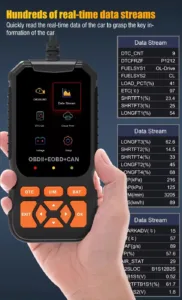
- Connect an OBD2 scanner to read and confirm code P0103. Record freeze frame data to see engine conditions (RPM, load, temperature) when the fault occurred. Check for other related codes like P0172 (System Too Rich).
- Perform a detailed visual inspection of the air intake system from the air filter box to the MAF sensor. Look for cracks, loose clamps, or disconnected hoses that could allow unmetered air in before the sensor.
- Inspect the MAF sensor connector and wiring harness for damage, corrosion, or signs of a short circuit.
- Carefully remove the MAF sensor and clean it with a dedicated MAF sensor cleaner. Allow it to dry completely before reinstalling. Do not touch the sensing elements.
- With the engine idling, use your scan tool to monitor the MAF sensor’s live data, typically reported in grams per second (g/s). Compare the reading at idle and at a steady 2500 RPM to the manufacturer’s specifications. An abnormally high reading (e.g., 8-10 g/s at idle when it should be 2-4 g/s) confirms the issue.
- Use a digital multimeter to test the MAF sensor’s wiring harness. Check for a short to power in the signal wire by measuring voltage between the signal wire and ground with the key on.
Possible Causes and Diagnostic Methods
| Possible Cause | How to Check? |
|---|---|
| Dirty/Contaminated MAF Sensor | Clean with MAF sensor cleaner. Monitor live data before and after cleaning. |
| Wiring Short to Power | Use a multimeter to check for voltage on the MAF signal wire with the key on (engine off). Should be very low (under 1V). If it reads 5V or 12V, there is a short. |
| Intake Air Leak (Pre-MAF) | Perform a smoke test on the intake system upstream of the MAF sensor. Visually inspect all hoses and connections. |
| Faulty MAF Sensor | Test with live data. A known-good sensor can be substituted to see if the problem is resolved. |
| Faulty PCM/ECM | Diagnose only after ruling out all other causes. May require professional reprogramming or replacement. |
Required Tools: OBD2 scanner (capable of reading live data), digital multimeter, MAF sensor cleaner, basic hand tools, smoke machine (for professional leak detection).
How to Fix Fault Code P0103? (Solutions)
Simple Fixes:
- Clean the MAF Sensor: This can resolve issues caused by contamination.
- Repair Intake Leaks: Tighten all intake hose clamps before the MAF sensor. Replace any cracked or deteriorated air intake ducting.
- Repair Wiring/Connectors: If a short circuit is found, repair the damaged wire with solder and heat shrink tubing. Clean corrosion from the MAF connector.
- After repairs, use your car code reader to clear the code and take a test drive to see if it returns.
In-Depth Diagnosis and Repair:
- Replace the MAF Sensor: If cleaning doesn’t work and live data confirms an out-of-spec high signal, replace the sensor. OEM parts are recommended.
- Repair Wiring Harness: If a short to power is confirmed, trace and repair the entire affected section of the wiring harness.
- In the rare event of a faulty ECM, professional reprogramming or replacement is required.
Troubleshooting by Symptom
| Symptom | Likely Focus Area |
|---|---|
| Black smoke and poor fuel economy | MAF sensor reading too high, causing severe over-fueling. Check for wiring short or failed sensor. |
| Rough idle and stalling | Could be a severely contaminated sensor or a significant pre-MAF intake leak causing erratic readings. |
| Lack of power only | May indicate a moderately high MAF signal causing a rich condition that hampers performance. |
| Code is intermittent | Loose electrical connection, corroded connector, or an intermittent wiring short. |
Fault Code P0103 in Common Vehicles
- Volkswagen Jetta / Golf / Passat (2005-2015, especially with 2.0L and 2.5L engines): Prone to MAF sensor failures and wiring harness issues. The sensors are sensitive to oil contamination from aftermarket air filters.
- Toyota Camry / Corolla (2007-2014): Generally reliable, but P0103 can appear due to a faulty MAF sensor or, less commonly, a vacuum leak in the PCV system causing a false high reading.
- Ford F-150 (2004-2010 with 5.4L V8): Known for MAF sensor failures. Also check for cracks in the intake elbow before the sensor.
- Honda Civic / Accord (2006-2012): MAF sensors can fail, often preceded by symptoms of poor fuel economy. Wiring connector issues are also common.
- Chevrolet Silverado / GMC Sierra (2007-2013): Similar to Ford, MAF sensor issues are frequent. Also susceptible to wiring harness issues where it rubs against other components.
- BMW 3-Series (E90, 2006-2011): Sensitive to MAF performance. Issues often arise from oil contamination if an aftermarket oiled air filter is used, or from vacuum leaks causing erratic readings.

- Nissan Altima / Sentra (2007-2012): Frequently sets P0103 due to a faulty MAF sensor. The connectors can also become brittle and cause poor contact.
- Subaru Impreza / Forester (2008-2014): Their MAF sensors are sensitive to circuit issues. A P0103 code here often points directly to a failed sensor or a short in the wiring.
- Hyundai Sonata / Elantra (2011-2015): Common causes include failed MAF sensors and intake leaks pre-sensor, particularly around the air filter box.
- Jeep Grand Cherokee (2005-2010 with 4.7L or 5.7L V8): Prone to MAF sensor failures, especially in dusty environments. The location of the sensor makes it vulnerable.
- Toyota RAV4 (2006-2012): Can experience P0103 from a failing MAF sensor. It’s often accompanied by a P0172 (System Too Rich) code.
- Mercedes-Benz C-Class (W204, 2008-2014): MAF sensors are a known wear item. Failure often leads to poor drivability and the P0103 code.
P0103 Frequently Asked Questions
What is the first thing I should check when I get a P0103 code?
The very first step is to use an obd2 code scanner to confirm the code and check for any related codes (like P0172). Then, perform a thorough visual inspection of the air intake system before the MAF sensor and the MAF sensor connector/wiring for obvious damage or shorts.
Can I drive my car with a P0103 code?
It is not recommended for extended driving. The incorrect, overly rich air-fuel mixture can drastically reduce fuel economy, increase harmful emissions, cause black smoke, and potentially damage the catalytic converter or oxygen sensors over time. Performance will also be poor.
Is a P0103 code serious?
Yes, it is considered a moderate severity code. While it may not cause an immediate breakdown, it leads to increased emissions, poor fuel economy, and can cause long-term damage to expensive components like the catalytic converter.
Can a dirty air filter cause a P0103 code?
Typically, a dirty air filter causes low airflow and is more associated with P0102. However, a severely clogged filter causing erratic airflow might contribute to an implausible signal, but a direct short or sensor failure is a more common cause of P0103.
Can a vacuum leak cause a P0103 code?
Usually, vacuum leaks cause a low MAF reading (P0102). However, an intake leak upstream of the MAF sensor (between the air filter and the sensor) can allow turbulent, unmetered air to hit the sensor, potentially causing a high or erratic reading that could trigger P0103.
I cleaned my MAF sensor, but the P0103 code came back. Why?
The most likely reason is a wiring fault, specifically a short to power in the MAF sensor signal circuit. Other possibilities are: the MAF sensor is truly faulty and cleaning wasn’t enough, or there is an intake leak upstream of the sensor.
Can I just reset the P0103 code without fixing anything?
You can clear it with a car code scanner, but if the root cause (like a wiring short) remains, the code will almost certainly return within one or two drive cycles as the ECU’s monitors run their tests again.
How much does it cost to fix a P0103 code?
The cost varies greatly. If it’s just cleaning the sensor, it may be less than $20. Labor for repairing a circuit short could be between $100 and $300. A new MAF sensor usually costs between $100 and $400 for the part, plus labor.
Can a bad battery or alternator cause a P0103 code?
In rare cases, yes. A weak electrical system with low or fluctuating voltage can cause sensors to send irregular signals, which the ECM may interpret as a performance problem. However, P0103 specifically indicates a high voltage signal, which is more indicative of a direct short to power in the wiring.
Related OBD2 Fault Codes
- P0100: Mass or Volume Air Flow Circuit Malfunction.
- P0101: Mass or Volume Air Flow Circuit Range/Performance.
- P0102: Mass or Volume Air Flow Circuit Low Input.
- P0172: System Too Rich (Bank 1) – Often a direct result of a MAF reading too high.
- P0171: System Too Lean (Bank 1) – Often a direct result of a MAF reading too low.
Important Note! Code P0103 often indicates a wiring short to power, which is a more serious electrical fault than a simple dirty sensor. Always diagnose the root cause—whether it’s a short circuit, a failed sensor, or an intake leak—before replacing parts. Using a quality obd code reader to view live sensor data and a multimeter to check for shorts is crucial for an accurate diagnosis. Never use anything other than dedicated MAF sensor cleaner on the sensor element.