
is there a dash cam that requires no wires?
Yes, there are indeed dash cams on the market that operate completely without wires, offering great installation convenience and a cleaner interior for car owners. However, it’s important to clarify that “wireless” typically has two meanings, which should be carefully distinguished when making a purchase.
Truly “Wireless” Dash Cams
These products are wireless in the true sense, with their core characteristic being reliance on a built-in battery for power, eliminating the need to connect to the vehicle’s power supply.
- How They Work: They operate via a built-in rechargeable lithium-ion battery. During installation, you only need to fix the main unit to the windshield using the included bracket to start recording, achieving genuine “zero cabling”.
- Pros and Cons: The biggest advantages are extremely simple installation and ease of movement between different vehicles. However, their battery life is limited by capacity, usually making it difficult to support 24/7 continuous recording. Additionally, lithium batteries pose safety risks and lifespan issues in high summer temperatures.
- Best Use Cases: They are ideal for short-term use in rental vehicles, owners who do not want any wiring operations, or as a temporary supplementary monitoring device.
The Other “Wireless”: Wi-Fi Data Transfer Type
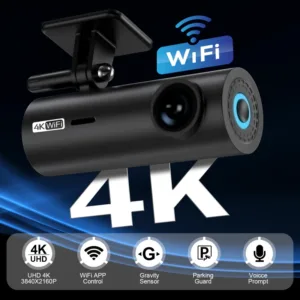
More often in the market, dash cams referred to as “wireless” indicate data transfer via Wi-Fi, not their power supply method.
- The Reality: These dash cams still need to be connected to the vehicle’s cigarette lighter or wired to the fuse box for power, essentially being “wired for power.” Their “wireless” aspect is reflected in the ability to connect to a self-created Wi-Fi hotspot via a mobile app for wireless preview, video download, and settings adjustment, saving the hassle of plugging and unplugging the memory card.
- Advantage: They provide convenient mobile app management while ensuring a stable power supply (enabling features like parking mode). Most mainstream dash cam brands currently offer this functionality.
Pros and Cons of Wireless Dash Cams
Before deciding on a truly wireless product, weigh its pros and cons.
- Pros:
- Easy Installation: Saves the complex wiring process, keeping the car interior neat and aesthetically pleasing.
- High Flexibility: Can be easily detached for use in different vehicles or taken away from the vehicle to prevent theft.
- Cons:
- Battery Life Anxiety: Battery capacity limits single recording sessions, making them unsuitable for users requiring long-duration parking surveillance.
- Poor Environmental Adaptability: Lithium batteries are sensitive to high and low temperatures, with performance significantly declining in harsh conditions.
- Limited Features: Due to power consumption constraints, truly wireless recorders often have inferior performance (e.g., resolution, number of channels) compared to continuously powered products.
Selection and Purchasing Advice
- Clarify Your Needs: First, think clearly: Do you need the convenience of completely getting rid of power cables, or just the ease of managing videos via Wi-Fi? These are two completely different product selection directions.
- Focus on Battery Technology: If opting for a truly wireless product, prioritize models that mention high-temperature-resistant batteries or the use of supercapacitors (which, while not enabling completely wireless operation, are safer and more durable).
- Refer to Reliable Brands: When choosing, consider brands with a mature reputation and technology.
I hope this information helps clarify the concepts and allows you to make the most suitable choice based on your actual needs.