
What is the P0000 fault code?
The fault code P0000 within the OBD2 (On-Board Diagnostics II) system is a special case. It indicates that no faults have been logged, meaning it does not represent a specific error. This code most commonly appears when a scanner or diagnostic system fails to detect any issues with the vehicle’s systems.
Although the P0000 code is not associated with a specific fault, its appearance can be due to peculiarities in the Engine Control Unit (ECU) software, malfunction of the diagnostic equipment, or errors in reading data.
In most cases, P0000 does not affect traffic safety or indicate a maintenance need. However, if it appears frequently, it is worth ensuring the diagnostic equipment is functioning correctly or consulting an expert for a check.
Meaning and Explanation of Fault Code P0000
P0000 – No Fault Detected
The P0000 code indicates there are no errors in the Engine Control Unit (ECU) memory. It does not point to a specific system (fuel, exhaust, transmission, etc.), but rather shows that there are no active DTCs (Diagnostic Trouble Codes).
Symptoms of Fault Code P0000
Although the P0000 code does not indicate a specific fault, its appearance may be accompanied by the following situations:
- The “Check Engine” light is illuminated, but scanning reveals only P0000 with no other fault codes.
- Inability to read other codes from the ECU memory.
- Scanner fails to connect or reports a protocol error.
- Periodic appearance of the P0000 code when using different scanners.
Main Causes of Fault Code P0000
- Diagnostic scanner connection error.
- Use of an outdated or incompatible OBD2 scanner.
- ECU software glitch.
- Issues with the diagnostic connector power circuit (OBD2).
- Electrical interference or unstable voltage.
How to Diagnose Fault Code P0000?
Although the P0000 code does not indicate a specific problem, its appearance still needs to be checked—especially when the “Check Engine” light is on or the vehicle behaves abnormally. The following is a series of operational steps to help you ensure everything is normal with the vehicle or identify potential hidden faults.
- Ensure the scanner is properly connected. Check that the OBD2 connector is clean, the contacts are not oxidized, and the scanner is firmly seated.
- Use a different diagnostic scanner. If your device only displays the P0000 code and cannot read other data, try a different one, preferably a professional or brand-specific scanner.
- Perform a comprehensive scan of all systems. Even if there are no errors in the “Engine” section, check other systems: ABS, airbags, transmission, etc.
- Check power to the diagnostic connector. Use a multimeter to measure voltage at the OBD2 connector pins (typically pins 4, 5, and 16).
- Perform an error reset and analyze behavior. Clear all codes, start the engine, and see if the code reappears. If the “Check Engine” light comes on again, repeat the diagnosis.
Possible Causes and Diagnostic Methods
| Possible Cause | How to Check? |
| Incorrect or incompatible scanner | Try another OBD2 scanner |
| ECU software glitch | Reset the adapter or update the software |
| Damaged power circuit for OBD2 connector | Check fuses, inspect the connector |
| Electrical interference or unstable power | Check on-board voltage, alternator, battery |
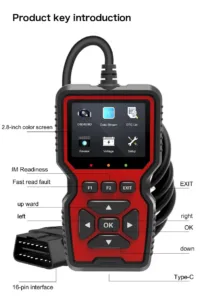
Tools Needed: A reliable OBD2 scanner (preferably supporting advanced protocols), a multimeter for voltage testing, lithium grease or contact cleaner (if the connector is oxidized), OBD2 connector pinout guide (for your specific vehicle)
How to Fix Fault Code P0000? (Problem Solutions)
P0000 Error Caused by Chips Oxidizing (Note: This header seems like a translation artifact. It might be referring to ECU chip issues broadly. The translation keeps it literal as context is unclear.)
Simple Fixes
- Disconnect and reconnect the diagnostic connector.
- Use a different, fully compatible scanner.
- Restart the ECU (disconnect the battery for 5-10 minutes).
- Check battery voltage (should be 12.4 volts or higher).
- Clear diagnostic codes and check if P0000 reappears.
In-Depth Diagnosis and Repair Steps
- Update the ECU firmware from an authorized dealer.
- Check the wiring to the CAN bus and OBD2 connector for open or short circuits.
- Replace the diagnostic connector if mechanical damage is detected.
- Perform diagnostics on other control units (ABS, SRS, TCM).
Addressing Issues by Symptom
| Symptom | Possible Solution |
| Only P0000 code is displayed, nothing else | Try a different OBD2 scanner |
| “Check Engine” light is on, but only P0000 code is present | Check power and diagnostic circuits |
| P0000 reappears after reset | Check the ECU, modifications, or re-flashing |
| No connection between scanner and ECU | Check the CAN bus, power circuits, and ground connections |
Fault Code P0000 in Common Vehicles
The P0000 code can appear in cars of various brands and models. Its frequency does not depend on the vehicle’s design features, but on the software used, the level of self-diagnostics, and compatibility with diagnostic equipment.
- P0000 in Toyota: Toyota vehicles, especially pre-2010 models, may display this code when using generic scanners. It often simply means there are no active faults.
- P0000 in Nissan: On Nissan models, the P0000 code might indicate the ECU is not logging any current errors. If the “Check Engine” light is also on, it’s recommended to re-check the system with another device.
- P0000 in Hyundai: For Hyundai and Kia, the P0000 code typically means “clean” ECU memory. However, on some models, a glitch may occur when reading other errors.
- P0000 in Volkswagen: This code is relatively rare in vehicles from this group. Its appearance could be due to using outdated diagnostic equipment.
- P0000 in Ford: In Ford vehicles, recording of this code is extremely rare. If it appears, it’s advised to check the power to the OBD2 connector and use a dedicated scanner.
P0000 Frequently Asked Questions
What should I do if I encounter fault code P0000?
Fault code P0000 does not indicate a specific fault and usually means no problems are reported in the OBD2 system. However, its recurrence or appearance alongside other symptoms may indicate issues with the diagnostic equipment or instability in the vehicle’s electronic systems.
What does fault code P0000 mean?
The P0000 code means there are no active errors in the OBD2 system. It may appear after a completed, fault-free self-test or when using a scanner that displays “No errors.”
Is the P0000 code dangerous?
The P0000 code itself is not dangerous. However, if this fault appears alongside an illuminated “Check Engine” light, it may indicate diagnostic failure or other hidden problems.
Why does the scanner only show P0000 and nothing else?
This could be due to limited scanner functionality, ECU communication errors, or a lack of other stored codes. Trying another, more advanced scanner is recommended.
How do I reset the fault code for P0000?
Actually, P008B doesn’t require resetting because it’s not an error. However, you can use an OBD2 scanner to clear all fault codes or temporarily disconnect the battery.
Can P0000 appear due to ECU failure?
In rare cases, yes. Communication errors, outdated firmware, or control unit malfunctions might cause the P0000 code to appear without other error codes.
Important! If the P0000 code appears simultaneously with a fault indicator (Check Engine light), the system must be rechecked with another scanner. There might be connectivity, compatibility, or ECU-related issues. If you see the P0000 code, start with the simplest steps—check the connection quality of the diagnostic connector and try a different scanner. If necessary, conduct a comprehensive check of all vehicle systems to ensure there are no hidden problems.