
What does the P0078 code mean?
The P0078 trouble code, applicable to all car manufacturers, means “Exhaust Valve Control Solenoid Circuit (Bank 1)“.
Background Information: The camshaft controls the opening and closing of the valves. In a variable valve timing system, the electronic camshaft actuator (or oil control valve, OCV) adjusts the camshaft angle by changing the oil pressure to the camshaft adjuster (mechanical) according to instructions from the engine control module (ECM), ensuring that the valves open and close at the optimal time. This fault code indicates a malfunction in the exhaust camshaft actuator.
Symptoms of Error Code P0078
- Reduced engine power
- Poor throttle response
- Increased fuel consumption
- Engine operation in limp mode (“limp home mode”)
- Check engine light illuminated
- Misfires under load
- Turbocharger whistling or making unusual noises during acceleration
Main Causes of Error Code P0078
- Faulty exhaust bypass control solenoid
- Damaged or short-circuited wiring
- Corroded or contaminated connectors
- Engine control unit (ECU) problems
- Contact oxidation and poor circuit connections
- Installation of non-OEM parts or chip tuning
How to Diagnose Error Code P0078?
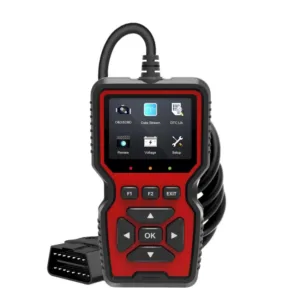
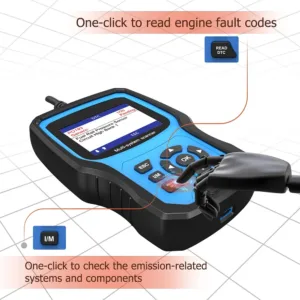
- Connect an OBD2 scanner. Connect the diagnostic scanner to the OBD-II connector, usually located under the steering column. Read the fault codes and record any related errors that appear along with P0078.
- Check wiring and connectors. Inspect the wiring and connectors leading to the exhaust bypass control solenoid. Look for signs of damage, overheating, oxidation, or poor contact.
- Measure valve resistance. Remove the valve connector and measure the coil resistance with a multimeter. Compare it to the manufacturer’s technical data. Resistance that is too low or too high may indicate a malfunction.
- Check circuit voltage with ignition on. Check the power and signal at the valve connector pins. Insufficient voltage indicates a problem with the wiring or ECU.
- Directly check the valve. Use an external power source to energize the valve and check for mechanical activation. If there is no clicking sound, the valve is likely faulty.
Possible Causes and Diagnostic Methods
| Possible Cause | How to Check? |
| Exhaust Control Valve | Measure resistance and check for sticking |
| Power and Signal Circuits | Check for integrity, faults, and short circuits |
| Connectors and Contacts | Visually inspect for corrosion and oxidation |
| ECU | Diagnose with a scanner |
Tools required: OBD2 diagnostic scanner, multimeter, set of wrenches and screwdrivers, contact cleaner, vehicle wiring diagram reference
How to fix error code P0078? (Solution to the problem)
Simple repair methods
- Reset the error code with a scanner, then test again after a short drive
- Check and clean the valve connector
- Clean oxides and impurities from the contact points
- Replace damaged wiring sections
- Check the fuse for the control circuit
In-depth diagnostic and repair solutions
- Replace the exhaust control valve (solenoid valve)
- Solder or replace damaged circuits
- Check and replace the ECU if an internal fault occurs
- Set the control unit after replacing parts
- Recalibrate the valve using professional equipment
Troubleshooting by symptoms
| Symptom | Possible Solution |
| Reduced engine power | Check/replace bypass valve |
| Engine fails to start | Reset code, check circuit |
| Increased fuel consumption | Boost control diagnostics |
| Turbocharger whistling sound | Check valve, pipes and connections |
| Limp mode | ECU diagnostics, faulty component replacement |
Common vehicle error code P0078
P0078 in Volkswagen Passat: In Passat cars equipped with the 2.0 TSI engine, the P0078 error is usually associated with a faulty turbocharger control solenoid valve. This problem may be accompanied by loss of traction and pressurization errors. Checking the circuit and valve is recommended.
P0078 in BMW 320d: In BMW diesel engines, the error may occur due to broken wiring contacts or failure of the boost control program. Reprogramming the control unit or replacing the valve usually helps.
P0078 in Audi A4: In Audi models with TFSI engines, the error indicates a control valve malfunction or system contamination. The problem may be intermittent. Circuit diagnostics are mandatory.
P0078 in Hyundai Santa Fe: Hyundai turbo diesel engines are characterized by valve circuit breaks and solenoid valve malfunctions. The ECU can also develop problems after prolonged operation.
P0078 in Mercedes-Benz C-Class: In C-Class models equipped with a turbo engine, the P0078 error is usually caused by dirty or stuck valves. It’s also worth checking the connectors for moisture and oxidation.
P0078 Frequently Asked Questions
Is it possible to drive with a P0078 error?
No, because the fault can lead to unstable turbocharging and reduced engine power, affecting the safety and lifespan of the turbocharger.
Will the P0078 error disappear on its own?
If the problem is intermittent (e.g., a loose connector), the error may temporarily disappear. However, it will reappear if the cause is not eliminated.
Is it possible to reset the error without diagnostic equipment?
It can be reset via a scanner or by disconnecting the battery, but without proper diagnosis, the error will quickly reappear.
Do I need to replace the valve to fix the P0078 error?
Not necessarily. First, you need to diagnose the circuit and connectors. If the valve is indeed defective, replacing the valve is one solution.
What other errors might accompany P0078?
P0079, P0035, and P2562 errors often appear simultaneously with P0078 – they indicate related problems in the boost control system.
Related OBD2 errors for P0078
P0035 – Turbocharger/Supercharger Bypass Valve Control Circuit High
P0079 – Exhaust Valve Control Solenoid Circuit Low (Bank 1)
P2562 – Turbocharger Boost Control Position Sensor A Circuit
Important! If you encounter error P0078, do not delay diagnosis. Even if the engine is running normally, prolonged operation can lead to reduced turbocharger lifespan and other serious consequences. It’s best to address the problem as soon as possible to avoid expensive repairs.