
What does the P0044 code mean?
The P0044 fault code is a generic OBD-II code that means “HO2S Heater Control Circuit High (Bank 1, Sensor 3)“.
Background Information: This code indicates the Powertrain Control Module (PCM) or Engine Control Module (ECM) has detected an abnormally high voltage or resistance condition in the heater control circuit for the Heated Oxygen Sensor (HO2S) located on Bank 1, Sensor 3. Bank 1 refers to the side of the engine containing cylinder number 1. Sensor 3 is typically the second downstream oxygen sensor, located after the catalytic converter(s). The heater element inside the oxygen sensor is crucial for bringing the sensor up to its optimal operating temperature (around 750°F or 400°C) quickly after a cold start. A “High” circuit condition means the PCM detects voltage or resistance exceeding its programmed threshold, preventing proper control of the heater element.
Symptoms of Error Code P0044
Signs of error P0044 may include:
- Illuminated Check Engine Light (MIL) on the dashboard.
- Reduced fuel efficiency – mileage may drop by 1-4 MPG as the engine may run in a less efficient mode or the heater circuit draws excessive power.
- Rough idle or hesitation during cold starts, especially in cold weather, as the sensor may not heat up properly or the faulty circuit causes irregular operation.
- Potential for failed emissions test due to the illuminated Check Engine Light and potential incomplete OBD-II readiness monitors.
- Often no noticeable drivability issues during normal warm driving, as the fault is primarily electrical within the heater circuit.
Main Causes of Error Code P0044
- Short to Battery Voltage (B+) in the Heater Circuit Wiring – A damaged wire, corroded connector, or pin-to-pin short can connect the heater control wire directly to battery voltage, causing a persistently high reading.
- Faulty ECM/PCM Heater-Control Driver – An internal failure of the transistor or circuit within the control module that switches the heater on/off can cause it to stick “on” or leak voltage.
- Faulty Software Calibration or Corruption in the PCM – Outdated, corrupted, or incorrect software can cause the module to misinterpret normal circuit voltage as “high”.
- Damaged or Failing Heated Oxygen Sensor (Bank 1, Sensor 3) – A partially failed heater element inside the sensor can draw excess current, raising the measured voltage in the circuit.
- Open Circuit or Excessively High Resistance in the heater control circuit wiring or connectors, causing a high-resistance condition that the PCM reads as a fault.
- Poor Electrical Connection or Corrosion at the sensor connector, PCM connector, or intermediate connectors, creating high resistance.
How to Diagnose Error Code P0044?
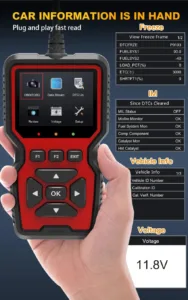
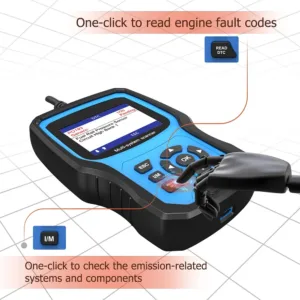
- Use a professional obd2 scanner to confirm the presence of P0044 and check for any other related codes. Record freeze frame data (engine temperature, battery voltage).
- Perform a thorough visual inspection of the Bank 1, Sensor 3 oxygen sensor wiring harness. Look for chafing, melting (especially near the exhaust), pinched wires, or exposed conductors that could short to power.
- Inspect all related electrical connectors (sensor, PCM, any inline connectors) for bent pins, green/white corrosion, moisture ingress, or loose connections. Clean with electrical contact cleaner if needed.
- Consult the vehicle’s service manual to determine the heater circuit architecture. Identify whether the PCM controls the power supply (12V) side or the ground side of the heater circuit.
- With the ignition ON (engine off) and the sensor disconnected, use a digital multimeter to check for voltage on the heater control wire. If the PCM controls power, there should be battery voltage (~12.6V) on the control wire. If it controls ground, there should be battery voltage on the constant power wire.
- Check for a short to battery voltage. With the sensor and PCM connectors disconnected as needed, check for continuity between the suspected heater control wire and the positive battery terminal. Any continuity indicates a short to power.
- Check circuit resistance. Measure the resistance of the heater control circuit from the PCM connector pin to the sensor connector pin. It should be very low (less than 5 ohms). High resistance indicates a poor connection or damaged wire.
- Test the oxygen sensor heater element. Disconnect the sensor and measure the resistance across its heater pins (consult wiring diagram). A typical reading is between 4-20 ohms at room temperature. An infinite reading (OL) indicates an open; a very low reading (near 0) may indicate a short.
- If wiring and sensor test good, suspect a faulty PCM/ECM. This is rare and should be considered only after all other possibilities are eliminated. Professional diagnosis with a capable scan tool to monitor live heater control data is recommended.
Possible Causes and Diagnostic Methods
| Possible Cause | How to Check? |
| Short to Battery Voltage in Wiring | With the battery disconnected and relevant connectors unplugged, check for continuity between the heater control wire and the positive battery terminal. Any continuity confirms a short to power. |
| Faulty PCM Heater-Control Driver | Using a professional scan tool, monitor the commanded heater duty cycle or voltage for Bank 1, Sensor 3. A command of 0% but a live reading of high voltage suggests an internal PCM fault. |
| Open Circuit / High Resistance | Measure the resistance of the entire heater control circuit from the PCM pin to the sensor pin. Compare to specification (often less than 5 ohms). High resistance indicates corrosion or a broken wire. |
| Faulty Oxygen Sensor Heater | Disconnect the sensor and measure the resistance of its internal heater element. Compare to manufacturer spec (typically 4-20Ω). An out-of-spec reading indicates a failed sensor. |
| Corroded or Loose Connector | Inspect the sensor and PCM connectors for green/white corrosion, bent pins, or terminals that are not fully seated. Clean with electrical contact cleaner and dielectric grease. |
| Software/Calibration Issue | Check for Technical Service Bulletins (TSBs) for your specific vehicle regarding PCM recalibration for false P0044 codes. This may require a dealership scan tool to update module software. |
Tools needed: OBD2 code scanner (with live data capability), digital multimeter (DMM), basic hand tools (sockets, wrenches), vehicle-specific wiring diagram/service manual, electrical contact cleaner, safety glasses.
How do I fix error code P0044? (Solutions to the Problem)
Simple Fixes
- Repair wiring short to power. If inspection reveals a wire rubbed through and touching a positive battery cable or other 12V source, repair the damaged section with solder and heat-shrink tubing. Reroute the harness away from hot or sharp objects.
- Clean corroded connectors. Disconnect the battery, then disconnect the sensor and PCM connectors. Clean all pins thoroughly with electrical contact cleaner, dry completely, apply a small amount of dielectric grease, and reconnect firmly.
- Check and secure ground connections. If the PCM controls the ground side of the heater circuit, ensure the sensor’s ground path to the chassis or engine block is clean, tight, and free of corrosion.
- Clear the code with your car code reader and perform a drive cycle to see if it returns.
In-depth Diagnosis and Repair Solutions
- Replace the faulty oxygen sensor (Bank 1, Sensor 3). This is the most common fix. Ensure you purchase the correct downstream sensor for your specific vehicle. Use an oxygen sensor socket for removal and installation.
- Repair or replace the damaged wiring harness. For severe damage or a confirmed short to power, it may be necessary to replace a section of the engine wiring harness. Ensure all repairs are soldered and properly insulated.
- Update PCM/ECM software. If a TSB exists for a software glitch causing false P0044 codes, a dealership or specialist with the proper programming equipment can flash the latest calibration to the module.
- Replace the Powertrain Control Module (PCM). This is a last-resort, costly repair. It should only be done after exhaustive testing confirms the PCM’s internal driver circuit is faulty. The new module will require programming/VIN matching.
- After any repair, use your obd2 code scanner to clear the code, reset readiness monitors, and verify the code does not return during a test drive.
Troubleshooting Based on Symptoms
| Symptom | Possible Solution |
| Check Engine Light is on, code P0044 is present, car runs fine. | Focus on an electrical fault: likely a wiring short to power, a failing sensor heater, or a poor connection. Start with a visual inspection and multimeter tests. |
| Code returns immediately after clearing with a scanner. | Indicates a persistent hard fault. Likely a permanent short to voltage in the wiring or a completely failed sensor heater element. |
| Code appears intermittently, especially when driving over bumps or in wet weather. | Suggests an intermittent short or loose connection. Inspect the wiring harness for areas where it may chafe against metal, and check connectors for looseness or moisture. |
| Other oxygen sensor heater circuit codes are also present (e.g., P0041, P0043). | Check for a common problem like a wiring harness issue affecting multiple circuits, or a fault in the PCM’s power or ground supply for the heater circuits. |
| Recent battery replacement or jump-start, then P0044 appears. | Voltage spikes can damage sensitive electronics. Check the sensor and wiring first. If no issue is found, clearing the code with a car code scanner may resolve it if it was a transient glitch. |
Common Error Code P0044 in Vehicles
Toyota/Lexus P0044 (GR, UR, AR series engines): Common in Toyota Camry, Corolla, RAV4, Highlander, Tundra, Tacoma, Lexus RX, ES, GS. Toyota systems are sensitive to wiring harness issues where the sensor wiring passes near the exhaust manifold or catalytic converter. Heat can degrade insulation, leading to shorts. Also check for corrosion in the connector located underneath the vehicle. A professional obd2 code scanner is useful for accessing Toyota-specific live data for the heater control circuit.
Honda/Acura P0044 (K-series, J-series, L-series engines): Found in Honda Civic, Accord, CR-V, Pilot, Odyssey, Acura TLX, RDX, MDX. A frequent cause is water intrusion into the sensor connector, leading to corrosion and high resistance or short circuits. The downstream sensor (Sensor 3) is often located under the vehicle near the rear catalytic converter and is susceptible to road splash. Inspect the wiring where it runs along the underbody.
Ford P0044 (EcoBoost, Modular V8, Duratec engines): Frequent in Ford F-150 (especially with 3.5L/5.0L), Explorer, Escape, Focus, Fusion, Mustang. Ford’s PCM closely monitors heater circuit voltage. A common fault point is the wiring harness where it is clipped to the transmission or exhaust, leading to insulation wear and a short to the chassis or exhaust. Using a capable car code scanner to view PID “HO2S Heater Control Circuit Bank 1 Sensor 3” is helpful.
General Motors (GM) P0044 (LS, LT, Ecotec engines): Appears in Chevrolet Silverado/Sierra, Equinox, Malibu, Traverse, Cadillac XT5, GMC Terrain. GM vehicles may set this code due to a faulty sensor or a wiring issue. Check for Technical Service Bulletins (TSBs) related to sensor harness routing updates. The fuse for the heater circuit is often in the underhood fuse block (e.g., “O2 Sensor” fuse).
Nissan/Infiniti P0044 (VQ, VR, MR series engines): Seen in Nissan Altima, Rogue, Sentra, Pathfinder, Infiniti Q50, QX60. The downstream sensor wiring may be routed near the rear subframe or fuel tank and can be pinched during repairs or by shifting heat shields. Corrosion at the connector on the transmission tunnel is also common.
Hyundai/Kia P0044 (Theta, Nu, Lambda engines): Common in Hyundai Sonata, Santa Fe, Tucson, Kia Sorento, Sportage, Optima. Issues often stem from a faulty sensor or a corroded connector at the firewall. The sensor heater circuit may share a fuse with other components; check the fuse diagram. Diagnose by checking circuit resistance from the PCM to the sensor.
Subaru P0044 (FB, FA series engines): Affects Subaru Outback, Forester, Impreza, Crosstrek. The symmetrical exhaust layout means the Bank 1 downstream sensor is on the passenger side. Check for wiring damage from off-road driving or corrosion from road salt. Also, inspect the main engine harness connector near the firewall for water ingress.
Volkswagen/Audi P0044 (EA888, EA839 engines): In VW Golf, Jetta, Tiguan, Audi A4, A6, Q5. VAG vehicles often require a specific scan tool like VCDS or OBDeleven for in-depth diagnosis of heater circuit duty cycle and resistance values. Wiring issues are common near the turbocharger or catalytic converter due to extreme heat melting insulation.
BMW P0044 (N55, B58, N63 engines): Occurs in BMW 3 Series, 5 Series, X3, X5. Diagnosis often requires ISTA (BMW’s diagnostic software) to perform guided tests on the oxygen sensor heater control. Check for water intrusion into the DME (ECU) box or damaged wiring in the engine bay near the exhaust manifolds.
Mercedes-Benz P0044 (M276, OM642 engines): Seen in Mercedes C-Class, E-Class, GLC, GLE. Requires STAR Diagnostic system for accurate fault reading and to actuate the heater circuit for testing. Complex underbody shielding can trap moisture and heat, leading to connector corrosion or wire insulation damage over time.
Chrysler/Dodge/Jeep/Ram P0044 (Pentastar V6, Hemi V8): Found in Jeep Wrangler/Grand Cherokee, Dodge Charger/Challenger, Ram 1500. A common issue is a chafed wiring harness where it passes near a sharp bracket on the transmission or the exhaust manifold heat shield. Also check the fuse in the Totally Integrated Power Module (TIPM).
Mazda P0044 (SkyActiv-G engines): In Mazda 3, Mazda 6, CX-5, CX-9. The downstream sensor is after the main catalytic converter. Sensor failure is common; use an OEM or high-quality replacement. Wiring can be damaged during exhaust work if not properly supported.
Volvo P0044 (Drive-E engines): In Volvo S60, XC60, XC90. Volvo’s electrical systems are sensitive; always check for related communication codes. The sensor connector is often located in a well-protected area but can suffer from corrosion over time. Diagnose using Volvo’s VIDA system for precise measurements.
P0044 Frequently Asked Questions
What is the first thing I should do when I see code P0044?
The first step is to use a reliable obd2 scanner to confirm the code and check for any other related codes. Then, perform a detailed visual inspection of the wiring harness for Bank 1, Sensor 3, looking for any signs of chafing, melting, or shorts to nearby power wires or hot exhaust components.
Is it safe to drive my car with the P0044 code?
Yes, it is generally safe to drive for a short period. The P0044 code indicates an electrical fault in the heater circuit of a downstream oxygen sensor. This sensor primarily monitors catalytic converter efficiency and does not directly control the air-fuel mixture for engine performance. However, you will fail an emissions inspection, and prolonged driving with a short circuit could potentially lead to further electrical damage.
How much does it typically cost to repair a P0044 error?
Costs vary. If it’s a simple wiring repair, it may cost between $100 and $250 for parts and labor. Replacing the downstream oxygen sensor typically costs between $250 and $600 for parts and labor, depending on the vehicle and sensor location (labor is higher if the sensor is difficult to access). PCM/ECM replacement or reprogramming is the most expensive, often exceeding $1,000.
Can I fix a P0044 code myself?
Yes, if you have intermediate automotive electrical skills and tools. You will need a socket wrench (often a special oxygen sensor socket), a jack and jack stands for safety, a digital multimeter for testing, and an obd code reader to clear the code after repair. The most challenging part is often accessing the sensor, which may require raising the vehicle. Extreme caution is needed when working near the hot exhaust system.
What’s the difference between P0044, P0042, and P0043?
All three codes relate to the heater control circuit for Bank 1, Sensor 3. P0042 indicates a general heater control circuit malfunction. P0043 specifically indicates a “Low” condition in that circuit (low voltage/current, often an open circuit or high resistance). P0044 specifically indicates a “High” condition in the circuit (high voltage/current, often a short to power or a faulty PCM driver).
Will disconnecting the battery clear the P0044 code?
It may temporarily turn off the Check Engine Light, but the code will remain stored as a “pending” or “permanent” code in the PCM’s memory. To properly clear the code and turn off the light, you must use an OBD2 diagnostic scanner after the underlying issue is fixed.
Can a bad catalytic converter cause code P0044?
No, P0044 is specifically an electrical fault indicating a high voltage condition in the heater circuit of the oxygen sensor itself. A failing catalytic converter would typically set codes like P0420 (Catalyst System Efficiency Below Threshold). However, extreme heat from a failing converter could potentially damage the nearby sensor’s wiring insulation over time, leading to a short.
My car failed emissions inspection with P0044. Will fixing it guarantee a pass?
Fixing the P0044 code and clearing it will allow the OBD-II monitors to run. You will need to complete a full drive cycle to set all monitors, including the catalyst monitor. Once the monitors are “ready” and no codes are present, the vehicle should pass the OBD-II portion of the emissions test.
After replacing the oxygen sensor, do I need to reset the ECU or just clear the code?
Simply clearing the code with a car code scanner is usually sufficient. The PCM will begin learning the new sensor’s characteristics immediately. In some cases, performing an “ECU reset” or “adaptive values reset” via a capable scanner can help the system adapt faster, but it’s not always required.
What does “Heater Control Circuit High” specifically mean?
It means the Powertrain Control Module (PCM) has detected voltage or resistance in the heater circuit that is above its predetermined maximum threshold. This is usually caused by a short circuit connecting the heater control wire directly to battery voltage (12V), a faulty PCM driver that is stuck “on”, or extremely high resistance in the circuit that mimics a high voltage condition.
Could a problem with the vehicle’s charging system (alternator) cause P0044?
Yes, a failing alternator that is overcharging the electrical system (producing more than ~14.5 volts) could cause the PCM to see an abnormally high voltage on the heater circuit and set a P0044 code. Always check the battery voltage with the engine running as part of your diagnosis.
How can I prevent P0044 from happening again?
Use high-quality OEM or equivalent replacement sensors. When installing a new sensor or repairing wiring, ensure the harness is properly routed away from hot exhaust components, sharp edges, and moving parts. Use conduit or wire loom in high-heat areas. Apply dielectric grease to the electrical connector to prevent corrosion. Address any exhaust leaks promptly, as they can expose the sensor and wiring to excessive heat.
Is P0044 the same as P0054?
No. P0054 relates to the heater control circuit high for Bank 1, Sensor 2 (the first downstream sensor). P0044 is specifically for the heater circuit high for Bank 1, Sensor 3 (the second downstream sensor). They are similar faults but for different sensor locations.
Can I use an upstream oxygen sensor in a downstream position to fix this?
No. Upstream (pre-catalyst) and downstream (post-catalyst) oxygen sensors are often different parts. They may have different connector types, wire lengths, heater resistance values, and most importantly, different electrical characteristics and calibration for their specific location in the exhaust stream. Using the wrong sensor can cause poor performance and additional fault codes.
P0044 Related OBD2 Errors
- P0038 – HO2S Heater Control Circuit High (Bank 1, Sensor 2)
- P0041 – O2 Sensor Heater Circuit Low (Bank 1, Sensor 3)
- P0042 – HO2S Heater Control Circuit (Bank 1, Sensor 3)
- P0043 – HO2S Heater Control Circuit Low (Bank 1, Sensor 3)
- P0054 – HO2S Heater Control Circuit High (Bank 1, Sensor 2)
- P0058 – HO2S Heater Control Circuit High (Bank 2, Sensor 2)
- P0064 – HO2S Heater Control Circuit High (Bank 2, Sensor 3)
- P0138 – O2 Sensor Circuit High Voltage (Bank 1, Sensor 2)
- P0141 – O2 Sensor Heater Circuit Malfunction (Bank 1, Sensor 2)
- P0158 – O2 Sensor Circuit High Voltage (Bank 2, Sensor 2)
- P0161 – O2 Sensor Heater Circuit Malfunction (Bank 2, Sensor 2)
- P0420 – Catalyst System Efficiency Below Threshold (Bank 1)
Important Note! Code P0044 is an electrical fault that will cause an illuminated Check Engine Light and a failed emissions test. While drivability is often unaffected, the underlying short circuit could potentially lead to further electrical issues if left unrepaired. Diagnosis should always start with a thorough visual inspection of the wiring harness. Using a professional-grade obd2 code scanner to view live data and a multimeter for electrical tests is crucial for accurate diagnosis. When working under the vehicle, always use proper jack stands and allow the exhaust system to cool completely. If you are not confident in the diagnosis, consult a qualified technician.