
How to Install a Dash cam
- Insert the memory card into the dashcam’s card slot, paying attention to the orientation.
- Install the windshield bracket and dashcam.
- Clean the windshield with a car towel and install the dashcam in a suitable position, ensuring it doesn’t obstruct the driver’s view.
- Plan the wiring: should it run directly to the cigarette lighter or to another location?
- Plug the dashcam’s power cord into the car’s cigarette lighter socket, turn on the dashcam display and adjust the angle, then connect the dashcam’s power cable.
- After installation, check and test the functions to ensure they are working properly.
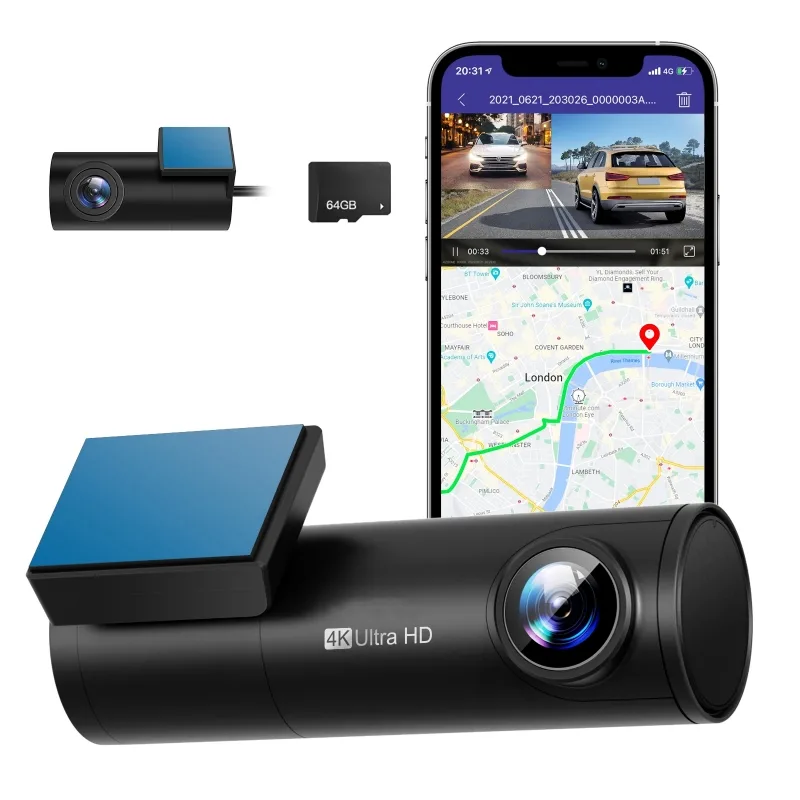
How to Wire a Dashcam
The closer the dashcam is to the rearview mirror, the better. Firstly, a centered shooting angle is wider, and secondly, installation near the rearview mirror minimizes obstruction of the windshield’s view. Installing the dashcam between the rearview mirror and the windshield is the most centrally located position.
- When installing in this location, be careful. If the dashcam is too close to the rearview mirror, it may affect the mirror’s adjustment angle. I didn’t pay attention when I installed mine and placed it too close to the rearview mirror, resulting in the dashcam shifting and falling off when adjusting the angle. I had to re-attach the base.
- Avoid disassembling anything inside the car when wiring the dashcam. Therefore, the only tools needed are a simple pry bar, double-sided tape, and 3M adhesive. The pry bar can easily tuck the dashcam cable inside the trim panel; of course, if you have superhuman strength, you can complete the wiring by hand without a pry bar. The double-sided tape is used to hold one section of the power cable, which will be mentioned later. The 3M adhesive can be used to fix the dashcam base and also to secure larger cable bundles.
- After determining the installation location of the dashcam, the first thing to do is to figure out the wiring layout and how to route the cable to hide it as much as possible. This step seems the simplest, but it is actually the most crucial. The final aesthetic of the wiring depends on your own judgment. Next, check the wiring path: Car interior materials vary in hardness. Soft materials are easy to work with; simply press and push to insert the dashcam’s power cable. Hard materials require a pry tool to create a gap before inserting the cable.
- For vehicles equipped with side curtain airbags, be extra careful when wiring. Avoid the airbag’s deployment area to prevent interference with its operation.
- When wiring the dashcam, start from the USB power port, heading towards the roof. Roof wiring is easy; simply tuck the cable into the gap between the roof panel and the glass. This can be easily done by hand, but using a pry tool will ensure a more precise installation.
- When tucking the wire into the A-pillar, the procedure depends on the vehicle. For models equipped with A-pillar side curtain airbags, the trim panel in that area is relatively soft, requiring extra care during wiring. The force applied must be carefully controlled to avoid damaging the panel. For models without A-pillar side curtain airbags, the wire can be tucked directly in. The vehicle used for this demonstration did not have side curtain airbags, so the wire was simply tucked into the gap between the hard and soft trim panels on the A-pillar.
- After the wire descends from the A-pillar, we found that the glove box trim panel is sealed, preventing the wire from directly entering the glove box. With vehicles in this configuration, the wire must continue downwards. By prying open the door frame’s sealing strip, the wire can be easily tucked in, and then the wiring can continue downwards.
- Once the power cable has successfully passed through the gap in the pedal, there are two wiring options: First, run it directly through the carpet to the bottom of the glove box, secure the power cable, and then run it exposed to the cigarette lighter socket. Second, continue with the concealed wiring running across the glove box, then the exposed wiring reaches the cigarette lighter. I chose the second method because it provides a better visual appearance and is more secure, but it’s also more complicated to install.
- Finally, plug the power cord into the cigarette lighter socket. Once you’ve confirmed that the dashcam powers on and starts normally, the wiring is complete.