I. Which type of car tire pressure gauge is best?
Tire pressure significantly impacts a car’s performance, so many people are concerned about it and want to know their tire pressure at all times. Cars with built-in tire pressure monitoring systems (TPMS) can display the pressure directly. Those without TPMS often have aftermarket systems installed. So, what types of tire pressure monitoring systems are there? What are their advantages and disadvantages?
Common tire pressure monitoring systems are divided into three types: internal, external, and OBD tire pressure monitoring.
1. Internal Tire Pressure Monitoring System
Advantages of internal tire pressure monitoring: First, because it’s an internal system, the tire pressure and temperature readings are taken from inside the tire, resulting in accurate measurements. Second, you don’t need to remove anything when inflating the tires; you can simply use a tire inflator, unlike external systems where you have to remove the sensors each time. Third, because it’s installed inside the tire, it’s less likely to be damaged or stolen.
Disadvantages of internal tire pressure monitoring: First, installation is more complicated and requires a professional technician at a tire shop. Second, the price is higher. However, the advantages of internal tire pressure monitoring outweigh the disadvantages; it’s a one-time installation and very convenient to use.
It’s important to note that if you need to remove the tires for repairs or replacement, you must inform the mechanic that you have an aftermarket tire pressure monitoring system installed and that there are tire pressure sensors inside the tires. Since they are not visible from the outside, if you don’t remind them, the sensors can easily be damaged during tire removal. This has happened many times.
2. External Tire Pressure Monitoring System
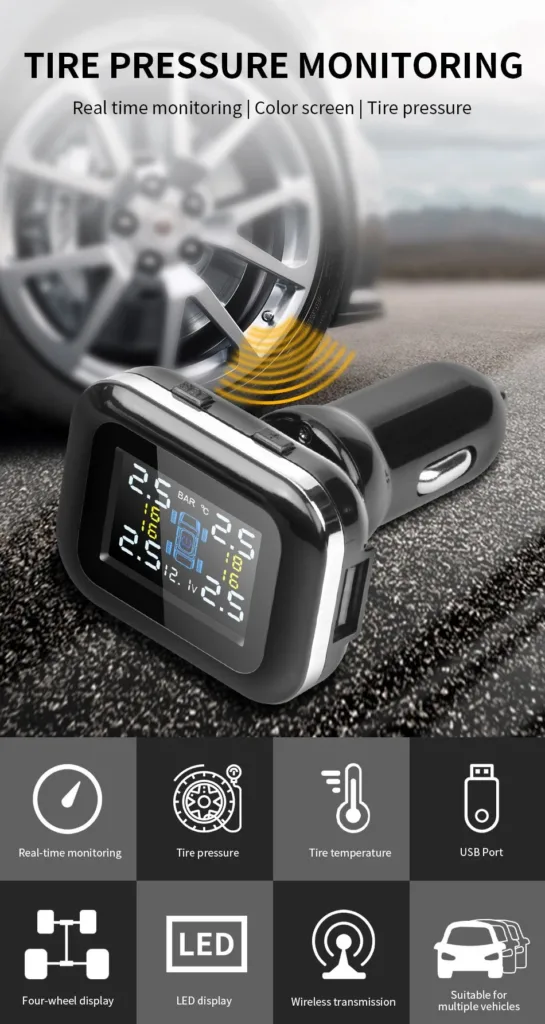
External tire pressure monitoring systems generally only require screwing the sensors onto the tires, and the tire pressure data will be displayed on the screen. Installation is very simple and can be done yourself. Another advantage is that it’s significantly cheaper than internal tire pressure monitoring systems.
Advantages of external tire pressure monitoring: Easy installation; you can do it yourself. The sensors are labeled for each wheel, so you just screw them onto the corresponding wheels. A special wrench is needed to tighten the anti-theft nuts. When rotating tires, you don’t need to re-pair the sensors; simply remove them and place them back in their original positions. Disadvantages of external tire pressure monitoring systems: First, because they are external, they are easily removed or stolen. For example, if the car is parked in a residential area, children might play with them as toys and break them. Second, if the device is accidentally bumped while driving, it is easily damaged, and repairing it individually is difficult; you might need to replace the entire set. Although inexpensive, it’s not worry-free. Third, external tire pressure monitoring is also affected by external temperature, leading to inaccurate readings. Therefore, besides being cheap and easy to install, external tire pressure monitoring has too many disadvantages.
Whether built-in or external, because there’s an extra component on the wheel, the original dynamic balance is disrupted, which may cause steering wheel vibration at high speeds. If vibration occurs, four-wheel dynamic balancing is necessary.
3. OBD-type tire pressure monitoring
Every car has an OBD interface, the port used to connect a diagnostic computer when the car has a fault. OBD-type tire pressure monitors plug into this interface. Installation is very simple; the entire system consists of only one component, which you simply plug in. It doesn’t display tire pressure values, but it will alarm when the tire pressure is abnormal. It only alarms when one tire’s pressure is low. Its principle is: it has a small chip inside, and because it’s plugged into the OBD interface, it can read the values from the four wheel ABS sensors. When the tire pressure is the same, the rotation speed of the four wheels is the same. When the pressure in a wheel decreases, the wheel’s diameter decreases, and that wheel’s rotation speed will be faster than the others. When it exceeds a preset value, it will determine that the tire pressure is low and then alarm. It can only detect low pressure in one wheel; if all four wheels have low pressure, it will not alarm. This type of tire pressure monitoring is the easiest to install but the least accurate.
II. Is external or built-in tire pressure monitoring better?
Built-in tire pressure monitoring is generally recommended due to its higher reliability. If you don’t want to spend money on professional installation and want to do it yourself, you can choose an external system. You can choose according to your needs.