
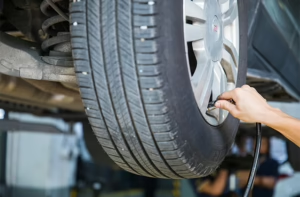
I. How does a tire pressure gauge work?
Inside the main tube of the tire pressure gauge, there is a well-sealed piston. A compression spring connects the piston to a plug at the other end, pushing the piston to the left side of the tube. When measuring tire pressure, pressurized air from the tire rushes into the gauge, pushing the piston to the right. The higher the tire pressure, the longer the piston travels. When the tire pressure gauge is released from the valve stem, the pressurized air stops flowing in, and the spring immediately pushes the piston back to the left.
Inside the gauge is a calibration rod located above the piston and connected to the plug. When the piston moves to the right, it pushes the calibration rod. When the piston returns to its original position, the calibration rod remains at its maximum displacement; this position is the tire pressure reading.
II. How to Use a Tire Pressure Gauge
A tire pressure gauge is an instrument used to measure the air pressure of a vehicle’s tires. Low tire pressure causes increased tire deformation, making the sidewalls more prone to cracking. It also causes flexing, leading to excessive heat, accelerated rubber aging, fatigue of the tire cord layers, and cord breakage. Furthermore, it increases the tire’s contact patch, accelerating shoulder wear. High tire pressure causes excessive stretching and deformation of the tire cords, reducing tire elasticity and increasing the load on the vehicle during driving. This can lead to internal cracks and blowouts upon impact. High pressure also accelerates tread wear and reduces puncture resistance.
Using a tire pressure gauge, car owners can know the current tire pressure and compare it to the standard value for their vehicle’s tire pressure unit to decide whether to deflate or inflate. The operating instructions for a tire pressure gauge are as follows:
- Align the measuring end slot of the tire pressure gauge with the tire valve and press firmly. Adjust the angle between the center line of the measuring port and the axis of the gauge body to 90°-180°. Before taking the reading, gently tap the instrument casing or surface glass with your finger to eliminate friction in the transmission mechanism.
- During measurement, the pointer of the pressure gauge will deflect; the indicated value is the inflation pressure of the tire. The higher the tire pressure, the more the pointer deflects.
When observing, wait until the pointer and the mirror pointer overlap. Only then will the pointer accurately represent the tire pressure value, accurate to one decimal place.
After use, press and hold the release valve to return the pressure gauge pointer to zero.
III. What does “bar” mean on a tire pressure gauge?
“Bar” is a unit of air pressure, measured in megapascals (MPa). It’s also the unit used to display tire pressure on a tire pressure gauge. Generally, passenger car tire pressure is around 2.0-2.5 bar, not exceeding 3.5 bar. In summer, when temperatures are high, tire pressure may rise above 3.0 bar when starting the car. Therefore, tire pressure should be slightly lower than usual in summer.
Tires lose approximately 1 pound per square inch of pressure per month, which is 0.1 bar. The rate of pressure loss varies from tire to tire, so a 0.1 bar error across four tires is acceptable. Different speeds require different tire pressures. If the vehicle is to be driven at sustained high speeds, it is recommended to increase the tire pressure by 0.2 to 0.3 bar. This reduces heat generated by excessive deformation of the tire sidewalls, improving safety. If possible, it is recommended to install a tire pressure monitoring system to monitor tire pressure at any time.