
1. Introduction to Tire Pressure Monitoring (TPMS)
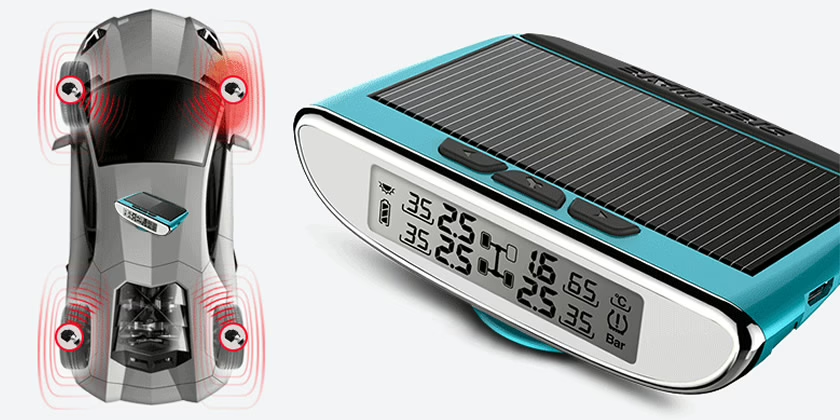
Tire pressure monitoring systems automatically monitor tire pressure in real time while the vehicle is in motion, alerting the driver to leaks and low pressure to ensure driving safety.
2. Types and Principles of Tire Pressure Monitoring Systems
Direct Tire Pressure Monitoring: Direct TPMS uses pressure sensors installed in each tire to directly measure tire pressure. A wireless transmitter sends the pressure information from inside the tire to a central receiver module, which then displays the tire pressure data. The system automatically alerts the driver when tire pressure is too low or there is a leak.
Indirect Tire Pressure Monitoring: Indirect TPMS works by calculating the tire’s rolling radius when its pressure drops.By comparing the difference in tire rotation speed, the system monitors tire pressure. In essence, indirect tire pressure monitoring relies on calculating the tire’s rolling radius to monitor tire pressure.Indirect tire pressure monitoring systems actually rely on calculating the tire’s rolling radius to monitor tire pressure.
3. Is a Tire Pressure Monitoring System (TPMS) Necessary?
Tire pressure monitoring is absolutely necessary. Tires are the only part of a car that contacts the ground; both driving and braking forces originate from them. TPMS ensures optimal tire condition and has the following functions:
- Maintaining proper tire pressure is crucial for driving safety; abnormal tire pressure can lead to serious consequences.
- Low tire pressure causes excessive wear on the tire tread, leading to premature tire failure.
- Increased fuel consumption: Low tire pressure increases the contact area between the tire and the ground, increasing friction and resistance, thus increasing fuel consumption.
Reduced braking performance: High tire pressure reduces the contact area between the tire and the ground, decreasing friction and increasing braking distance.
Shortened tire life: High tire pressure causes excessive wear in the center of the tire tread.
Potential for tire blowout: Tire pressure 25% below the recommended value increases the probability of a blowout by 3 times; pressure 25% above the recommended value increases the probability of a blowout by 1 time.
4.Internal vs. External Tire Pressure Monitoring System (TPMS)
Accuracy: Internal sensors sample pressure and temperature inside the tire, providing accurate readings. External sensors, pressed against the valve core, offer some assurance regarding their sealing, making them more susceptible to external environmental influences and potential temperature deviations.
Usage Environment: Sensors located inside the tire operate more stably. External sensors are susceptible to adverse effects such as accidental impacts and water damage.
Anti-theft: While external sensors have anti-theft nuts, they are not difficult to remove with tools. Internal sensors require tire removal, which is unlikely to be undertaken by thieves.
Battery Life: Built-in sensors are typically designed for a lifespan of 5 years or more (based on 2 hours of driving per day), while external sensors generally only last 1-2 years. External sensors, limited by size and weight, can only use smaller button batteries. Common battery specifications for built-in sensors are CR2450 (550mAh), while for external sensors, CR1632 (120mAh) is commonly used.
Installation: External sensors are very easy to install yourself, taking only a few minutes, but need to be unscrewed every time you inflate the tire. Built-in sensors cannot be installed DIY; you need to go to a mechanic shop to remove the tire. You don’t need to completely remove the tire; use a tire changer to pry open a gap at the valve stem, replace the original valve stem, and then perform dynamic balancing. Inflation is unaffected. The weight of a built-in sensor (including the valve stem) is usually around 30g, requiring dynamic balancing. External sensors typically weigh less than 10g and do not require dynamic balancing.
Cost: Built-in sensors have higher material costs than external sensors, hence the higher price.
5. Tire Pressure Monitoring System (TPMS) Buying Guide
Generally, there are two types of TPMS: mechanical and electronic.
Mechanical: Mechanical TPMS are generally cheaper and more durable. However, some observant drivers will notice that the pressure reading differs when the TPMS is on the valve and when it’s removed, indicating a potential error and even tire leaks. Over time, the readings become less accurate. Therefore, it’s best to replace these TPMS regularly.
Electronic: Having learned about the characteristics of mechanical TPMS, what about electronic ones? They are more accurate, but unlike mechanical TPMS, they shouldn’t be handled carelessly, avoiding bumps and knocks. Electronic TPMS are more susceptible to damage from impacts, as these can affect the measured pressure. Handle them gently to ensure accurate tire pressure readings.
6.Timely Data Transmission
Finally, let’s talk about tire pressure gauge data transmission. Electronic tire pressure gauges should promptly relay tire pressure data via sensors and display it on the screen. In cases of rapid deflation, an alarm should be triggered. This ensures tire safety, informing the driver of the tire pressure status so they can prepare accordingly, avoid accidents, and greatly enhance the safety of passengers.