
What does the P0030 code mean?
The P0030 is a generic OBD-II powertrain trouble code. Its official definition is “Heated Oxygen Sensor (HO2S) Heater Control Circuit (Bank 1, Sensor 1)“.
This diagnostic trouble code indicates a malfunction in the electrical circuit that controls the internal heater of the upstream oxygen sensor on engine Bank 1. This sensor, positioned before the catalytic converter, contains a heating element designed to bring the sensor to its optimal operating temperature (typically around 600-800°F) rapidly after a cold engine start. A properly heated sensor allows the engine control module to enter closed-loop fuel control faster, which is critical for optimal fuel efficiency, reduced emissions, and proper engine performance. The Engine Control Module monitors the voltage, current, and resistance in this heater circuit. When the detected values fall outside the specified range, the ECM illuminates the Check Engine Light and stores code P0030. The first step in any diagnosis is to connect a professional obd2 scanner to confirm the code and check for any related faults.
Symptoms of Error Code P0030
- Illuminated Check Engine Light (MIL).
- Noticeably decreased fuel economy (poor MPG).
- Rough, unstable, or fluctuating engine idle.
- Reduced engine power and sluggish acceleration.
- Engine hesitation or stumbling during acceleration.
- Potential for the engine to run rich, leading to black exhaust smoke in severe cases.
- Failed emissions test due to improper air-fuel mixture control.
- Extended warm-up time before the engine runs smoothly.
Main Causes of Error Code P0030
- Faulty Heated Oxygen Sensor: The internal heating element within the Bank 1, Sensor 1 oxygen sensor can burn out (open circuit) or short internally.
- Damaged Wiring Harness: Short to ground, short to power, or an open circuit (broken or corroded wire) in the heater control circuit wires between the sensor and the ECM.
- Poor Electrical Connections: Corrosion, bent pins, moisture ingress, or loose connections at the oxygen sensor connector or the ECM connector.
- Blown Fuse: The fuse supplying power to the oxygen sensor heater circuit in the under-hood or interior fuse box may be blown.
- Faulty Engine Control Module (ECM): A rare cause where the internal driver circuit within the ECM that controls the heater ground fails.
- Low System Voltage: A weak battery or failing alternator can cause insufficient voltage for the heater circuit to operate correctly.
How to Diagnose Error Code P0030?
- Connect an obd2 diagnostic scanner to the vehicle’s DLC port. Read and confirm the P0030 code. Note any other related codes (e.g., P0031, P0032, P0135). Clear the codes and perform a test drive to see if P0030 returns as a current fault. This helps determine if the issue is intermittent or hard.
- Perform a thorough visual inspection. Locate the upstream oxygen sensor on Bank 1 (consult service manual). Inspect the sensor’s wiring harness, especially where it routes near hot exhaust manifolds, for any signs of melting, chafing, or physical damage. Check the electrical connector for corrosion, bent pins, or signs of overheating.
- Check the relevant fuse. Consult the vehicle’s fuse diagram to locate the fuse for the oxygen sensor heater circuit (often labeled “O2 HTR,” “SENSOR,” or “EFI”). Remove and visually inspect the fuse, or test it for continuity with a multimeter.
- Test the oxygen sensor heater resistance. With the engine off and cool, disconnect the oxygen sensor electrical connector. Set a digital multimeter to measure resistance (Ohms). Measure across the two pins for the heater (typically the two thicker wires; consult a wiring diagram). Compare the reading to the manufacturer’s specification (commonly between 5 and 25 ohms). An infinite reading (OL) indicates an open heater. A reading near 0 ohms indicates a short.
- Test the heater circuit wiring. With the sensor and ECM connectors disconnected as needed, use the multimeter to check for continuity in the power and ground wires of the heater circuit. Also check for shorts to ground or power on these wires.
- Check for power at the sensor connector. Reconnect the sensor. With the ignition ON (engine off), back-probe the heater power wire at the sensor connector. It should show battery voltage (approx. 12V). If not, trace the circuit back to the fuse and relay.
- Use an advanced obd2 diagnostic tool with bidirectional controls to command the heater on and off while monitoring the circuit status and current draw in live data, if supported by the vehicle.
Possible Causes and Diagnostic Methods
| Possible Cause | How to Check? |
| Open Heater in O2 Sensor | Disconnect sensor, measure heater resistance. Infinite resistance (OL) confirms failure. |
| Shorted Heater in O2 Sensor | Disconnect sensor, measure heater resistance. Very low resistance (near 0 ohms) confirms short. |
| Open Circuit in Wiring | Check continuity in heater power and control wires from sensor connector to ECM pins. No continuity confirms a break. |
| Short to Ground in Wiring | Check for continuity between heater control wire and chassis ground (with ECM/sensor disconnected). Continuity confirms a short. |
| Blown Fuse | Visual inspection and continuity test of the relevant fuse in the fuse box. |
| Bad Connector/Corrosion | Visually inspect the sensor and vehicle-side connector for green/white corrosion, bent pins, or loose fit. |
Tools needed: A reliable obd2 diagnostic scanner or obd reader for code reading and data, a quality digital multimeter for electrical testing (resistance, continuity, voltage), basic hand tools (wrenches, socket set, oxygen sensor socket), electrical contact cleaner, dielectric grease, and the vehicle’s service manual for wiring diagrams and specifications.
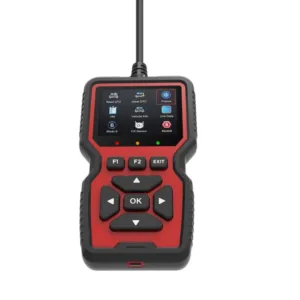
How do I fix error code P0030? (Solutions to the Problem)
Simple Fixes
- Replace a Blown Fuse: If the correct fuse is blown, replace it with one of the exact same amperage rating. Investigate why it blew (e.g., temporary short) to prevent recurrence.
- Repair Damaged Wiring/Connectors: If inspection reveals damaged insulation or broken wires, repair them using solder and heat-shrink tubing. Clean corroded connectors with electrical contact cleaner, apply dielectric grease, and ensure a secure connection.
In-depth Diagnosis and Repair Solutions
- Replace the Faulty Oxygen Sensor: This is the most common repair. If resistance testing confirms the heater is faulty, replace the Bank 1, Sensor 1 oxygen sensor. Always use an OEM or high-quality equivalent part. Use a proper oxygen sensor socket for removal to avoid damage. Install a new sensor with the provided anti-seize compound (if any), being careful not to contaminate the sensor tip. Tighten to the specified torque. After installation, clear the codes with your obd tool scanner and perform a test drive to ensure the code does not return.
- Repair or Replace the Wiring Harness: For extensive wire damage within the harness, it may be necessary to run new replacement wires from the sensor connector to the ECM, following the original routing and securing them properly away from heat and moving parts.
- Diagnose and Replace a Faulty ECM: This is a last resort. Only proceed if all wiring, fuses, connectors, and the oxygen sensor have been verified as fully functional, and diagnostic data points to an internal failure of the ECM’s heater driver circuit. Replacement ECMs require professional programming and vehicle immobilizer matching.
Fix faults based on symptoms
| Symptom Pattern | Recommended Repair Path |
| Code P0030 is current, along with poor fuel economy and rough idle. | High probability of a failed O2 sensor heater. Perform resistance test on the sensor. If faulty, replace the upstream oxygen sensor on Bank 1. |
| Code is intermittent, appears during/after rain or car wash. | Suggests a moisture-related short or corroded connector. Focus on inspecting the wiring harness and connector for water ingress. Dry thoroughly, clean contacts, and apply dielectric grease. |
| Code returns immediately after being cleared with an obd2 diagnostic scanner. | Indicates a persistent hard fault (permanent open or short). Systematically test the heater resistance and the control circuit wiring for shorts to ground/power or opens. |
| Multiple heater circuit codes (e.g., P0030 and P0050) are present. | May indicate a common power supply issue, such as a blown fuse feeding multiple sensors or a bad ground connection shared by the heater circuits. |
Common Error Code P0030 in Vehicles
General Motors (Chevrolet, GMC, Buick, Cadillac): Very common in models with V6 and V8 engines, including the Chevrolet Silverado, Tahoe, Suburban, and Cadillac Escalade. The heater circuit for the pre-cat oxygen sensor can fail due to sensor aging or because the wiring harness suffers heat damage from proximity to the exhaust manifold. Using a professional obd2 diagnostic tool to monitor the heater circuit status is recommended for GM vehicles.
Ford (EcoBoost engines, V8 engines): Prevalent in Ford F-150 (especially with the 5.0L V8 or EcoBoost V6), Ford Explorer, and Ford Mustang. The upstream oxygen sensor heater is a known wear item. The wiring may also be susceptible to damage from road debris or heat from the turbocharger in EcoBoost models.
Toyota/Lexus: Common in high-mileage vehicles like the Toyota Camry, Corolla, RAV4, and Lexus ES/RX models. While Toyota oxygen sensors are generally durable, the heater element can eventually fail after 100,000+ miles. Diagnosis should rule out simple wiring issues before sensor replacement.
Honda/Acura: Frequently seen in Honda Accord, Civic, CR-V, and Acura TL/MDX. Similar to Toyota, failure often correlates with high mileage. It’s important to check the specific fuse and relay for the sensor heater in the under-hood fuse box.
Volkswagen/Audi: Extremely common across many models (e.g., VW Golf, Jetta, Passat; Audi A4, A6). The upstream Lambda sensor (oxygen sensor) heater is a common failure point. Diagnosis on these vehicles often benefits greatly from a VAG-compatible obd2 diagnostic scanner that can access manufacturer-specific data and perform component tests.
BMW: Common in various series (3, 5, 7, X5). The heater circuit for the pre-catalytic converter oxygen sensor is monitored by the DME (ECU). Faults can be caused by a bad sensor, wiring issues (often in the harness near the hot exhaust), or, less commonly, a faulty DME. Advanced scanning tools are typically needed for precise diagnosis.
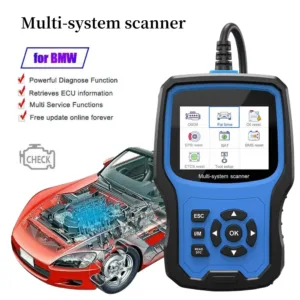
Hyundai/Kia: Prevalent in models like the Hyundai Sonata, Santa Fe, and Kia Sorento, Sportage. As with other brands, the upstream O2 sensor heater is a consumable component that wears out over time and mileage.
P0030 Frequently Asked Questions
Is it safe to drive with a P0030 code?
You can usually drive for a short distance, but it is not recommended for extended periods. The engine will remain in open-loop mode, using pre-programmed fuel maps instead of real-time feedback from the oxygen sensor. This leads to reduced fuel efficiency, higher emissions, and potentially poor performance or drivability issues. Prolonged driving with a faulty heater can also allow the catalytic converter to run cooler than designed for longer periods, though the primary risk is to fuel economy and emissions.
Will the P0030 code cause my car to fail inspection?
Yes, in most regions that perform OBD-II emissions testing, an illuminated Check Engine Light and a stored P0030 code will result in an automatic failure of the inspection. The code indicates an emissions-related component is malfunctioning.
What’s the difference between P0030, P0031, and P0032?
All three codes relate to the Bank 1 Sensor 1 heater circuit. P0030 is a generic circuit malfunction. P0031 specifically indicates the heater control circuit voltage is too low (typically a short to ground). P0032 indicates the circuit voltage is too high (typically a short to power or an open circuit).
Can a bad battery cause the P0030 code?
Yes, a weak or failing battery (or alternator) can cause low system voltage. The ECM may detect this as an out-of-range condition in the heater circuit and set P0030. It’s good practice to check battery voltage before diving into sensor diagnostics.
How much does it cost to fix P0030?
Costs vary widely: Diagnostic fee: $80-$150. A new upstream oxygen sensor: $100-$400 (part). Labor: 0.5-1.5 hours ($75-$225). Total typically ranges from $255 to $775, depending on the vehicle make, model, and repair shop rates. DIY repair (sensor cost only) is possible if you have the skills, tools, and an obd reader to reset the system.
Will disconnecting the battery clear P0030?
It may temporarily clear the code and turn off the light, but if the underlying fault (e.g., a broken heater) is still present, the code will return as soon as the ECM completes its self-tests on the next drive cycle. The proper fix must be performed, and the code should be cleared with a scan tool.
Can I use a universal oxygen sensor to fix P0030?
Yes, but it requires splicing wires correctly according to the vehicle-specific wiring diagram. While often cheaper, improper installation can lead to further issues. A direct-fit, plug-and-play sensor is generally recommended for most DIYers to ensure correct installation and function.
P0030 Related OBD2 Errors
- P0031: HO2S Heater Control Circuit Low (Bank 1 Sensor 1)
- P0032: HO2S Heater Control Circuit High (Bank 1 Sensor 1)
- P0036: HO2S Heater Control Circuit (Bank 1 Sensor 2)
- P0037: HO2S Heater Control Circuit Low (Bank 1 Sensor 2)
- P0038: HO2S Heater Control Circuit High (Bank 1 Sensor 2)
- P0050: HO2S Heater Control Circuit (Bank 2 Sensor 1)
- P0053: HO2S Heater Resistance (Bank 1 Sensor 1)
- P0135: O2 Sensor Heater Circuit Malfunction (Bank 1 Sensor 1)
Important! Code P0030 indicates an electrical fault in a critical emissions control component. Always disconnect the vehicle’s battery before performing any electrical testing or repair work on the sensor or wiring. If you are not comfortable with automotive electrical diagnostics, seeking help from a qualified technician is strongly advised to avoid misdiagnosis, unnecessary parts replacement, or potential damage to the vehicle’s electronic systems. Accurate diagnosis with a multimeter and a capable obd2 diagnostic scanner is key to an efficient and cost-effective repair.