
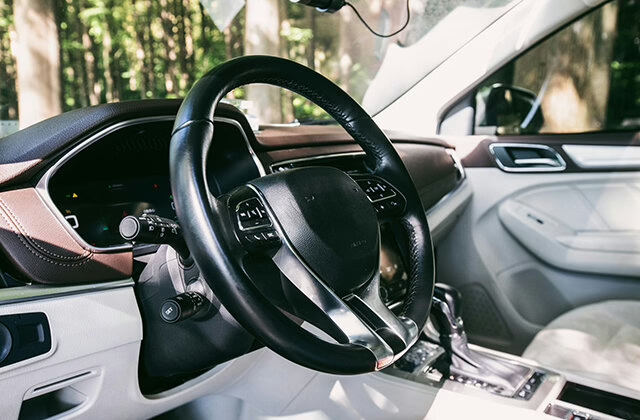
Components of an Automobile Steering System
1. Steering Control Mechanism
Mainly composed of the steering wheel, steering shaft, and steering column.
2. Steering Gear
This mechanism converts the rotation of the steering wheel into the swinging motion of the steering arm or the linear reciprocating motion of the rack and pinion, and amplifies the steering force. The steering gear is generally fixed to the vehicle frame or body, and the steering force usually changes direction after passing through the steering gear.
3. Steering Transmission Mechanism
This mechanism transmits the force and motion output from the steering gear to the wheels (steering knuckles), causing the left and right wheels to deflect according to a specific relationship.
Function of an Automobile Steering System
The steering gear amplifies the torque applied to the steering wheel by the driver, reduces its speed, and then transmits it to the steering transmission mechanism, increasing the force transmitted from the steering wheel to the steering arm and changing the direction of force transmission. To improve driving safety, modern automobiles generally use a segmented steering shaft connected by a universal joint. This improves driving safety, facilitates vehicle layout, deformation, and maintenance, and also facilitates the standardized production of steering systems.
Types of Automotive Steering Systems
1. Rack and Pinion Steering System
This is the most common type of steering system. Its basic structure consists of a pair of meshing pinions and a rack. When the steering shaft drives the pinions to rotate, the rack moves in a straight line. Sometimes, the rack directly drives the tie rod to steer the steering wheel. Therefore, this is the simplest steering system. Its advantages are simple structure, low cost, sensitive steering, small size, and the ability to directly drive the tie rod. It is widely used in automobiles.
2. Worm and Crank Pin Steering System
This type of steering system uses a worm as the driving element and a crank pin as the driven element. The worm has a trapezoidal thread, and the finger-shaped tapered pins are supported on the crank by bearings. The crank and steering rocker arm shaft are integrated. When steering, the steering wheel rotates the worm, and the tapered pins, embedded in the worm’s helical grooves, rotate on their own axis and move in an arc around the steering rocker arm shaft, thereby causing the crank and steering arm to swing, which in turn causes the steering wheel to deflect through the steering transmission mechanism. This type of steering gear is typically used in trucks requiring significant steering effort.
3. Recirculating Ball Steering Gear
The recirculating ball power steering system mainly consists of two parts: a mechanical part and a hydraulic part. The mechanical part comprises a housing, side covers, an upper cover, a lower cover, a recirculating ball screw, a rack and pinion nut, a rotary valve core, and a sector gear shaft. It has two pairs of transmission pairs: one pair is the screw and nut, and the other pair is the rack and sector gear or sector gear shaft. A recirculating steel ball is installed between the screw and the rack and nut, converting sliding friction into rolling friction, thereby improving transmission efficiency. The advantages of this steering gear are easy operation, low wear, and long service life. The disadvantages are complex structure, higher cost, and lower steering sensitivity compared to rack and pinion steering gears.