
I. How to Operate the Car Jump Starter
- Pull the parking brake, shift the transmission into neutral, and check the starter switch—it should be in the OFF position.
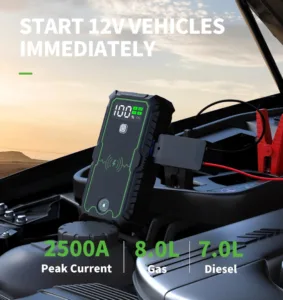
Place the jump starter on a level surface or non-moving platform, away from the engine and belts.
Connect the red positive clamp ( ) of the jump starter to the positive terminal of the dead battery. Ensure a secure connection.
Connect the black negative clamp (-) of the jump starter to the vehicle’s grounding post. Ensure a secure connection.
Verify all connections are correct and secure.
Attempt to start the vehicle (no longer than 5 seconds). If unsuccessful, wait at least 5 seconds before retrying.
After successful start, remove the negative clamp from the ground post.
Disconnect the red positive clamp from the battery positive terminal.
Recharge the battery after use.
II. How to Charge the Car Jump Starter
Lithium Polymer Charging Steps
1. Insert the included charging cable’s female connector into the “Emergency Starter” charging port and ensure a secure connection.
2. Plug the other end of the charging cable into a standard wall outlet and ensure a secure connection.
3. The charging indicator light will illuminate, indicating charging is in progress.
4. After charging completes, the indicator light will turn off. Let the battery rest for 1 hour. Verify the battery voltage meets specifications to confirm a full charge.
5. Do not charge for longer than 24 hours.
Maintenance-Free Lead-Acid Battery Charging Steps
1. Insert the included charging cable’s female connector into the charging port of the “Emergency Starter” and ensure it is securely connected.
2. Plug the other end of the charging cable into a standard electrical outlet and ensure it is securely connected.
3. The charging indicator light will illuminate, indicating charging is in progress.
4. When the indicator light turns solid green, charging is complete.
5. For initial use, extended charging is recommended.
III. Frequently Asked Questions
1. How many consecutive vehicle starts can be achieved after a full charge?
During our testing of the emergency jump starter over several days, we fully charged it and used it to start vehicles with three different engine displacements (1.3L, 1.6L, 2.4L), performing a total of 10 starts. After this, the battery still retained half its charge without needing to be recharged. Relevant data also indicates that for common engine displacements between 1.0L and 4.0L, a fully charged unit can typically start a vehicle 10-15 times.
2. Are there engine restrictions?
This product generally handles engines under 4.0L (or fewer than 8 cylinders). However, larger displacement engines with more cylinders require greater kinetic energy during startup, potentially causing instantaneous current spikes. Always verify the product’s current capacity before use.
3. Advantages over traditional jumper cables
From personal experience, manual transmission vehicles are somewhat easier to handle with the old-school push-start method. Automatic transmissions, however, require jump-start assistance. If no second vehicle is available, it can be incredibly stressful. An emergency jump starter eliminates the need for another vehicle.
Another major advantage is its compact size—comparable to a power bank and significantly smaller than traditional jumper cable kits. Including the battery clamps, it weighs only about 1 pound, making storage incredibly convenient.
4. Important Considerations
Incidents of power banks exploding due to high temperatures are not uncommon. and since the battery we’re discussing today is directly connected to the vehicle itself for emergency rescue, it does pose certain safety risks. Pay close attention to details during use. For instance, avoid storing this tool in your car during summer. Keep it in a dry place like a backpack or tool bag, and only take it out when needed. Otherwise, it could become a ticking time bomb. In other seasons that aren’t extremely hot, store it in a dry, cool place.