
What does the P0049 code mean?
The P0049 fault code is a generic OBD-II code that means “Turbocharger/Supercharger Turbine Overspeed“.
Background Information: This code indicates the Powertrain Control Module (PCM) or Engine Control Module (ECM) has detected that the turbocharger or supercharger turbine is rotating at a speed higher than the programmed safe limit. The PCM monitors turbine speed through a dedicated speed sensor (often a variable reluctance sensor) mounted on the turbocharger housing. An overspeed condition occurs when exhaust gases spin the turbine too fast, typically due to a failure in the boost control system (like a stuck wastegate) or a mechanical issue. This is a serious fault as sustained overspeed can lead to catastrophic turbocharger failure, sending debris into the engine and causing severe damage. The first step in diagnosis should always be to use a capable obd2 scanner to confirm the code and read related live data.
Symptoms of Error Code P0049
Signs of error P0049 may include:
- Illuminated Check Engine Light (MIL).
- Loud whistling, screeching, or abnormal noises from the turbocharger area, especially during hard acceleration.
- Thick black smoke from the exhaust due to an overly rich air-fuel mixture from uncontrolled boost.
- Engine overheating or higher than normal transmission temperatures.
- Engine knocking or pinging (detonation) caused by excessively high intake air temperatures and pressure.
- Severe loss of engine power or the engine entering “limp mode” to prevent damage.
- Fouled spark plugs from improper combustion.
- Other related codes such as underboost (P0299), overboost (P0234), or boost control circuit codes may also be present.
Main Causes of Error Code P0049
- Faulty or Stuck Wastegate: The wastegate valve, which bleeds off exhaust gas to control turbine speed, becomes stuck closed (mechanically seized or actuator failure).
- Failed Boost Control Solenoid/Actuator: The electronic or vacuum-controlled device that commands the wastegate fails, preventing it from opening.
- Faulty Manifold Absolute Pressure (MAP) Sensor or Boost Pressure Sensor: Sends incorrect pressure readings to the PCM, leading to improper boost control.
- Mechanical Turbocharger/Supercharger Failure: Worn bearings, damaged turbine or compressor wheels, or oil starvation causing imbalance and overspeed.
- Restricted or Clogged Air Intake or Exhaust System: A clogged air filter, collapsed intake hose, or blocked catalytic converter/downpipe creates excessive backpressure, forcing the turbine to spin faster.
- Disconnected, Cracked, or Collapsed Vacuum Lines (on vacuum-actuated systems): Prevents the wastegate actuator from receiving the signal to open.
- Loose, Corroded, or Damaged Electrical Connectors/Wiring in the turbo speed sensor or boost control circuits, causing erroneous signals.
- Defective PCM/ECM or Programming Error: An internal fault in the control module or incorrect software calibration (less common).
- Aftermarket Tuning or Modifications: Aggressive engine tuning that raises boost limits beyond the factory turbocharger’s safe operating range.
How to Diagnose Error Code P0049?
- Use an obd2 diagnostic scanner to confirm the P0049 code and check for any related codes (e.g., P0234, P0299, P003A, P0045-P0048). Note freeze frame data, especially engine RPM, load, and boost pressure when the code set.
- Perform a thorough visual and auditory inspection. With the engine off and cool, inspect all turbocharger piping, intercooler hoses, vacuum lines, and electrical connectors for cracks, disconnections, or damage. Listen for unusual whistling or grinding noises during a brief test drive (if safe).
- Locate the turbocharger speed sensor (refer to service manual). It is typically mounted on the turbocharger’s compressor or center housing.
- With the ignition OFF and sensor disconnected, use a digital multimeter to measure the sensor’s resistance across its terminals. Compare to manufacturer specifications (often between 200-1000 ohms). An out-of-spec reading indicates a faulty sensor.
- Inspect the sensor wiring harness, especially where it routes near the hot exhaust manifold or turbo. Look for chafing, melting, or shorts to ground/power.
- Using a professional obd2 diagnostic tool with bidirectional controls and live data, monitor key parameters:
- Desired vs. Actual Boost Pressure (in psi or bar).
- Turbocharger Speed (RPM) if the PID is available.
- Wastegate Actuator Duty Cycle or Position.
- MAP Sensor Voltage/Value.
Command the wastegate actuator and observe if the position and boost pressure respond correctly.
- Perform a boost leak test on the intake system. Pressurize the system (typically to 15-20 psi) and listen/feel for leaks that could cause the turbo to work harder.
- Check for exhaust restrictions. This may require checking backpressure with a gauge or inspecting the catalytic converter and downpipe for physical damage or clogging.
- If all else checks out, consider the possibility of a mechanical turbo failure or a faulty PCM. Professional diagnosis with an oscilloscope to view the turbo speed sensor signal may be necessary.
Possible Causes and Diagnostic Methods
| Possible Cause | How to Check? |
| Stuck Closed Wastegate | Manually try to move the wastegate actuator arm. It should move freely. Apply vacuum (or 12V) to the actuator to see if it moves. If stuck, the turbo may need replacement. |
| Faulty Boost Control Solenoid | Test solenoid resistance. Use a scan tool to command it ON/OFF while listening for an audible click. Check for power and ground at its connector. |
| Bad MAP/Boost Sensor | Compare the sensor’s live reading at key-on (engine off) to barometric pressure. It should be very close. Test with a multimeter per the manual’s pinout and voltage/resistance specs. |
| Restricted Airflow | Inspect and replace the air filter. Check for collapsed or soft intake hoses that may suck closed under boost. Visually inspect the intercooler for damage. |
| Exhaust Restriction | Check for glowing red exhaust components. Measure backpressure at the oxygen sensor port (should typically be under 1.5 psi at idle and under 3 psi at 2500 RPM). |
| Faulty Turbo Speed Sensor | Measure resistance. Check the sensor signal with an oscilloscope for a clean AC waveform that increases frequency with engine RPM. |
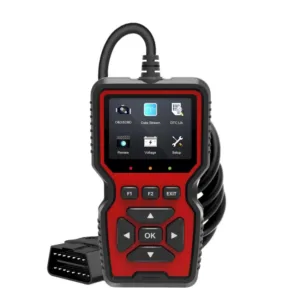
Tools needed: A professional-grade obd2 diagnostic scanner (with live data and bidirectional controls), digital multimeter (DMM), basic hand tools, boost leak tester, vacuum pump/gauge, safety glasses, vehicle-specific service manual.
How do I fix error code P0049? (Solutions to the Problem)
Simple Fixes
- Replace a clogged air filter: A severely restricted filter is a common and easy fix.
- Repair intake/exhaust leaks: Tighten loose clamps, replace cracked or collapsed silicone couplers and vacuum hoses.
- Clean and secure electrical connectors: Disconnect, clean with electrical contact cleaner, apply dielectric grease, and firmly reconnect all connectors for the turbo speed sensor, MAP sensor, and boost solenoid.
- Clear codes and perform a drive cycle: If the issue was a temporary glitch (e.g., from a loose connector), clearing the codes with your obd reader may resolve it. Monitor to see if the code returns.
In-depth Diagnosis and Repair Solutions
- Replace the faulty turbo speed sensor: If resistance is out of spec, replace with an OEM or high-quality equivalent part.
- Replace the boost control solenoid or wastegate actuator: If testing confirms failure. On integrated turbo units, this may require replacing the entire turbocharger assembly.
- Replace the MAP sensor or boost pressure sensor: Ensure the new sensor is calibrated for your specific vehicle.
- Repair or replace damaged wiring: Use solder and heat-shrink tubing for permanent repairs. Ensure proper routing away from heat sources.
- Clean or replace a stuck wastegate: Sometimes carbon buildup can be cleaned with specialized solvents, but often replacement is necessary.
- Replace the turbocharger or supercharger assembly: This is the most costly repair, required for internal mechanical failures (worn bearings, damaged wheels). Always replace oil feed lines and ensure proper priming to prevent repeat failure.
- Flash/update PCM software: If a Technical Service Bulletin (TSB) exists for a software glitch causing false overspeed codes, a dealer flash may be the solution.
- After any repair, use your obd2 diagnostic tool to clear all codes and perform a thorough test drive, monitoring live data to ensure boost pressure and turbine speed are within normal parameters.
Troubleshooting Based on Symptoms
| Symptom | Possible Solution |
| Check Engine Light on with P0049, loud turbo whistle. | Immediate concern for mechanical overspeed. Diagnose for stuck wastegate first, then check for exhaust restriction. |
| Code is intermittent, appears only at high RPM/load. | Look for a boost control solenoid that is failing under high duty cycle or a slightly sticking wastegate. |
| Code accompanied by P0234 (Overboost). | Focus almost exclusively on the wastegate control circuit: solenoid, actuator, vacuum lines, and wiring. |
| Vehicle has no power, stuck in limp mode, no unusual noise. | Could be a faulty sensor (MAP or turbo speed) sending erroneous data. Diagnose sensor circuits. |
| Black smoke and poor performance after recent modifications. | Suspect an aggressive tune exceeding the turbo’s safe operating range. Revert to stock tune or consult a professional tuner. |
Common Error Code P0049 in Vehicles
Ford P0049 (EcoBoost engines – 1.5L, 2.0L, 2.3L, 2.7L, 3.5L): Common in F-150, Explorer, Mustang EcoBoost, Focus ST. The wastegate actuator on the BorgWarner turbochargers can seize due to carbon buildup, especially on direct-injection engines. The turbo speed sensor wiring harness is also prone to heat damage near the exhaust manifold. Diagnosis requires a professional scanner to monitor “Desired Boost” vs. “Actual Boost” and “Turbocharger Speed” PIDs.
Volkswagen/Audi P0049 (TSI/TFSI engines – EA888 Gen 3 & 4, EA211): Frequent in Golf GTI/R, Audi A4/S4, Q5. On earlier EA888 engines, the integrated exhaust manifold turbocharger’s wastegate actuator linkage is a known failure point. On newer models with variable geometry turbos (VGT), issues with the vane position sensor or control solenoid can trigger P0049. VAG-specific diagnostics (VCDS, OBDeleven) are essential for reading “Charge Pressure Actuator” specified vs. actual values and performing basic settings.
General Motors (GM) P0049 (Duramax Diesel L5P, LML, 2.0L Turbo LTG): In Chevrolet Silverado/Sierra HD, Cadillac ATS/CTS, Camaro 2.0T. On Duramax trucks with the L5P engine, this code often relates to the Variable Geometry Turbo (VGT) actuator or its position sensor. A bidirectional scan tool is crucial for commanding vane position and monitoring feedback sensor voltage. On the 2.0L LTG, check the wastegate solenoid and its vacuum supply.
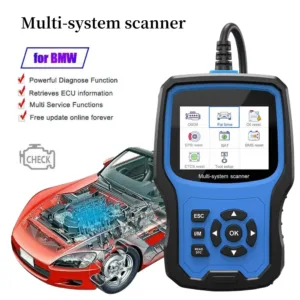
BMW P0049 (N54, N55, B58, S55 engines): In 335i, 540i, M3/M4 (S55), X3 M40i. The electronic wastegate actuator (EWG) motor or its integrated control module is a common failure point on these turbochargers. The turbo speed sensor may also fail. Diagnosis requires ISTA software for guided functions, checking actuator adaptation values and real-time turbo speed readings.
Mercedes-Benz P0049 (OM642, OM654, M176/M177/M178 turbo engines): In E350 BlueTEC, C300, AMG 63 models. Can be caused by a faulty charge pressure actuator (Y77) or a short in its wiring. On diesel models, issues with the exhaust gas recirculation (EGR) cooler or valve causing excessive backpressure can also lead to turbine overspeed. STAR Diagnostic is necessary for accurate diagnosis.
Toyota/Lexus P0049 (8AR-FTS 2.0L, V35A-FTS 3.5L Twin-Turbo engines): In Lexus NX/IS/RC/GS 200t/300, Toyota Supra (B58), Tundra/Sequoia with i-FORCE MAX. Check the wastegate valve solenoid and the turbo speed sensor. The VVT-iW system on the exhaust camshaft can also affect turbo spool; ensure it is functioning correctly.
Honda/Acura P0049 (1.5L L15B7, 2.0L K20C1 turbo engines): In Civic Si/Type R, Accord 2.0T, RDX. The wastegate valve actuator or the boost control solenoid valve circuit can fail. Inspect the wiring harness near the turbocharger for heat damage. A capable obd tool scanner can access the PCM to monitor wastegate duty cycle and boost pressure.
Subaru P0049 (FA20DIT, FA24DIT engines): In WRX, STI, Ascent, Outback XT. The turbocharger wastegate control solenoid is a common culprit. Also, inspect the up-pipe and downpipe for damage or leaks that could affect exhaust flow to the turbo. Subarus are sensitive to aftermarket downpipes without proper tuning.
Hyundai/Kia P0049 (Theta II 2.0T, Smartstream 2.5T GDi engines): In Sonata N-Line, Kia Stinger, Sorento X-Line. Check the turbocharger wastegate actuator and the associated control solenoid wiring. Issues often arise from harness chafing against the engine cover or heat shield. Also known for potential carbon buildup on intake valves affecting airflow.
Chrysler/Dodge/Jeep P0049 (2.0L Turbo, 3.0L EcoDiesel, 3.6L Pentastar with turbo): In Jeep Wrangler 2.0T, Ram 1500 EcoDiesel. On the EcoDiesel, this code frequently relates to the VGT turbo actuator or its position sensor circuit. On the 2.0L, a faulty wastegate solenoid or a leak in the charge air cooler system can be the cause.
Nissan/Infiniti P0049 (VR30DDTT 3.0L Twin-Turbo, MR16DDT 1.6L Turbo engines): In Nissan Z, Infiniti Q50/Q60 Red Sport, Juke Nismo. Diagnose by checking circuit voltages with a multimeter. The turbocharger actuator control module or the boost pressure sensor can be fault points. Also check for recalls or TSBs related to turbo coolant lines.
Mazda P0049 (2.5T Skyactiv-G engine): In Mazda 3 Turbo, CX-5/CX-9/CX-90 Turbo. Issues may stem from the wastegate actuator solenoid or a leak in the pressurized intake system. The turbo speed sensor is integrated; diagnosis requires monitoring specific PIDs for boost control.
P0049 Frequently Asked Questions
What is the first thing I should do when I see code P0049?
Immediately reduce aggressive driving and avoid high engine loads. Use an obd2 diagnostic scanner to confirm the code and check for related codes like P0234. Visually inspect for obvious issues like disconnected hoses or damaged wiring. This code indicates a condition that can quickly destroy the turbocharger.
Is it safe to drive my car with the P0049 code?
No, it is not safe for extended driving. The vehicle will likely be in limp mode with reduced power. Continuing to drive, especially under load, risks the turbocharger disintegrating. Metal fragments from a failed turbo can enter the engine intake or oil system, leading to catastrophic engine failure. Have the vehicle towed to a repair facility if possible.
How much does it typically cost to repair a P0049 error?
Costs vary dramatically: Sensor or solenoid replacement: $300-$800. Repairing wiring or vacuum lines: $200-$500. Replacing a stuck wastegate actuator (if serviceable): $500-$1,500. Replacing the entire turbocharger assembly: $2,000-$6,000+ including parts and labor. The final cost depends entirely on the root cause.
Can I fix a P0049 code myself?
Only if you have advanced mechanical skills, proper tools (scanner, multimeter), and understand forced induction systems. Replacing sensors or solenoids is often straightforward. However, diagnosing a stuck wastegate or internal turbo failure is complex. If the root cause is misdiagnosed, you risk costly further damage. For most DIYers, professional diagnosis is recommended.
What’s the difference between P0049 and P0234?
P0234 is “Turbocharger/Supercharger Overboost Condition.” It means the intake manifold pressure is too high. P0049 is “Turbocharger/Supercharger Turbine Overspeed.” It means the physical turbine wheel is spinning too fast. They often occur together, as an overboost condition (high pressure) is usually caused by an overspeeding turbine. P0049 is more directly indicative of a mechanical control failure.
Will disconnecting the battery clear the P0049 code?
It may turn off the light temporarily, but the code is stored in the PCM’s non-volatile memory. To properly clear it, you must use an obd2 diagnostic scanner after the repair is complete. Some vehicles may require a specific drive cycle to reset all readiness monitors.
Can a bad oxygen sensor or MAF sensor cause code P0049?
Indirectly. A faulty Mass Air Flow (MAF) sensor providing incorrect airflow data can cause the PCM to miscalculate required boost, potentially leading to an overspeed condition. However, P0049 is more directly linked to the boost control system (wastegate, solenoids, turbo speed sensor) itself.
My car failed emissions inspection with P0049. Will fixing it guarantee a pass?
Yes, once the code is repaired, cleared, and the vehicle completes a drive cycle to reset all readiness monitors (including the comprehensive component and fuel system monitors), it should pass the OBD-II scan portion of the test, provided no other monitors are incomplete.
After replacing the turbocharger, do I need a special procedure?
Absolutely. Critical steps include: Priming the new turbo with oil before first start (crank without ignition). Replacing the oil feed line (often recommended). Checking and cleaning the intercooler for debris from the old turbo. On many modern vehicles, a turbocharger actuator adaptation/calibration procedure using a professional obd2 diagnostic tool is required.
How can I prevent P0049 from happening again?
Use high-quality synthetic oil and change it at recommended intervals to protect turbo bearings. Allow the engine to idle for 30-60 seconds after hard driving before shutting it off (lets the turbo cool). Address any check engine lights promptly. Avoid cheap aftermarket tuning. Regularly inspect turbo piping and connections for leaks.
Does this code mean my turbo is definitely broken?
Not necessarily. It could be a faulty sensor, wiring, or control solenoid preventing the wastegate from opening. However, it is a strong indicator of a problem within the turbo system that, if ignored, will likely lead to turbo failure. A proper diagnosis is needed to determine if the turbo itself is damaged.
Could low engine oil cause a P0049 code?
Yes. Turbochargers rely on a constant supply of pressurized oil for lubrication and cooling. Low oil level or pressure can cause bearing wear, leading to imbalance and eventual overspeed as the turbine wheel contacts the housing. Always check oil level as part of the diagnosis.
My code is intermittent and only appears in cold weather. Why?
Cold, dense air increases turbo efficiency and spool speed. An intermittently sticking wastegate actuator or a boost control solenoid with a marginal electrical connection may only fail under these specific, high-demand conditions. Focus on the wastegate actuator linkage and solenoid connector.
Can a basic code reader diagnose P0049?
A basic obd reader can confirm the code’s presence. For diagnosis, you need a scanner that can read live data (especially boost pressure, turbo speed RPM, wastegate duty cycle) and preferably command components, making a professional obd2 diagnostic tool highly recommended.
P0049 Related OBD2 Errors
- p0045 – Turbocharger/Supercharger Boost Control “A” Circuit/Open
- P0046 – Turbocharger/Supercharger Boost Control “A” Circuit Range/Performance
- P0047 – Turbocharger/Supercharger Boost Control “A” Circuit Low
- P0048 – Turbocharger/Supercharger Boost Control “A” Circuit High
- P0234 – Turbocharger/Supercharger Overboost Condition
- P0299 – Turbocharger/Supercharger Underboost Condition
- P003A – Turbocharger/Supercharger Boost Control “A” Position Exceeded Learning Limit
- P2564 – Turbocharger Boost Control Position Sensor “A” Circuit
Important Note: Code P0049 is a severe warning indicating your turbocharger is operating beyond its safe mechanical limits. Immediate diagnosis and repair are critical to prevent catastrophic and expensive engine damage. Do not ignore this code. While some causes are simple electrical fixes, others require significant mechanical repair. If you lack the expertise or proper diagnostic tools, seeking assistance from a qualified technician specializing in turbocharged vehicles is strongly advised.