
What does the B0002 code mean?
The B0002 is a generic OBD-II body trouble code. Its official definition is “Driver Frontal Stage 2 Deployment Control“.
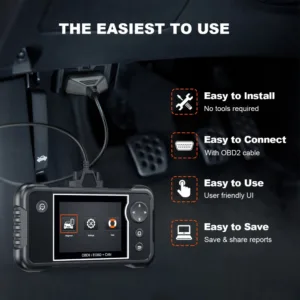
This diagnostic trouble code signals a fault detected by the Restraints Control Module in the electrical circuit responsible for the second-stage deployment of the driver’s frontal airbag. Modern advanced airbag systems often utilize dual-stage inflators designed to deploy with varying force based on the severity of a collision. “Stage 2” typically refers to a higher-force or full-force deployment used in more severe impacts. The RCM continuously monitors the resistance and electrical integrity of the firing circuit (squib) for this secondary stage within the driver’s airbag module. If the module detects an out-of-range resistance—indicating an open circuit, a short to ground/power, or improper continuity—it will store code B0002 and illuminate the Supplemental Restraint System warning light on the dashboard. This indicates a potential disablement of the secondary deployment function, compromising the system’s ability to adapt to a severe crash. The first diagnostic action is to connect a professional obd2 scanner capable of accessing the SRS system to confirm the code.
Symptoms of Error Code B0002
- Illuminated Airbag Warning Light (SRS light) on the instrument cluster.
- Possible “Service Airbag System” or “Airbag Fault” message on the driver information display.
- The driver’s frontal airbag may default to a single-stage deployment strategy or could be partially disabled.
- No noticeable effect on vehicle drivability, performance, or fuel economy.
- Accompanied by other SRS-related fault codes in many cases.
Main Causes of Error Code B0002
- Faulty Driver Airbag Module: The internal “Stage 2” squib within the airbag inflator assembly can develop an open or short circuit.
- Damaged Wiring Harness: Wires specifically for the Stage 2 circuit running from the RCM, through the clockspring, to the airbag can be chafed, pinched, or corroded.
- Poor Electrical Connection: Corrosion, bent pins, or an insecure connection at the multi-pin driver airbag connector, the clockspring, or the RMC connector.
- Faulty Clockspring (Spiral Cable): Internal traces within the clockspring corresponding to the Stage 2 circuit can break or short, especially when the steering wheel is turned.
- Faulty Restraints Control Module (RCM): An internal failure within the RCM’s driver circuit for the Stage 2 deployment.
- Previous Incomplete Repair: If a previous airbag-related repair did not properly address or clear all fault codes, or if a non-OEM component was installed.
- Cross-Coupled Circuits: The two wires for the Stage 2 squib may be shorted together or to the wires of the Stage 1 circuit.
How to Diagnose Error Code B0002?
- Safety Procedure & Initial Scan: Disconnect the vehicle’s negative battery cable and wait the manufacturer-specified time (typically 10-15 minutes) for the SRS backup power supply to deplete. Reconnect the battery and use a professional-grade vehicle diagnostics tool with SRS capability to read and confirm code B0002. Note all related SRS codes, as B0001 (Stage 1) often appears alongside it.
- Visual Inspection: With the battery safely disconnected, carefully remove the driver’s airbag module following the service manual procedure. Visually inspect the yellow airbag connector and its wiring for damage, corrosion, or discoloration. Inspect the wiring harness from the steering column down to the RCM for any obvious issues.
- Inspect Connectors and Clockspring: Ensure all SRS connectors (yellow) are fully seated and locked. Inspect the clockspring for any physical damage. Check for continuity through the suspected clockspring circuits for both Stage 1 and Stage 2 while slowly rotating the steering wheel through its full range.
- Resistance Measurement (Using Proper Tools): Using a high-impedance digital multimeter and a dedicated SRS load tool (NEVER probe the airbag directly), measure the resistance across the pins for the Stage 2 squib circuit. Compare the reading to the manufacturer’s specification (often similar to Stage 1, between 1.7 and 2.3 ohms). An infinite reading indicates an open; a near-zero reading indicates a short.
- Circuit Integrity Testing: Refer to the wiring diagram. With the RCM and airbag connectors disconnected, check for continuity on each of the two Stage 2 circuit wires from the RCM connector to the airbag connector. Also, test each wire for a short to ground and a short to battery voltage (12V).
- Advanced Scanner Diagnostics: Use a high-end obd2 code reader with live data and bidirectional functions for the SRS module. Some tools can monitor the circuit status parameters for both Stage 1 and Stage 2, which can help identify if the fault is isolated to one stage.
Possible Causes and Diagnostic Methods
| Possible Cause | How to Check? |
| Open Circuit in Stage 2 Squib or Wire | Measure resistance of the Stage 2 circuit using a load tool. Check continuity of both dedicated Stage 2 wires from RCM to airbag. |
| Short to Ground in Stage 2 Circuit | With RCM and airbag disconnected, check for continuity between each Stage 2 circuit wire and chassis ground. |
| Short to Power in Stage 2 Circuit | Check for voltage (12V) on either of the Stage 2 circuit wires with the ignition OFF and connectors disconnected. |
| Stage 1 & Stage 2 Wires Shorted Together | Check for continuity between a Stage 1 wire and a Stage 2 wire. They should be isolated from each other. |
| Faulty Clockspring (Stage 2 circuit only) | Test continuity for the Stage 2 circuit through the clockspring independently from the Stage 1 circuit while rotating the wheel. |
| High Resistance/Corrosion at Connector | Visually inspect for corrosion. Perform a voltage drop test across the connector while simulating a load, if possible. |
Tools needed: A professional obd2 diagnostic scanner with SRS module access, a high-quality digital multimeter, basic hand tools (Torx/star bits, trim tools), an SRS load tool adapter for safe testing, and the vehicle-specific service manual for wiring diagrams and torque specifications.
How do I fix error code B0002? (Solutions to the Problem)
Simple Fixes
- Re-seat and Clean Connectors: With the battery disconnected, disconnect, carefully clean with electrical contact cleaner, and firmly reconnect all associated SRS connectors (driver airbag, clockspring, RCM). Ensure locking mechanisms engage.
- Repair Minor Wiring Damage: If inspection reveals a lightly chafed wire that has not broken the conductor, repair it with solder and heat-shrink tubing that meets automotive standards.
In-depth Diagnosis and Repair Solutions
- Replace the Driver Airbag Module: If testing confirms an internal fault in the Stage 2 squib, the entire driver airbag assembly must be replaced. This is not a serviceable component. Use only a new, OEM-specified part and follow all handling safety procedures.
- Repair or Replace the Wiring Harness: For confirmed damage in the Stage 2 circuit wiring, repair the harness section properly or replace it entirely. Ensure correct routing and securing away from moving parts.
- Replace the Clockspring: A very common fix. If diagnostics point to a fault in the clockspring’s Stage 2 circuit trace, replace the entire clockspring assembly. Proper centering during installation is critical.
- Replace the Restraints Control Module: This is the last step if all other components and wiring for the Stage 2 circuit test perfectly. A new RCM almost always requires programming/configuration to the vehicle using a professional vehicle diagnostics tool.
Fix faults based on symptoms
| Symptom/Diagnostic Finding | Recommended Repair Path |
| Codes B0001 and B0002 are both present. | Likely a common fault: faulty airbag module (both squibs bad), faulty clockspring (all circuits affected), or a problem at the main airbag connector. Diagnose the shared component. |
| Only B0002 is present, Stage 1 tests normal. | Points to a fault isolated to the Stage 2 circuit: a single bad trace in the clockspring, a break in one specific wire, or a failed Stage 2 squib within an otherwise good airbag. |
| Intermittent B0002 code when turning the steering wheel. | Classic symptom of a failing clockspring where the Stage 2 circuit trace is broken at a certain wheel position. |
| B0002 with subcode for “Short to Battery” or “Short to Ground”. | Focus on finding where the Stage 2 circuit wiring is pinched against a metal ground or a live power wire, often in the steering column or under the dash. |
| Code returns immediately after clearing with a scanner. | Indicates a persistent hard fault. The defective component (sensor, wire, clockspring) has not been repaired. |
Common Error Code B0002 in Vehicles
Ford/Lincoln: Common in vehicles like the Ford F-150, Explorer, Fusion, and Lincoln MKX, MKT equipped with dual-stage driver airbags. The Restraints Control Module (RCM) is sensitive to resistance changes. Issues are frequently traced to the clockspring or the driver airbag module itself. Diagnosis requires a capable car scanner that can communicate with Ford’s SRS module.
General Motors (Chevrolet, GMC, Cadillac, Buick): Frequently seen in models like Chevrolet Silverado, Traverse, Cadillac XT5, and GMC Acadia. Problems often stem from wiring issues within the steering column or a faulty connector at the driver airbag. GM’s SRS system requires specific diagnostic procedures detailed in the service manual.
Chrysler/Dodge/Jeep/Ram (Stellantis): Very common in Jeep Grand Cherokee, Dodge Durango, and Ram 1500 trucks. The Occupant Restraint Controller (ORC) monitors both stages independently. A frequent cause is a failure within the driver airbag inflator unit or a damaged clockspring.
Toyota/Lexus: Occurs in Toyota Camry, Highlander, Sienna, and Lexus RX, GX models with advanced airbags. The spiral cable (clockspring) is a common point of failure, as is the airbag module itself after long-term exposure to temperature cycles and vibration.
Honda/Acura: Found in Honda Pilot, Odyssey, and Acura MDX, RDX. The SRS unit will store this code if the circuit for the second inflator is faulty. Typical repairs involve replacing the driver’s airbag module or the cable reel.
Nissan/Infiniti: Common in Nissan Pathfinder, Armada, and Infiniti QX60, QX80. The Airbag Diagnosis Sensor Unit (ADSU) sets this code. Diagnosing between a faulty clockspring and a bad airbag module requires careful resistance and continuity checks.
Hyundai/Kia: Appears in Hyundai Palisade, Kia Telluride, and other newer models with dual-stage airbags. As with other brands, connector integrity and clockspring health are primary inspection points. A professional-grade vehicle code reader is essential for proper diagnosis.
B0002 Frequently Asked Questions
Is it safe to drive with a B0002 code?
No. An illuminated SRS light with any airbag fault code, including B0002, means the supplemental restraint system is compromised. The driver’s airbag may not deploy as designed in a collision, particularly in a severe impact where Stage 2 deployment is needed. The vehicle should not be driven until the fault is diagnosed and repaired.
What is the difference between B0001 and B0002?
Both codes relate to the driver’s frontal airbag. B0001 refers to a fault in the circuit for “Stage 1 Deployment” (typically lower-force/moderate impact). B0002 refers to a fault in the circuit for “Stage 2 Deployment” (typically higher-force/severe impact). They are separate circuits within the same airbag module.
Can I clear the B0002 code to pass inspection?
Clearing the code with an obd2 code reader will temporarily turn off the light, but it will return within seconds or after a key cycle if the fault is still present. Most inspection systems can detect recently cleared codes, and an SRS light that is off during the test but was recently reset is still a cause for failure. The underlying problem must be fixed.
How much does it cost to repair a B0002 code?
Costs are significant due to the involved parts: Diagnostic: $100-$200. A new driver airbag: $400-$1,000+. A new clockspring: $200-$500. Labor: 1-3 hours ($100-$400). Total costs typically range from $800 to over $2,000, depending on the root cause and the vehicle make/model.
Do I have to replace the entire airbag for a B0002 code?
In the vast majority of cases, yes. The dual-stage inflator is a sealed, non-serviceable unit within the airbag assembly. If diagnostic testing confirms an internal fault in the Stage 2 squib, the entire driver airbag module must be replaced.
Can a B0002 code be caused by a recent battery replacement?
It is possible but unlikely. If the battery was disconnected and reconnected without allowing the SRS backup power to drain (by waiting), or if a power surge occurred, it could theoretically cause a spurious code. However, a true, persistent B0002 is almost always caused by a physical fault in the circuit or component.
After a minor accident, I have a B0002 code but the airbag didn’t deploy. Why?
Some vehicles’ RCMs may disable a stage if a certain crash sensor threshold is met but is below the deployment level. More commonly, the wiring or connectors in the steering column may have been stressed or damaged in the impact, creating an open or short that the RCM now detects as a B0002 fault.
B0002 Related OBD2 Errors
- B0001: Driver Frontal Stage 1 Deployment Control
- B0003: Driver Knee Bolster Deployment Control
- B0010: Passenger Frontal Stage 1 Deployment Control
- B0011: Passenger Frontal Stage 2 Deployment Control
- B0020: Left Side Airbag Deployment Control (Stage 1 or generic)
- B1000: SRS Control Module Internal Fault
- U0001: High Speed CAN Communication Bus (if the RCM communication is lost)
Important! The Supplemental Restraint System (SRS) contains explosive devices. Improper diagnosis, testing, or repair can cause accidental deployment, resulting in severe injury or death. Always follow the manufacturer’s specific safety procedures, including disconnecting the battery and waiting. If you are not a trained professional equipped with the correct tools, including a professional vehicle diagnostics tool and SRS service equipment, do not attempt this repair. This work must be performed by a qualified automotive technician.